People still search for “Claude 3.7 Sonnet vs o1” every day. Some are curious which one won. Others have code that still calls one of them and want to know if it’s time to switch. The short answer to both: neither model exists anymore. Anthropic retired Claude 3.7 Sonnet in February 2026 and OpenAI shut off o1 in October 2026.
That doesn’t make the comparison useless. It was the first real fight between two different ideas of how an AI should “think”, and the result still explains why today’s models work the way they do. Below are the real numbers (not the inflated ones floating around), what each model was good at, and what to use instead now.
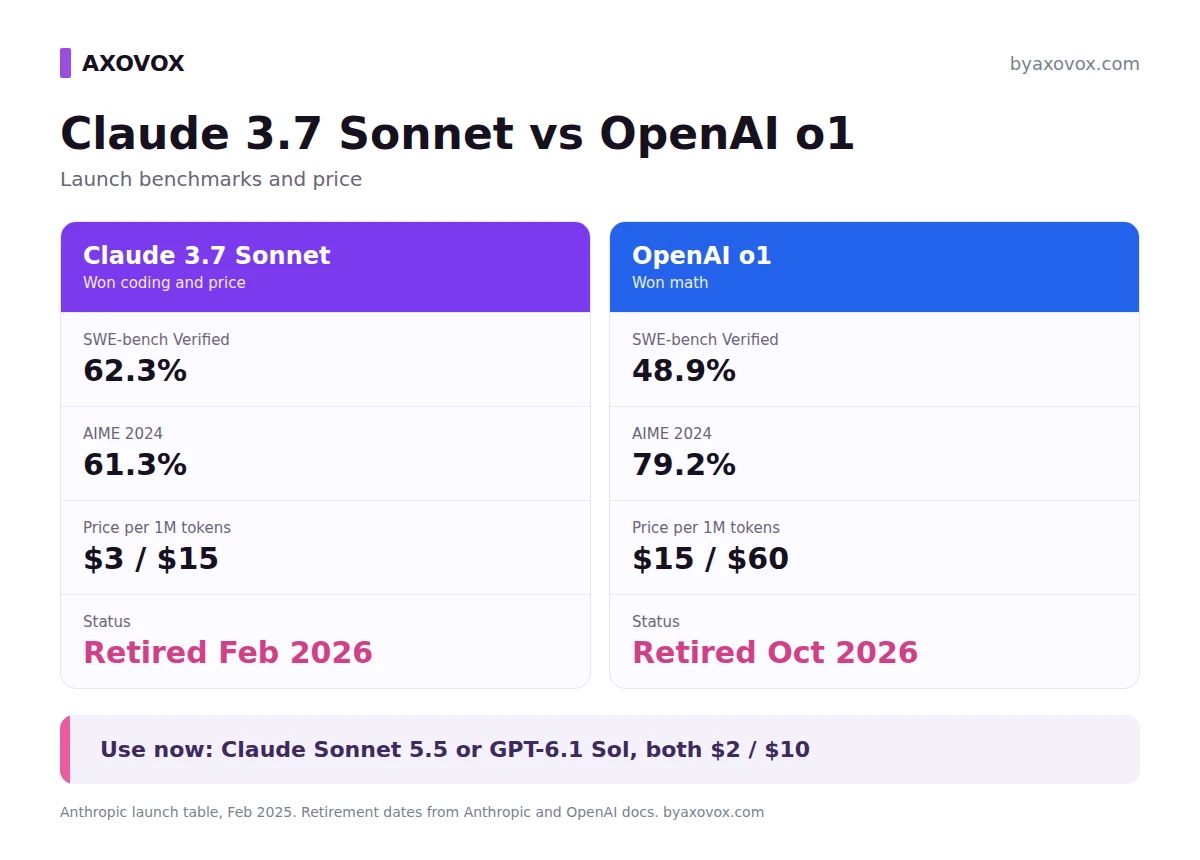
- Both models are retired. Claude 3.7 Sonnet was switched off on February 19, 2026, and o1 on October 23, 2026. API calls to them now fail.
- Claude 3.7 Sonnet won coding clearly: 62.3% on SWE-bench Verified against o1’s 48.9%. The 92% and 89% figures you see online are made up.
- o1 won competition math: 79.2% on AIME 2024 against 61.3% for Claude with extended thinking.
- Claude was five times cheaper per token ($3 / $15 against $15 / $60 per million).
- Today, Claude Sonnet 5.5 and GPT-6.1 Sol both cost $2 / $10 and beat either old model by a wide margin.
Search your repo and environment variables for claude-3-7-sonnet-20250219, o1 and o1-2024-12-17. Anthropic lists the 3.7 Sonnet retirement on its model deprecations page. OpenAI’s deprecations page shows o1 and o1-pro shut down on October 23, 2026, with GPT-5.6 Sol as the official substitute.
The real benchmark numbers
These come from Anthropic’s Claude 3.7 Sonnet launch on February 24, 2025, which put o1 in the same table. Where two figures appear, the second uses extra compute: parallel attempts for Claude, majority voting over 64 samples for o1.
| Benchmark | Claude 3.7 Sonnet | OpenAI o1 |
|---|---|---|
| SWE-bench Verified (coding) | 62.3% / 70.3% | 48.9% |
| AIME 2024 (math) | 61.3% / 80.0% | 79.2% / 83.3% |
| GPQA Diamond (science) | 78.2% / 84.8% | 75.7% / 78.0% |
| MATH 500 | 96.2% | 96.4% |
| MMMU (visual reasoning) | 75.0% | 78.2% |
| API price per 1M tokens | $3 in / $15 out | $15 in / $60 out |
| Thinking | Optional, budget up to 128K tokens | Always on |
| Retired (API) | Feb 19, 2026 | Oct 23, 2026 |
Claude’s math and science scores above use 64K tokens of extended thinking. With thinking switched off, its AIME score dropped to 23.3%. That gap tells you a lot about where the gains came from.
Coding: Claude won, by a lot
A 13 point gap on SWE-bench was huge at the time. o1, o3-mini and DeepSeek R1 were all stuck around 49%. Claude 3.7 Sonnet jumped to 62.3% without any special setup.
The other big thing that launched that day was Claude Code, as a limited research preview. It could read a repo, edit files, run tests and push to GitHub from the terminal. In hindsight, that mattered more than the model itself. Most of today’s agentic coding tools trace back to that release.
One correction to a common claim. Artifacts (live React and HTML previews) is a feature of the Claude app, not of the model. o1 wasn’t “text only” either. ChatGPT had Canvas for editing code and documents side by side.
Reasoning: two different designs
This is the part that aged best.
- o1 always reasoned before answering. In the API you could set effort to low, medium or high, but you couldn’t turn it off. Great for hard math. Annoying when you just wanted a quick rewrite of a paragraph.
- Claude 3.7 Sonnet was the first “hybrid” model on the market. The same model could answer instantly or think for longer, and API users could set a thinking budget up to 128K tokens. Thinking tokens were billed at the normal output price.
Claude’s hybrid approach won the argument. Almost every frontier model now lets you choose how hard it thinks, from instant to maximum effort. OpenAI went the same way with later GPT-5 and GPT-6 models.
Writing quality
This one’s subjective, so take it as our experience rather than a benchmark. Claude 3.7 Sonnet wrote looser, more natural prose. o1 was precise and well-structured but leaned on bullet points and sounded stiff in marketing copy. Neither one “passed AI detectors” reliably, and no model does. Anyone promising that is selling something.
Where Claude 3.7 Sonnet won
- Real-world coding, by 13 points on SWE-bench
- Five times cheaper per token than o1
- Instant answers when you didn’t need deep thinking
- More natural writing for blogs and marketing
Where o1 won
- Competition math (AIME) without extra tricks
- Visual reasoning on MMMU
- Built into ChatGPT, which most people already used
What to use instead in 2026
Here’s the funny part. The current mid-tier models are cheaper than Claude 3.7 Sonnet was, and far better.
- Replacing Claude 3.7 Sonnet: Claude Sonnet 5.5 costs $2 in and $10 out per million tokens and has a 1M token context window. For heavy agentic coding, Claude Opus 5.5 at $4 and $20 is the step up.
- Replacing o1: OpenAI’s official substitute is GPT-5.6 Sol. GPT-6.1 Sol is newer and costs $2 and $10, with OpenAI saying it nearly matches its GPT-6 Astra flagship on coding.
When you switch, test your prompts again. Newer models follow instructions more literally and use thinking differently, so a prompt tuned for 3.7 Sonnet or o1 can give different output on the new model.
Claude 3.7 Sonnet beat o1 for coding and price, and o1 beat it for pure math. Both are gone now, so the useful question is which model replaces yours. For most developers and content teams, that’s Claude Sonnet 5.5 or GPT-6.1 Sol.
Comparing chat assistants for everyday work rather than the API? See our ChatGPT vs Gemini comparison.
FAQ
Is Claude 3.7 Sonnet still available?
No. Anthropic deprecated it on October 28, 2025 and retired it on February 19, 2026. API requests to claude-3-7-sonnet-20250219 no longer work.
Is OpenAI o1 still available?
Not in the API. OpenAI shut down o1 and o1-pro on October 23, 2026 and lists GPT-5.6 Sol as the replacement.
Was Claude 3.7 Sonnet better than o1 for coding?
Yes. In Anthropic’s launch benchmarks it scored 62.3% on SWE-bench Verified, or 70.3% with a custom high-compute setup, against 48.9% for o1.
Which was better at math?
o1. It scored 79.2% on AIME 2024, against 61.3% for Claude 3.7 Sonnet with extended thinking. Claude only caught up (80.0%) with parallel attempts.
What should I use instead of Claude 3.7 Sonnet or o1?
Claude Sonnet 5.5 or GPT-6.1 Sol for most work. Both cost $2 per million input tokens and $10 per million output tokens, which is less than either retired model.
Disclosure: information and opinion, not sponsored. Benchmarks come from Anthropic’s February 2025 launch table. Retirement dates and current prices were checked on Anthropic’s and OpenAI’s developer docs on November 7, 2026.