On September 15 the screenshots started: sponsored anchor text living inside an AI Mode sentence, wearing a Sponsored label like a name tag at a party it wasn’t invited to. Days earlier, some shopping answers were ads top to bottom. The answer box spent two years eating the results page; September installed the cash register.
On August 27 an SEO posted a screenshot captioned “Holy moly.” A day later Google confirmed it: Overviews now open fully expanded for some queries, Show More gone, Ask Anything waiting, organic reachable by scroll, like a basement with good lighting. The pattern behind it, the numbers, and the five moves.
OpenAI opened its September keynote with a small story: an early tester forgot to invoice a client, and his AI agent noticed, prepared the invoice, and sent it after a one-tap approval. Cute anecdote, until you reverse the camera. Somewhere in that story there’s a BUSINESS that received an email written by software, got checked… Read more: Your Next Customer Has No Eyes: The Agent-Readiness Audit for Your Website
“Count the fingers” died in 2023. The 2026 reality is better: the big generators now sign their images, free tools read the signature, and the real skill is knowing which checks prove and which only hint. The proof ladder, the video tells, and the rule that protects you both ways.
You long-pressed the power button and a stranger answered. The switch-back button every guide describes was removed in late September 2026; the guides are obituaries that haven’t been updated. What died, who’s exempt, and the escape hatches that genuinely still exist.
I’ve stopped keeping up with model names; clients ask which one matters and the honest answer is none of them, individually. Every engine decides whether to recommend you the same way. Five principles that survive every launch, each with a test you can run today.
It arrived without asking: a tab in your results, an AI button in Chrome’s search bar, a nudge under half your searches. The setting that deletes it doesn’t exist, so “remove” really means “stop seeing it.” Four ways that work, from gentle to scorched-earth, honestly labeled.
“I don’t Google things anymore” and “Google handles 90% of world search” are both true at once, which means replacement is the wrong question. Search split into two jobs: ChatGPT took figure-this-out, Google kept take-me-there-and-prove-it. The scoreboard, the numbers, and where your searches should split.
A millionaire bet his Ferrari he could make $100 in one hour using only ChatGPT. He lost, and that’s the most honest data point in this genre. The 7 methods that actually produce income, with the numbers I’ve seen invoiced, and the 3 famous ones to skip.
The scrappy startup that invented the category against Google deciding the category belongs to Google. After months of running both: AI Mode is search that answers, Perplexity is an answer engine that shows its homework. Where each wins, and the twist: their sources overlap more than 90%.
Before any website gets a word in, Google answers: a generated paragraph on top, links demoted below. What an AI Overview actually is, the three-step machinery behind it, why your recipe search gets an essay while your plumber search doesn’t, and what the box did to clicking.
Both answer anything, both sound confident, and neither is universally better. The one-line version: ChatGPT writes better, Gemini knows better. The scoreboard job by job, the situations that actually come up, and the lazy-but-correct setup that ends the question.
Google has two AI answer systems in the same search box and everyone mixes them up, including people writing about them professionally. The clean split: AI Overviews happens TO your search; AI Mode is a place you GO. Side by side, the 10-second test, and which one a business should chase.
Half your feed is posting AI Mode screenshots and your Google shows All, Images, News, Videos. No tab. It’s almost never a bug: eligibility is decided per account and per rollout wave. The six causes in order of likelihood, and the direct door that skips the tab entirely.
Three warm messages from mom become “Dinner canceled. Mother displeased.” Apple’s summaries can’t do jokes or tone, and turning them off takes under a minute, once you know there are four different switches. Global, per app, the lock-screen shortcut, and the italics tell.
Google’s AI just told the world something wrong, and there’s no obvious “this is false” button. There is a report path: the hidden thumbs-down, the wording that gets reviewed instead of buried, and the part that matters when it’s your business: the Overview rebuilds from its sources until the sources change.
One day it was just there: a blue circle above your chats, no opt-in, no off switch. There’s finally a toggle that hides it, 20 seconds in Settings. Where it is, the fallback stack for phones that don’t have it yet, and the honest list of what doesn’t work.
“I’m standing where the map sent me and I don’t see you.” Your address and your pin are two separate things in Google’s system, text vs coordinate, which is why fixing one never fixes the other. The 5-minute drag, the snap-back sequence, and the last-20-meters trick.
A customer googles your name and Google’s AI opens with your competitor. The AI isn’t loyal to the query, it’s loyal to the evidence and the fix is supplying better testimony: the brand-answer page, crowded evidence, the comparison play, and the name-twin cleanup.
The map pack ranks; AI Mode argues. It reads review sentences, pages and profiles as evidence, then names two or three businesses with reasons attached — and #3 in the pack can be #1 in the answer. How the picks work, the “because” strategy, and the review ask that changes everything.
Every AI-marketing thread says you must add llms.txt. Google says, on record, it doesn’t use it, and 97% of published files get zero requests. The honest verdict in three lines, the 10-minute setup with a copy-paste template, and the one audience that genuinely reads the file.
Your page covers the topic, and AI Mode quotes four other sites anyway. The reason: one question gets decomposed into dozens of hidden sub-queries, and the answer is built from the best passage for each. The unit of competition isn’t the page anymore – it’s the passage. The full method.
The chatgpt.com line in your analytics is a floor, not a total: most AI-recommended customers take the name, google you, and land as branded organic search. The three tracking layers- the GA4 referral report, the branded-search proxy, and the one question that catches the whole invisible path.
A customer quotes a price you haven’t charged since 2023: “ChatGPT told me.” There’s no record to edit and no correction form – answers are assembled fresh from public sources, so wrong info always has an origin. The interrogate-hunt-fix-verify method, step by step.
Half of searches open with an AI answer, and until June 2026 you had zero official data on whether your pages appeared in any of it. Search Console now has a dedicated Generative AI report, and most owners haven’t opened it. Where it hides, the impressions-are-citations mindset, and the 15-minute routine.
GPTBot, ClaudeBot and PerplexityBot are either reading your site daily or being turned away, and you never decided either. The three kinds of AI crawler (blocking one is harmless, blocking another is self-harm), the Cloudflare default nobody remembers setting, and three ways to see the guest list.
Eight years in business, and ChatGPT tells a customer it couldn’t find you. It’s not a directory that missed you, it’s a referee that only vouches for what it can verify, and the most common culprit is your own site blocking AI crawlers via a toggle you never turned on. The 3-layer fix.
A customer calls: “Are you guys… still open?” Google says permanently closed while your lights are on. The surprise: anyone can mark you closed, no owner confirmation needed. The 2-minute fix, the appeal when it’s blocked, and how to make your profile too alive to flag.
Google is showing your cookie notice as your description, or a sentence that ends mid-word. The truth: Google passes on meta descriptions most of the time and builds snippets per query. The fix is twofold – make yours pick-able, and make everything it might grab instead worth quoting.
You crafted the perfect title, Google shows something else. The title tag is a suggestion, not a command — since 2021 Google generates displayed titles itself, and it rewrites the majority that break its rules. The five triggers, the H1-alignment fix, and the CTR test that tells you if it matters.
Every response you write is read by two audiences, and the reviewer is the smaller one. Copy-paste templates for the glowing, the harsh, the unfair, the fake and the 3-star shrug, with the rationalization spots marked and the four rules that govern all of them.
A customer says “the number didn’t work,” and Google shows one that isn’t yours. Google cross-checks your phone against directories and public edits, and can override your own profile when they disagree. The 3-minute fix, the quoted-search trick that finds every feeding source, and the guard.
Reach, likes and followers are the platform’s scoreboard — platforms sell attention. Your scoreboard is customers, and the two can point opposite directions for years. The three tiers of metrics, the one-hour tracking setup, and the monthly review that needs exactly five numbers.
You moved months ago and Google still sends customers to the old door. The reason it “keeps coming back”: your address lives in three places Google reconciles, and you only fixed one. The full fix in the right order, the suspension trap to avoid, and the ghost-pin removal.
“Sponsored” on Instagram means three different things: a boosted post, a real Ads Manager campaign, or a paid creator partnership — different buttons, different price tags, wildly different results. All three, the trap inside the Boost button, and the fit test before spending anything.
Both AI systems name specific businesses, neither shows a page two, and they don’t pick the same way — a business can be recommended constantly in one and invisible in the other without knowing. Where customers ask what, how each decides, and the one playbook with two tilts.
Yesterday: on the map, 74 reviews, steady calls. Today: suspended. Most reinstatement succeed when done right, and the worst move is the tempting one creating a fresh profile, which converts a fixable problem into a ban. The triggers, the appeal, the evidence, and the wait.
Your website already ranks for keywords – dozens, maybe hundreds and most owners have no idea which ones. Google’s own free report lists every search your site appears for, with positions and clicks. Where it lives, how to read it, and the three moves it unlocks.
Most YouTube advice is written for people who want to become YouTubers. A business doesn’t need an audience — it needs to be the answer. The search-first strategy: the 10-video plan mined from customer questions, the phone-only production bar, and what to skip without guilt.
The mechanics that raise the odds are real and learnable: the 2-second hook, one strong emotion, a share trigger, a trend bent to your niche. Then the question viral-tips articles never ask – would a million strangers’ views be worth anything to YOUR business? For many, the answer changes the plan.
PPC management is paying a specialist to run your ads so the budget buys customers instead of lessons. The useful part comes after the definition: the actual weekly work, real fee ranges, the budget line where hiring beats DIY, and the red flag that should end any sales call.
The customer swears the quote never arrived. The newsletter gets four opens. It’s usually not your wording — since 2024, Gmail and Yahoo enforce sender authentication, and unauthenticated mail gets junked no matter how politely it’s written. The 5-minute check and the one-hour fix.
Ranking problems and indexing problems get confused constantly, and the difference decides everything. The 10-second site: search that tells you which one you have, the four ways sites stay invisible – including the WordPress checkbox that hides thousands of them and the fix for each.
There are seven distinct types of social media marketing: organic content, paid social ads, influencer partnerships, user-generated content, community building, social selling, and employee advocacy. Every agency article lists them. Almost none answers the question a small business actually has: which ones are worth MY hours and MY budget, and which ones can I skip… Read more: 7 Types of Social Media Marketing: Which to Do, Which to Skip
A photographer’s ad clicked by camera shoppers. A plumber paying for “plumber salary” searches. The platform knows exactly which searches spend your money — the list is just one level deeper than the screens you see. Where it lives and the two fixes.
Three messages, three audiences, three channels — that’s the common version. The part every other article skips: there is no official 3-3-3 rule. Four different frameworks share the name. All of them, side by side, plus the worked example and when to break the rule entirely.
You can’t delete a Google review — no button for that exists at any price. But fake reviews, competitor hits, and wrong-business reviews get removed all the time when they’re reported right. The 2-minute flag, the appeal that gets read, and the math that makes surviving reviews small.
SEO is making your website the answer Google shows when customers search for what you sell. That’s the definition. The rest is how it works in 2026, when Google doesn’t just rank pages anymore — it writes answers and cites a few sources. The three jobs, the AI layer, and honest timelines.
Every guide says install another plugin. You don’t need one: FAQ schema is a single block of text pasted into a Custom HTML block, and WordPress handles it natively. The 60-second method, a template to steal, and the fixes when validation fails.
Every “get more customers” article lists 47 tactics. Nobody has 47 hours. So here’s the opposite: the five sources that reliably produce customers for small businesses, ranked by what they cost and how fast they pay, with honest numbers on each. Do them roughly in order. Stop when you’re busy. The ranking at a glance… Read more: How to Get More Customers (Ranked by What It Costs and How Fast It Works)
Google will happily take $300 a month or $30,000. Neither tells you if the account can work. The real question: can you afford enough clicks to learn anything? The click math, the working minimum, and the spending order.
Somebody just asked ChatGPT for the best business in your category, and it answered with three names in four seconds. The 2-minute test to see if you’re one of them, the five signals that decide it, and the fix order if you’re not.
“It depends” is true and useless. Here are the actual benchmarks: the 7-12% rule, the three questions that move your number, what each budget tier realistically buys, and the honest cases where spending less is right.
Raise prices, lose customers — fair fear, wrong math. At 50% margins, a 10% raise lets you lose 16% of your customers and earn exactly the same money. The break-even math, the five timing signals, and the copy-paste announcement email.
Featured snippets and AI citations get filled by the same hunt: a machine looking for a passage it can lift cleanly. One structural discipline wins both. Here’s the exact format, with a before-and-after you can copy.
Every AI tool list assumes you have a marketing team and a big budget. You don’t. Here’s the spending order that actually fits a small business: what’s free and genuinely enough, what the first $50 should buy, and why nothing past $100 deserves your money without proof.
Two kinds of businesses call us: the ones who tried everything and nothing worked, and the ones who tried nothing and know it. Both fine. Both fixable. But they need opposite first moves, and the one thing they share is believing their situation is uniquely bad. It isn’t. Here’s where each one starts.
No secret ranking file decides which businesses ChatGPT names — just seven inspectable criteria: retrievable, identifiable, quotable, specific, corroborated, current, and associated. What each one weighs, a self-check for every one, and the four things people think matter that don’t.
A small business website in 2026 costs $10-99 per month on a DIY builder, $1,500-8,000 one-time with a freelancer, or $5,000-15,000 with an agency, plus $1,000-6,000 per year in running costs almost nobody budgets for. Everyone asks this question, every provider answers “it depends,” and both sides leave annoyed. So here are the actual numbers,… Read more: How Much Does a Website Cost in 2026? (Real Prices)
Google AI Mode passed a billion users: search as a conversation, with Google’s index behind it. What it is in plain language, how it differs from AI Overviews, why ‘position 3’ no longer exists in an AI answer, and the work that gets your business cited before competitors notice the window.
Whether ChatGPT and Google AI cite your content stops being a mystery in twenty minutes a month: a ten-prompt panel, a two-minute fetch test, the GA4 referral report, and the Search Console signature. Four free checks, and what each result tells you to fix.”
One marketer with AI is a boost; a whole team without a system is five subscriptions, five voices, and one confused audience. The team layer that fixes it: one shared brief, a prompt library, the one-sentence review rule, and the 30-day rollout that sticks.”
Not on Google’ is five different problems wearing one symptom: not indexed, buried, a Business Profile issue, the proximity filter, or testing wrong. Four searches tell them apart in ten minutes, and only one of the five takes months to fix.”
Email returns $36-42 per dollar and most small businesses still don’t have a list, because ‘the newsletter someday’ never survives a busy week. The actually-starting version: one free tool, one magnet worth an address, three welcome emails written once, and a twenty-minute monthly habit.
Every step to get cited by ChatGPT, Perplexity, and Google AI, in one sequence: crawler access, liftable structure, facts worth quoting, the reputation models trust, and the monthly measurement that proves it’s working. Five phases, with links to the deep dive on each.
Here’s the strange thing about ChatGPT and small business marketing: 58% of small businesses now use generative AI, content and marketing is the #1 use case — and almost everyone is using it at maybe 20% of its capability. We know because we see the inputs: one-line prompts, zero business context, first draft published. Then… Read more: How to Use ChatGPT for Marketing: What Actually Works (2026)
60% of searches now end with no click — the old traffic playbook is dying while it’s still being sold. Where traffic actually comes from in 2026: the clicks AI can’t take, AI citations, the local map pack, email you own, and paid you control.”
We run an agency, which means we test every ‘game-changer’ AI tool clients forward us. Most are wrappers. These ten aren’t – the full stack, real prices ($100–250/mo total), the free ones nobody uses, and the category we refuse to buy.
Every ‘free’ marketing idea pays in hours, so this list is ranked by payoff-per-hour, not padded to fifty. The four that matter most, eleven amplifiers, and the free stuff we’d skip. Zero dollars, honestly priced.
46% of Google searches are local and the map pack takes 44% of the clicks. The full 2026 checklist, ordered by ranking weight: Business Profile, reviews, citations, local content, community links — and the AI answers now covering most local searches.”
3–6 months to see it working, 6–12 to see it winning, 12+ for competitive terms — the honest month-by-month SEO timeline, what speeds it up, the new AI-citation fast lane, and what a ’30-day guarantee’ really means.”
Featured snippets quote one page word-for-word; AI Overviews write a new answer from many sources — and in 2026 they show up on nearly half of all searches, commercial queries included. How each feature works, which sends more traffic, and why the same content structure wins both boxes.
The businesses with the most Google reviews aren’t luckier, they ask more people, at the right moment, with a link that takes one tap. That’s the whole system: ask everyone, ask at peak happiness, remove every step between “sure” and “posted.” Below is the exact ask, the timing, what’s illegal (more than you’d think), and… Read more: How to Get More Google Reviews
Your Google Business Profile decides who wins the map pack — and most profiles are barely half-finished. This 2026 checklist covers every section in working order: categories, services, photos, reviews, Q&A, and the settings that get profiles suspended. Fifteen minutes a month keeps you ahead of nearly every competitor in your city.
Google’s AI Overviews don’t just summarize the top 3 results — they pull quotable passages from across the index, which means being citable can beat being top-ranked. This playbook covers what triggers an Overview, how Google picks its sources, and the six steps that get your pages into the box: liftable answers, schema, freshness, and the authority signals that separate you from content-mill sludge.
Most wasted ad spend hides in the same five places — and every one is visible inside your own account. These seven signs come with the exact click path to check each: conversion tracking, junk search terms, stale negatives, unsupervised broad match, homepage landing pages, auto-apply, and reports that brag about clicks. Twenty minutes tells you where your budget is going.
An honest answer from an agency: when hiring one is worth $1,500+/month, when a freelancer beats one, and when you should keep your money and do it yourself. Includes the founder-time math nobody does, the four signs you shouldn’t hire anyone yet, and the five questions to ask before signing any contract.
Rankings stable but clicks falling? That’s the AI Overviews signature. First rule out the boring causes — broken tracking, technical issues, seasonality — then run the 5-minute Search Console diagnosis that confirms where your clicks went. Plus the four moves that win them back, and the four panic reactions to avoid.
Rankings stable but clicks falling? That’s the AI Overviews signature. First rule out the boring causes (broken tracking, technical issues, seasonality), then run the 5-minute Search Console diagnosis that confirms where your clicks went. Plus the four moves that win them back, and the four panic reactions to avoid.
AI tools recommend some businesses and ignore the rest. Here’s why: crawler access, answer-first structure, third-party mentions, and freshness decide who gets cited by ChatGPT, Perplexity, and Google AI. The six fixes in order, from a 30-minute robots.txt check to the earned mentions that do the heavy lifting.
PPC buys traffic today; SEO builds traffic that compounds. When to choose which, what each actually costs, the 2026 twist (AI Overviews cutting clicks on both), and why the strongest strategy runs the two together instead of picking a side.
Most small businesses spend $1,500-$5,000 a month on digital marketing, and almost nobody publishes the numbers. Real 2026 ranges for SEO, ads, social, and email, how to size your budget with the SBA’s 7-12% revenue rule, and why the $500 “full-service” agency is the most expensive thing you can buy.
A growing share of buyers ask ChatGPT or read Google’s AI summary and act on whatever it recommends, without clicking anyone’s site. If your brand isn’t in that answer, you don’t exist for that buyer. What generative engine optimization actually is, how AI decides who to cite, and the checklist that puts you in the answer.
Two businesses sell the same thing; one charges triple and has a waitlist. The difference isn’t the product, it’s the story. Why you’re probably underpriced, the math behind it (a 1% price increase lifts profit ~8%), and the positioning that lets you raise prices and lose only the customers you never wanted.
Most brands don’t have a marketing problem, they have a marketing collection problem: disconnected tactics that each worked once and none of it compounds. Why campaigns break exactly at the moment you scale, the 95:5 rule behind it, and the four-job system that gets cheaper the longer it runs.
Half the ‘free’ AI tools are trials wearing a costume. The four flavors of free, the six tools that survive 30 days of real use, the $0 stack that runs a small business’s marketing, and the friction rule for when paying starts making sense.
 On September 15 the screenshots started: sponsored anchor text living inside an AI Mode sentence, wearing a Sponsored label like a name tag at a party it wasn’t invited to. Days earlier, some shopping answers were ads top to bottom. The answer box spent two years eating the results page; September installed the cash register.
 On August 27 an SEO posted a screenshot captioned “Holy moly.” A day later Google confirmed it: Overviews now open fully expanded for some queries, Show More gone, Ask Anything waiting, organic reachable by scroll, like a basement with good lighting. The pattern behind it, the numbers, and the five moves.
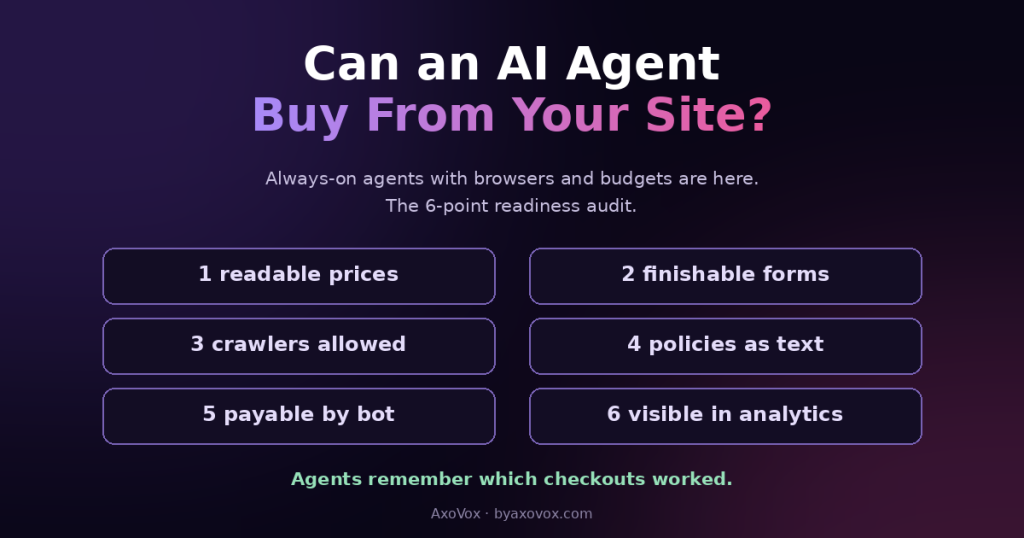 OpenAI opened its September keynote with a small story: an early tester forgot to invoice a client, and his AI agent noticed, prepared the invoice, and sent it after a one-tap approval. Cute anecdote, until you reverse the camera. Somewhere in that story there’s a BUSINESS that received an email written by software, got checked… Read more: Your Next Customer Has No Eyes: The Agent-Readiness Audit for Your Website
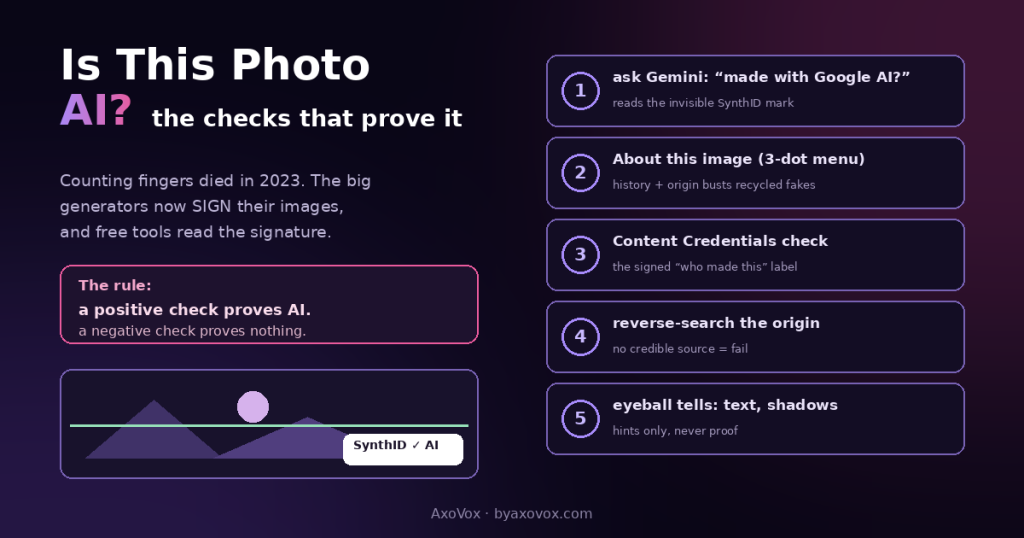 “Count the fingers” died in 2023. The 2026 reality is better: the big generators now sign their images, free tools read the signature, and the real skill is knowing which checks prove and which only hint. The proof ladder, the video tells, and the rule that protects you both ways.
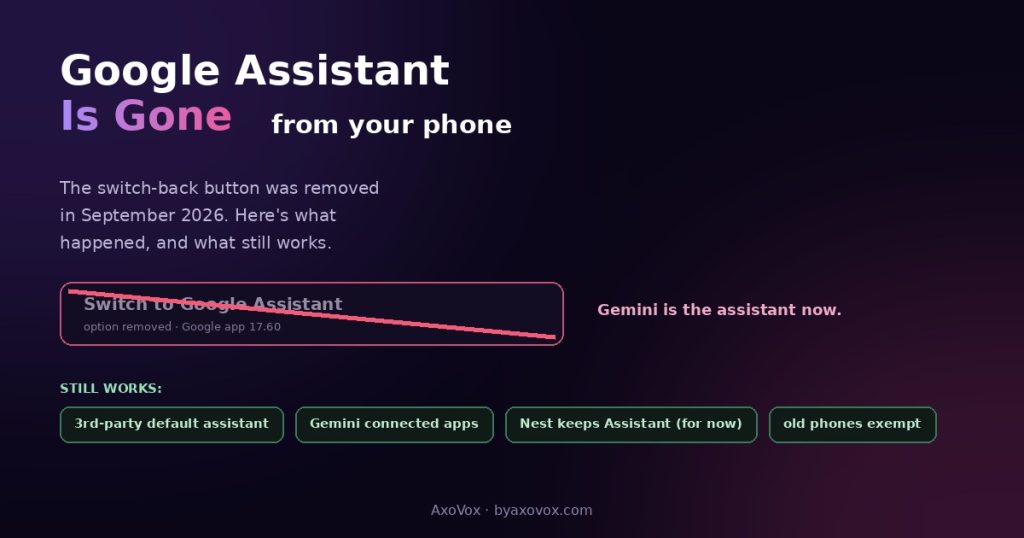 You long-pressed the power button and a stranger answered. The switch-back button every guide describes was removed in late September 2026; the guides are obituaries that haven’t been updated. What died, who’s exempt, and the escape hatches that genuinely still exist.
 I’ve stopped keeping up with model names; clients ask which one matters and the honest answer is none of them, individually. Every engine decides whether to recommend you the same way. Five principles that survive every launch, each with a test you can run today.
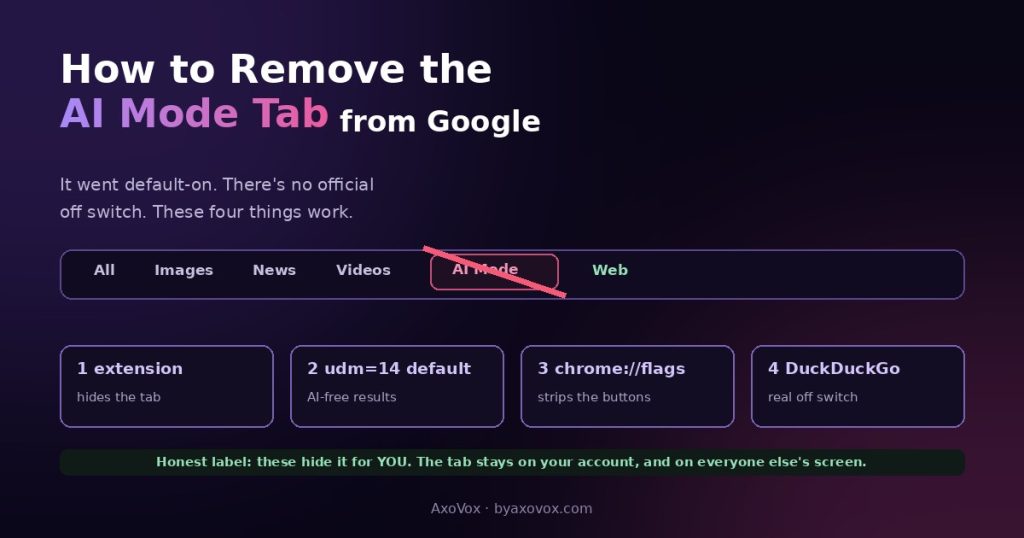 It arrived without asking: a tab in your results, an AI button in Chrome’s search bar, a nudge under half your searches. The setting that deletes it doesn’t exist, so “remove” really means “stop seeing it.” Four ways that work, from gentle to scorched-earth, honestly labeled.
 “I don’t Google things anymore” and “Google handles 90% of world search” are both true at once, which means replacement is the wrong question. Search split into two jobs: ChatGPT took figure-this-out, Google kept take-me-there-and-prove-it. The scoreboard, the numbers, and where your searches should split.
 A millionaire bet his Ferrari he could make $100 in one hour using only ChatGPT. He lost, and that’s the most honest data point in this genre. The 7 methods that actually produce income, with the numbers I’ve seen invoiced, and the 3 famous ones to skip.
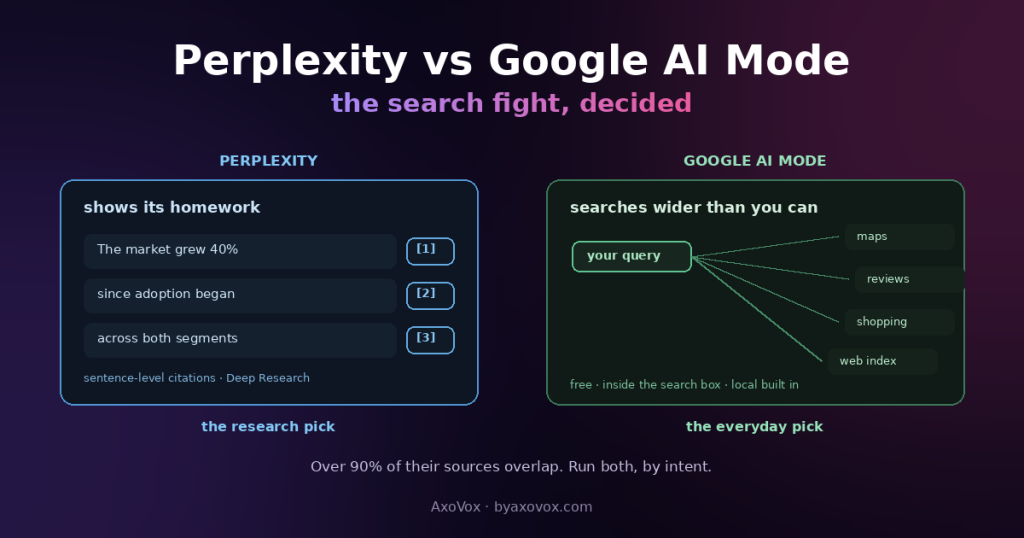 The scrappy startup that invented the category against Google deciding the category belongs to Google. After months of running both: AI Mode is search that answers, Perplexity is an answer engine that shows its homework. Where each wins, and the twist: their sources overlap more than 90%.
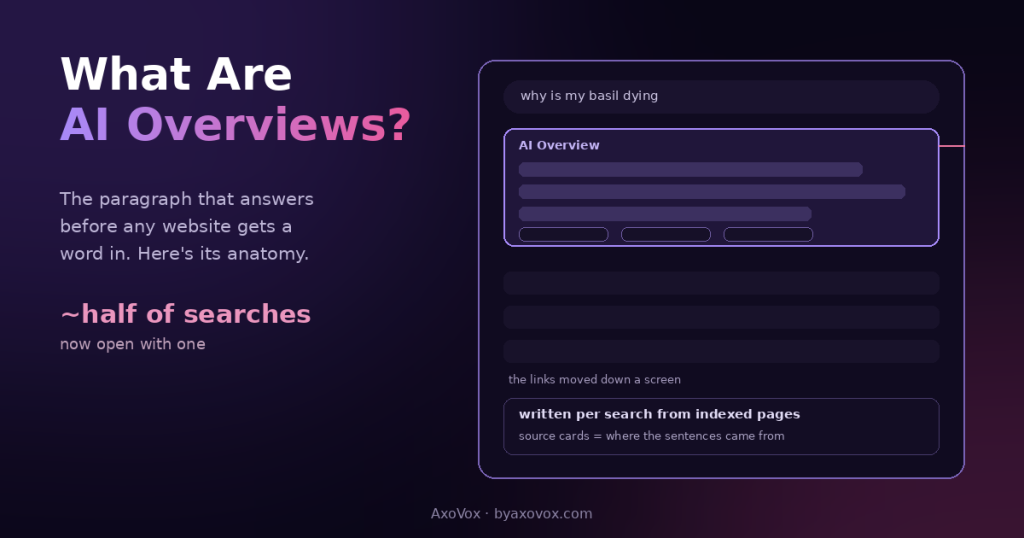 Before any website gets a word in, Google answers: a generated paragraph on top, links demoted below. What an AI Overview actually is, the three-step machinery behind it, why your recipe search gets an essay while your plumber search doesn’t, and what the box did to clicking.
 Both answer anything, both sound confident, and neither is universally better. The one-line version: ChatGPT writes better, Gemini knows better. The scoreboard job by job, the situations that actually come up, and the lazy-but-correct setup that ends the question.
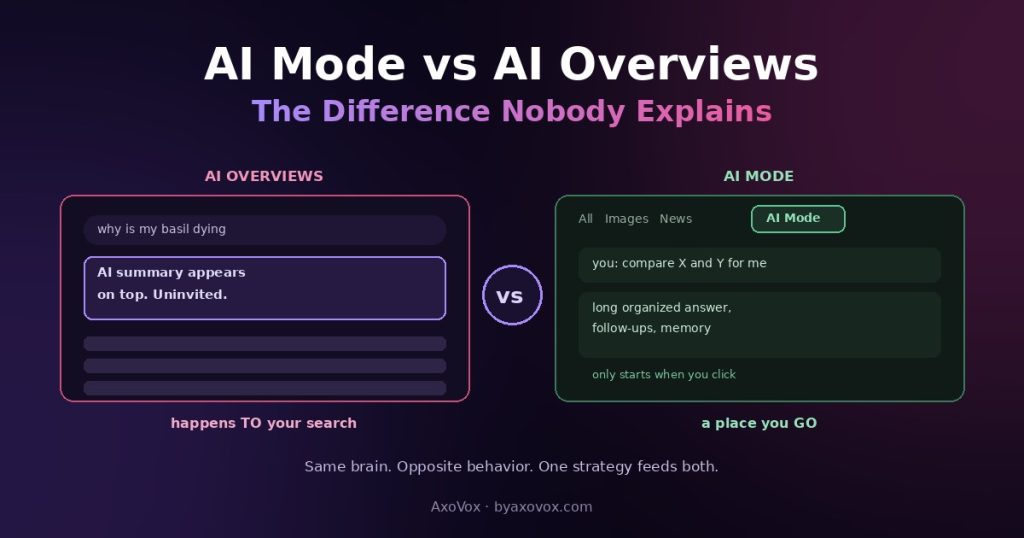 Google has two AI answer systems in the same search box and everyone mixes them up, including people writing about them professionally. The clean split: AI Overviews happens TO your search; AI Mode is a place you GO. Side by side, the 10-second test, and which one a business should chase.
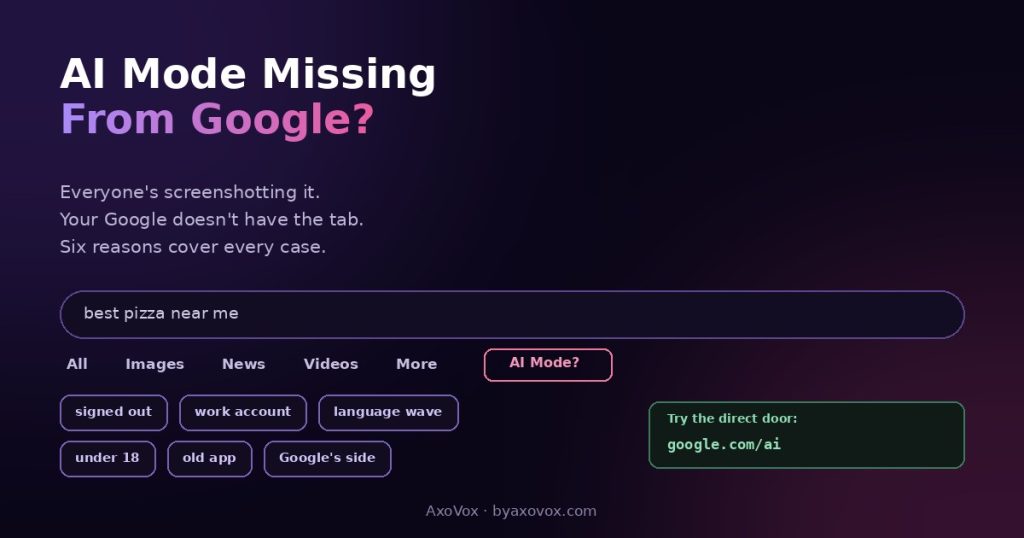 Half your feed is posting AI Mode screenshots and your Google shows All, Images, News, Videos. No tab. It’s almost never a bug: eligibility is decided per account and per rollout wave. The six causes in order of likelihood, and the direct door that skips the tab entirely.
 Three warm messages from mom become “Dinner canceled. Mother displeased.” Apple’s summaries can’t do jokes or tone, and turning them off takes under a minute, once you know there are four different switches. Global, per app, the lock-screen shortcut, and the italics tell.
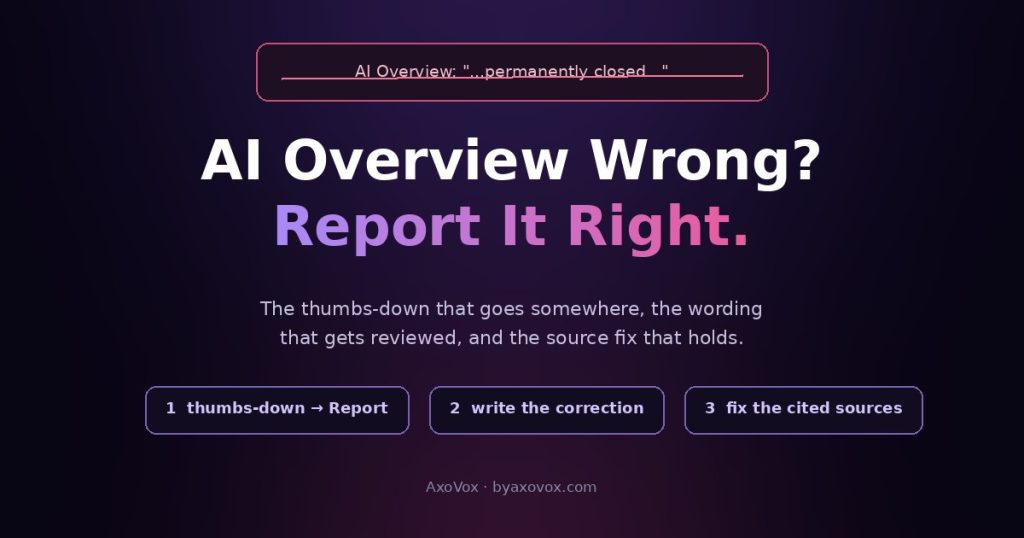 Google’s AI just told the world something wrong, and there’s no obvious “this is false” button. There is a report path: the hidden thumbs-down, the wording that gets reviewed instead of buried, and the part that matters when it’s your business: the Overview rebuilds from its sources until the sources change.
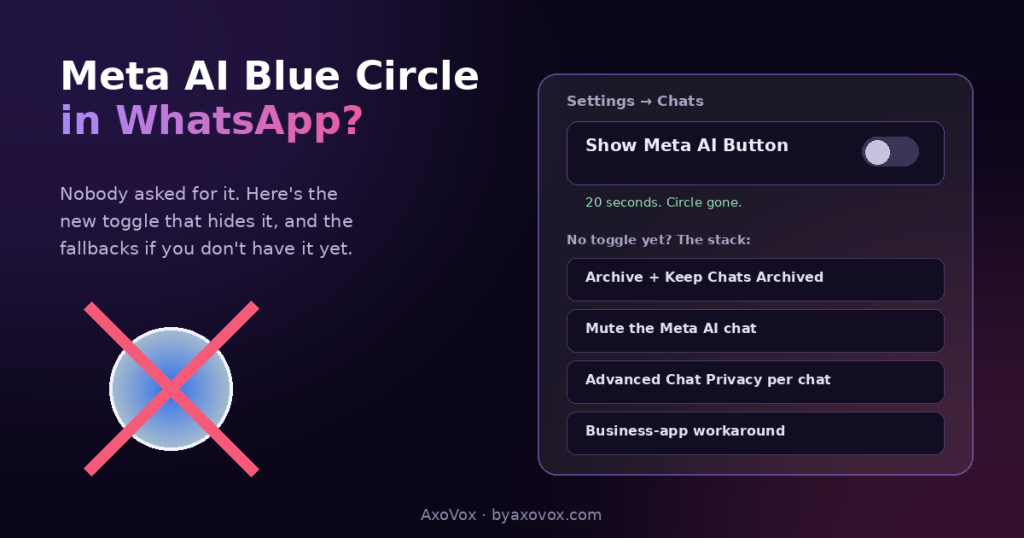 One day it was just there: a blue circle above your chats, no opt-in, no off switch. There’s finally a toggle that hides it, 20 seconds in Settings. Where it is, the fallback stack for phones that don’t have it yet, and the honest list of what doesn’t work.
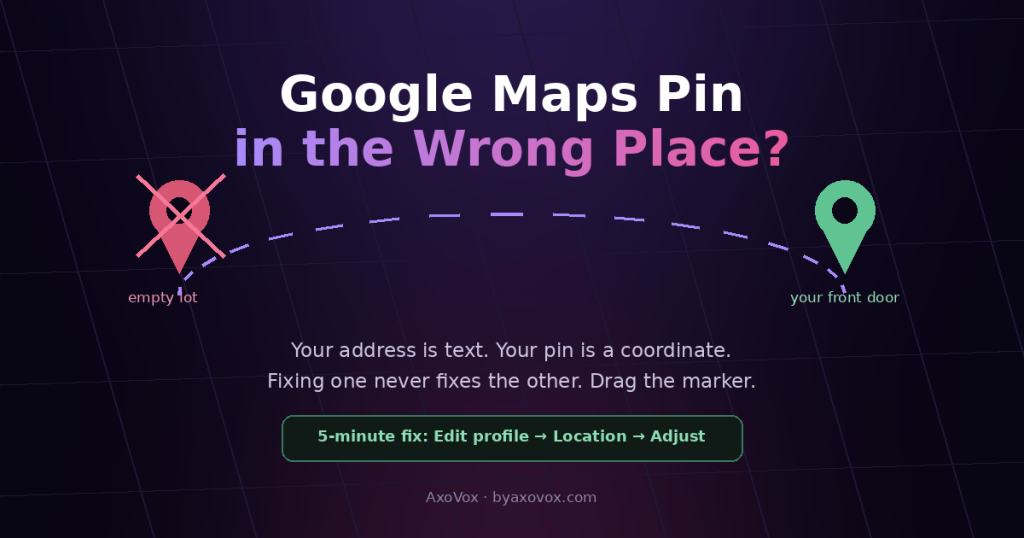 “I’m standing where the map sent me and I don’t see you.” Your address and your pin are two separate things in Google’s system, text vs coordinate, which is why fixing one never fixes the other. The 5-minute drag, the snap-back sequence, and the last-20-meters trick.
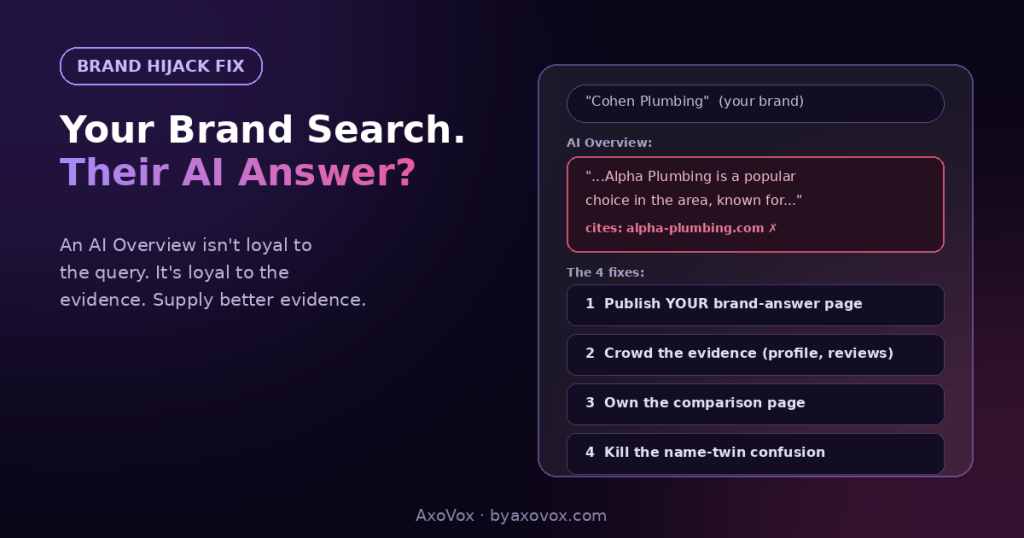 A customer googles your name and Google’s AI opens with your competitor. The AI isn’t loyal to the query, it’s loyal to the evidence and the fix is supplying better testimony: the brand-answer page, crowded evidence, the comparison play, and the name-twin cleanup.
 The map pack ranks; AI Mode argues. It reads review sentences, pages and profiles as evidence, then names two or three businesses with reasons attached — and #3 in the pack can be #1 in the answer. How the picks work, the “because” strategy, and the review ask that changes everything.
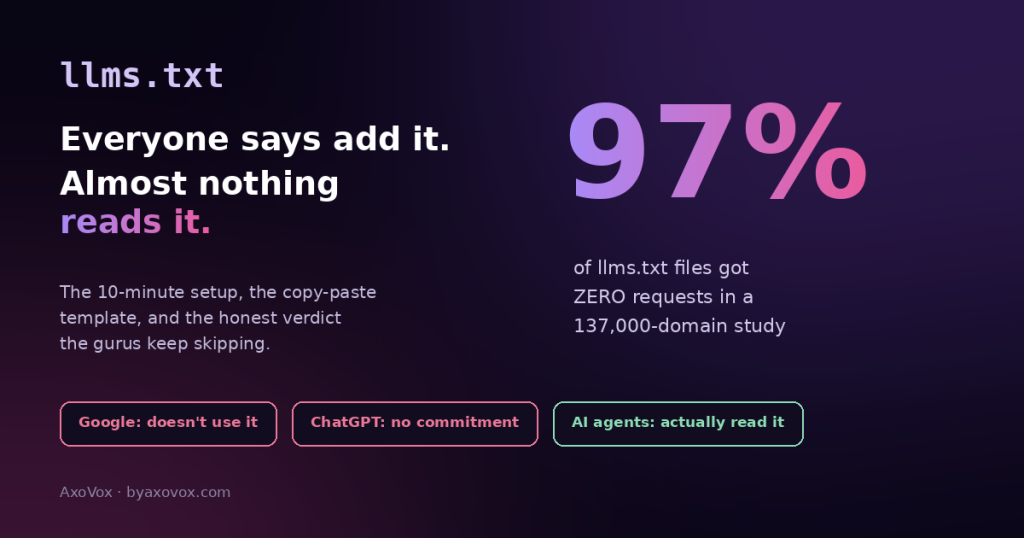 Every AI-marketing thread says you must add llms.txt. Google says, on record, it doesn’t use it, and 97% of published files get zero requests. The honest verdict in three lines, the 10-minute setup with a copy-paste template, and the one audience that genuinely reads the file.
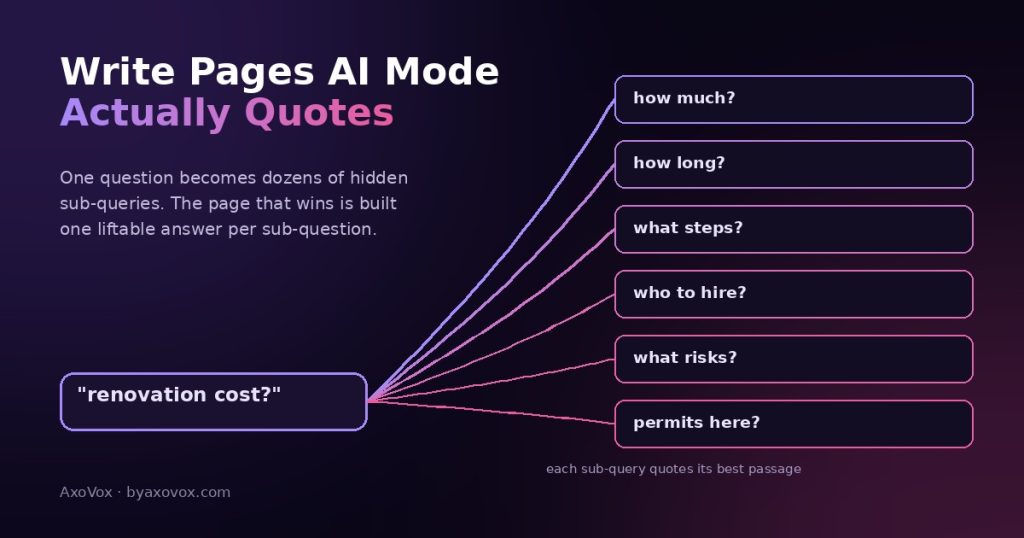 Your page covers the topic, and AI Mode quotes four other sites anyway. The reason: one question gets decomposed into dozens of hidden sub-queries, and the answer is built from the best passage for each. The unit of competition isn’t the page anymore – it’s the passage. The full method.
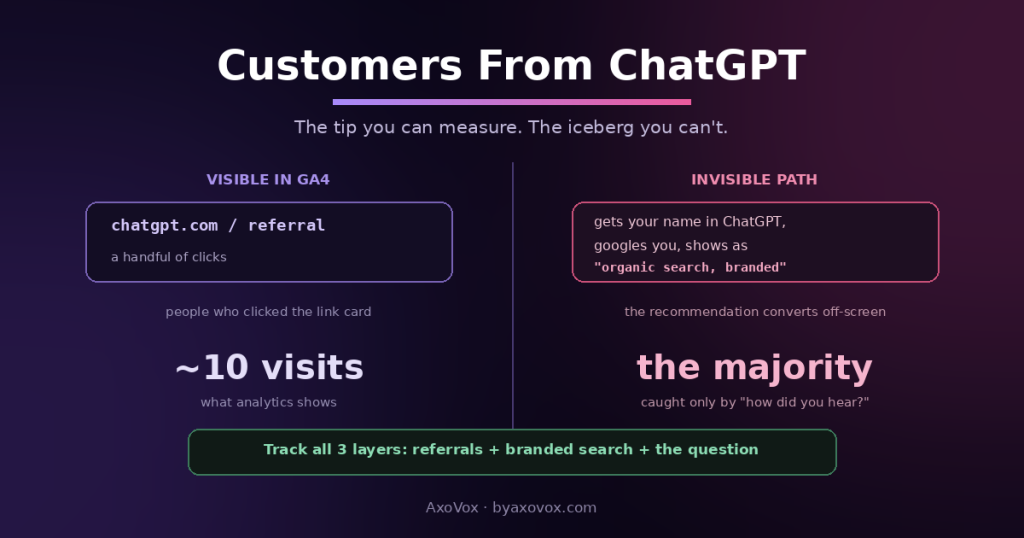 The chatgpt.com line in your analytics is a floor, not a total: most AI-recommended customers take the name, google you, and land as branded organic search. The three tracking layers- the GA4 referral report, the branded-search proxy, and the one question that catches the whole invisible path.
 A customer quotes a price you haven’t charged since 2023: “ChatGPT told me.” There’s no record to edit and no correction form – answers are assembled fresh from public sources, so wrong info always has an origin. The interrogate-hunt-fix-verify method, step by step.
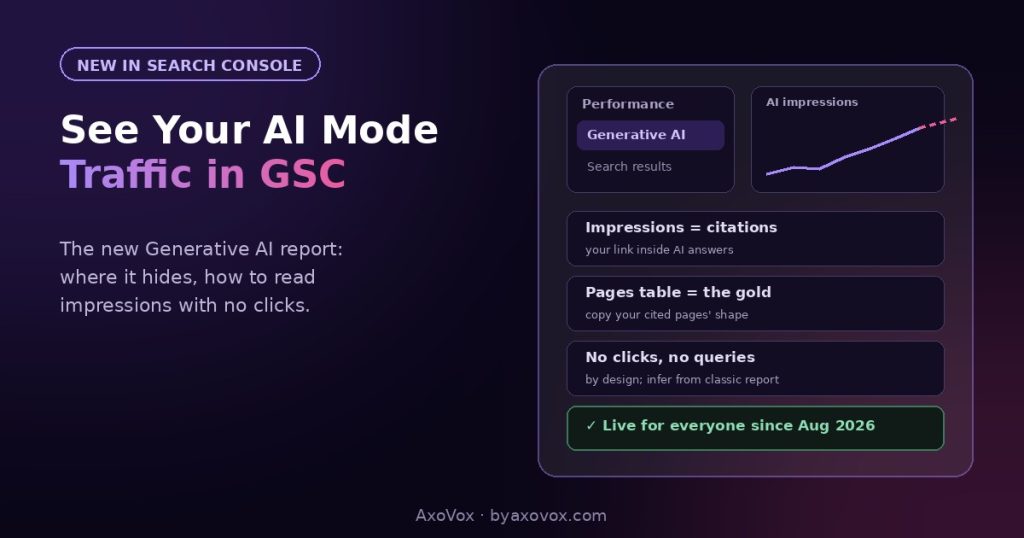 Half of searches open with an AI answer, and until June 2026 you had zero official data on whether your pages appeared in any of it. Search Console now has a dedicated Generative AI report, and most owners haven’t opened it. Where it hides, the impressions-are-citations mindset, and the 15-minute routine.
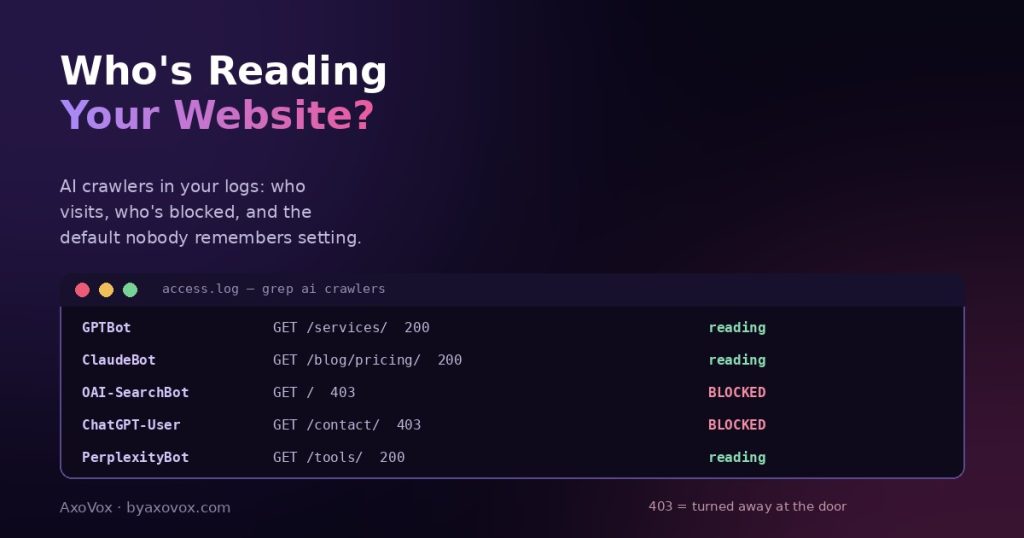 GPTBot, ClaudeBot and PerplexityBot are either reading your site daily or being turned away, and you never decided either. The three kinds of AI crawler (blocking one is harmless, blocking another is self-harm), the Cloudflare default nobody remembers setting, and three ways to see the guest list.
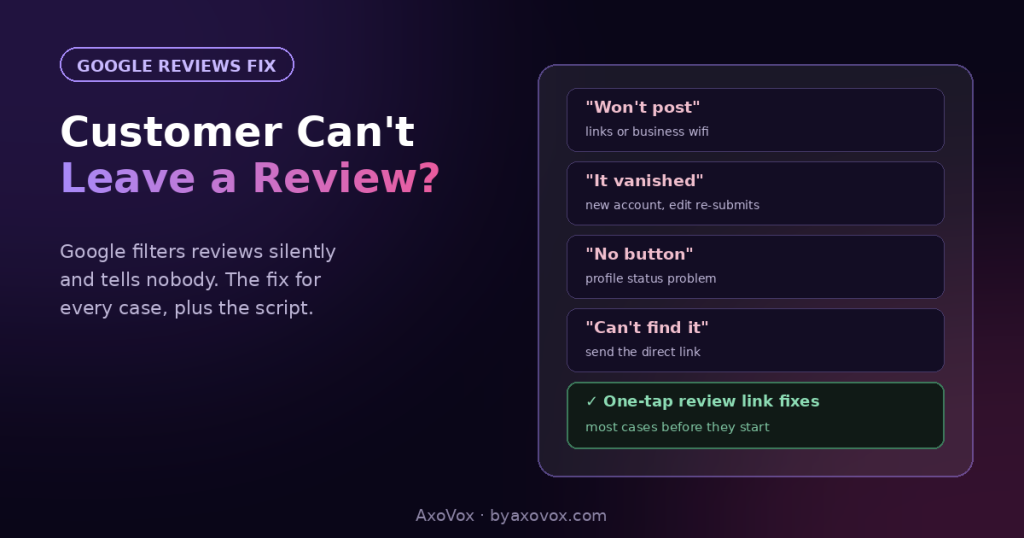 Eight years in business, and ChatGPT tells a customer it couldn’t find you. It’s not a directory that missed you, it’s a referee that only vouches for what it can verify, and the most common culprit is your own site blocking AI crawlers via a toggle you never turned on. The 3-layer fix.
 A customer calls: “Are you guys… still open?” Google says permanently closed while your lights are on. The surprise: anyone can mark you closed, no owner confirmation needed. The 2-minute fix, the appeal when it’s blocked, and how to make your profile too alive to flag.
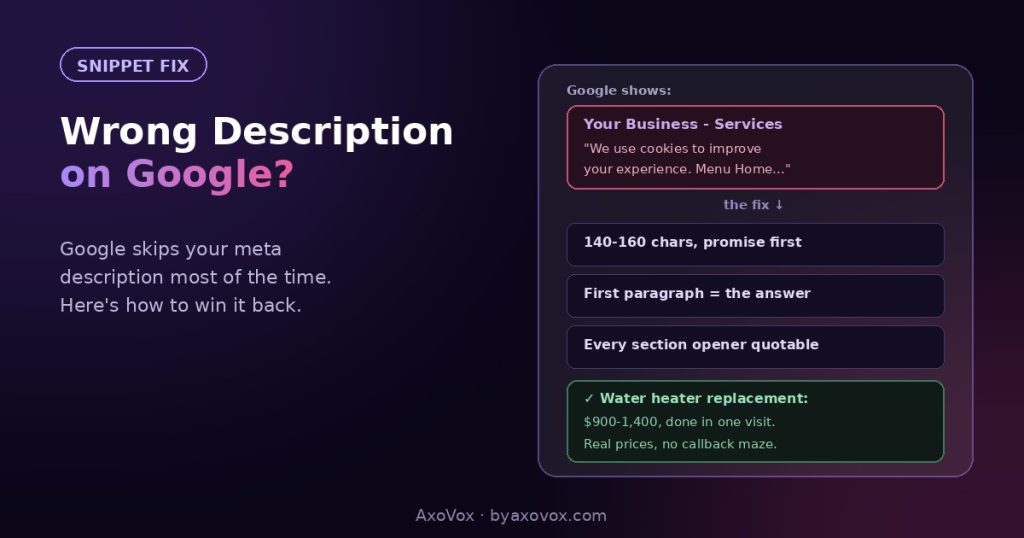 Google is showing your cookie notice as your description, or a sentence that ends mid-word. The truth: Google passes on meta descriptions most of the time and builds snippets per query. The fix is twofold – make yours pick-able, and make everything it might grab instead worth quoting.
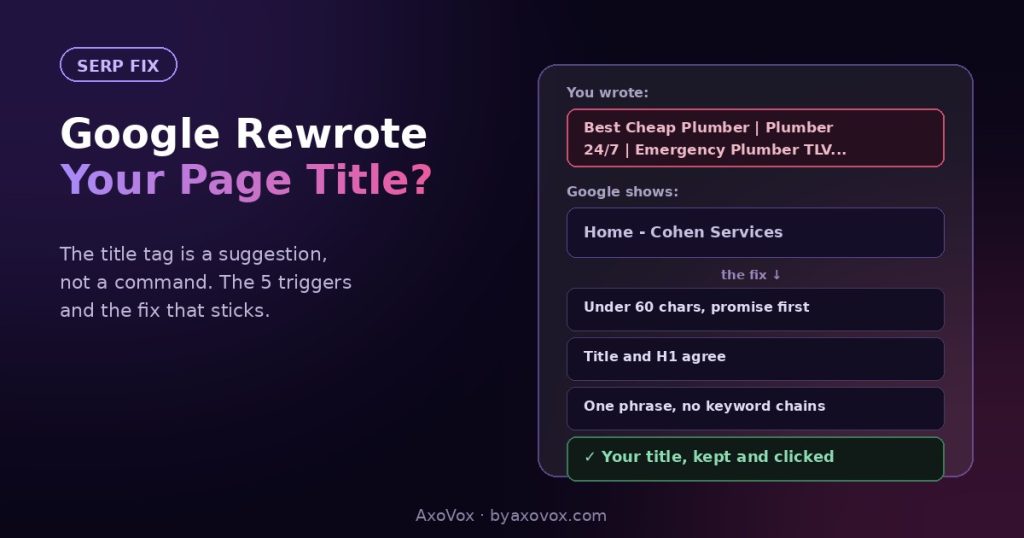 You crafted the perfect title, Google shows something else. The title tag is a suggestion, not a command — since 2021 Google generates displayed titles itself, and it rewrites the majority that break its rules. The five triggers, the H1-alignment fix, and the CTR test that tells you if it matters.
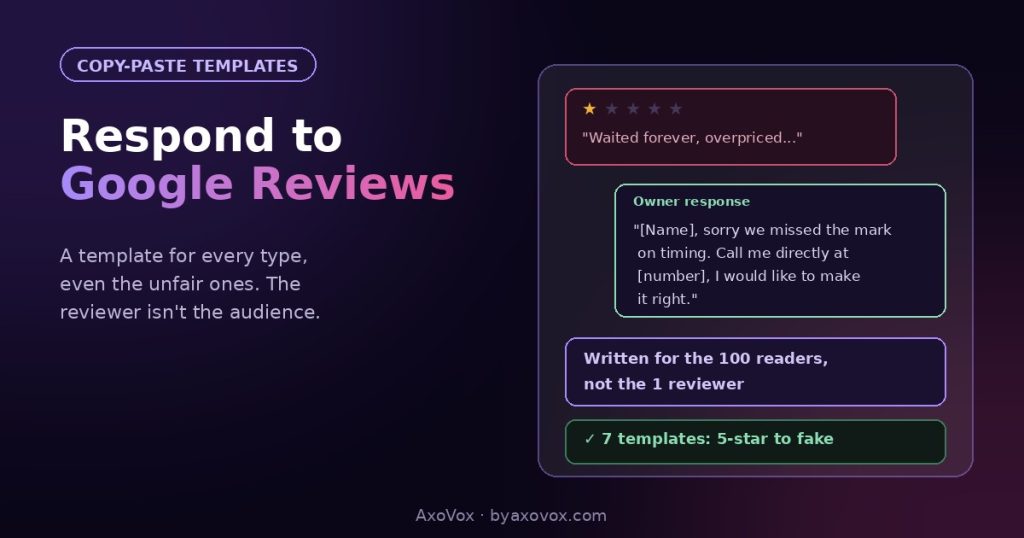 Every response you write is read by two audiences, and the reviewer is the smaller one. Copy-paste templates for the glowing, the harsh, the unfair, the fake and the 3-star shrug, with the rationalization spots marked and the four rules that govern all of them.
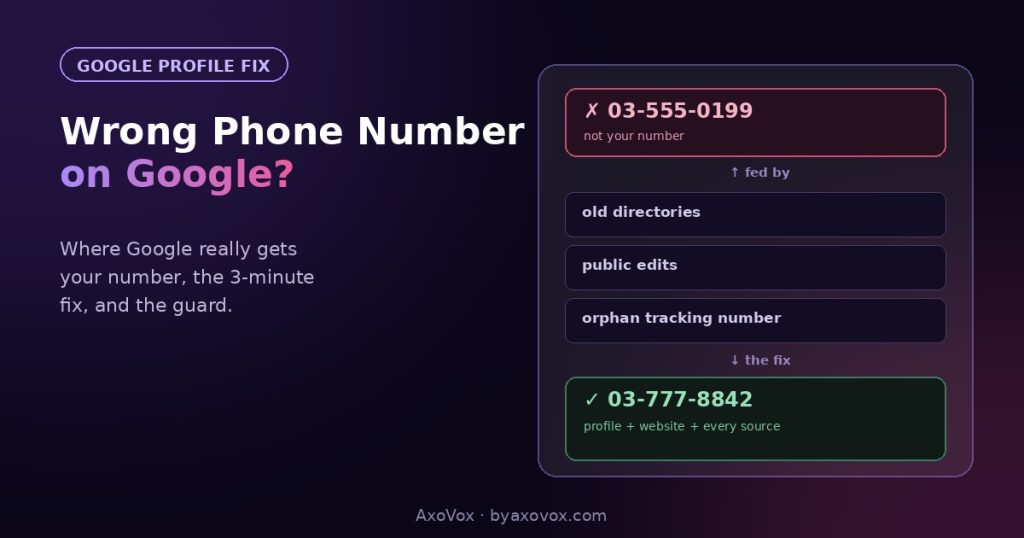 A customer says “the number didn’t work,” and Google shows one that isn’t yours. Google cross-checks your phone against directories and public edits, and can override your own profile when they disagree. The 3-minute fix, the quoted-search trick that finds every feeding source, and the guard.
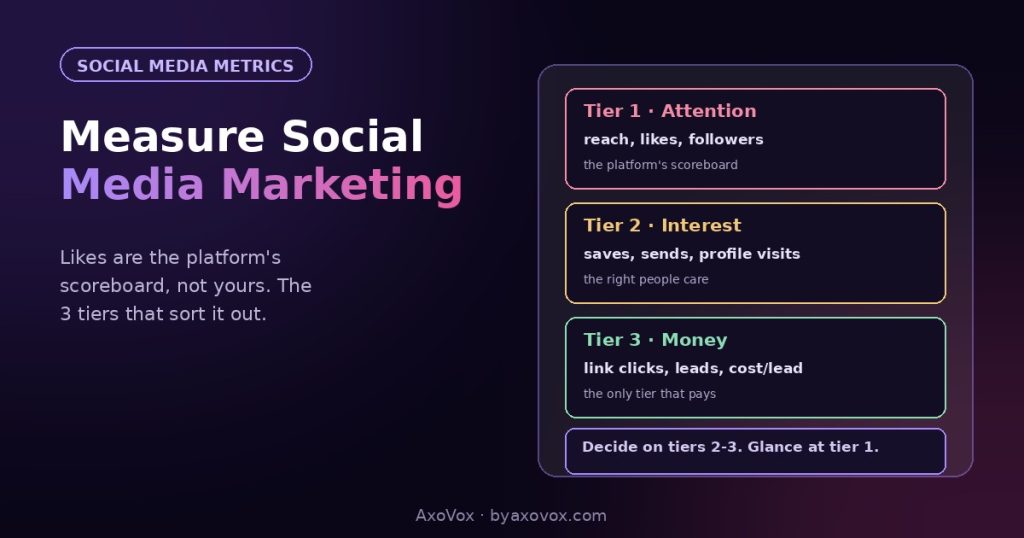 Reach, likes and followers are the platform’s scoreboard — platforms sell attention. Your scoreboard is customers, and the two can point opposite directions for years. The three tiers of metrics, the one-hour tracking setup, and the monthly review that needs exactly five numbers.
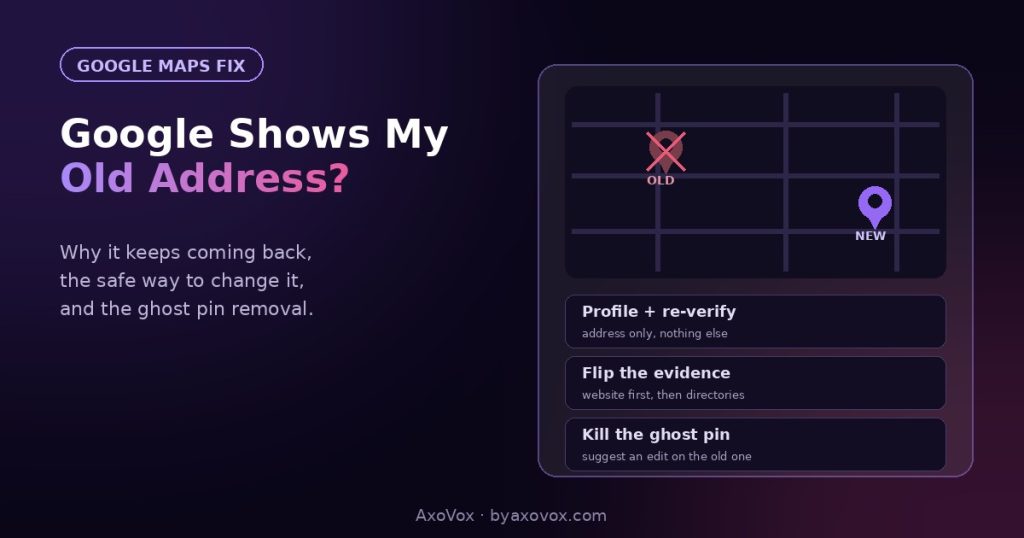 You moved months ago and Google still sends customers to the old door. The reason it “keeps coming back”: your address lives in three places Google reconciles, and you only fixed one. The full fix in the right order, the suspension trap to avoid, and the ghost-pin removal.
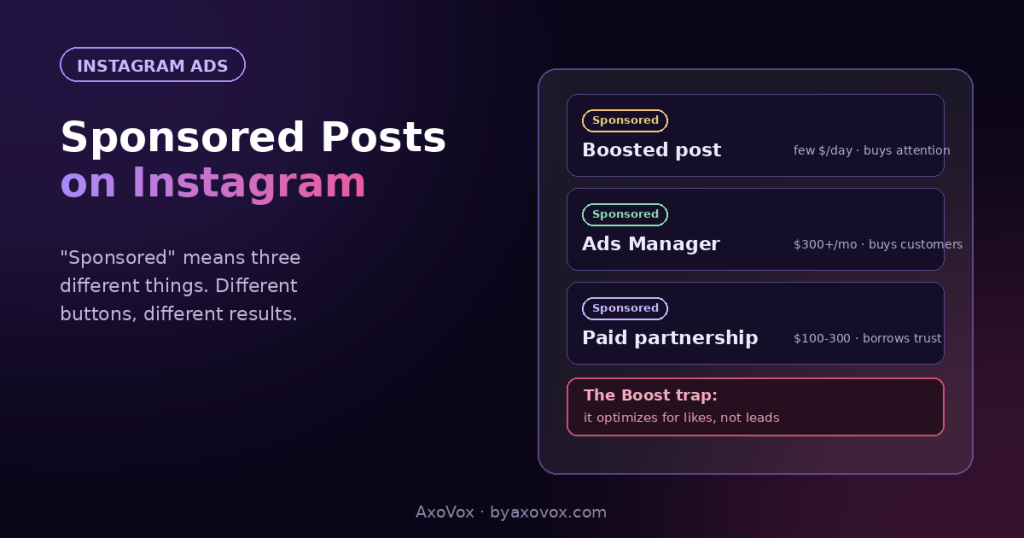 “Sponsored” on Instagram means three different things: a boosted post, a real Ads Manager campaign, or a paid creator partnership — different buttons, different price tags, wildly different results. All three, the trap inside the Boost button, and the fit test before spending anything.
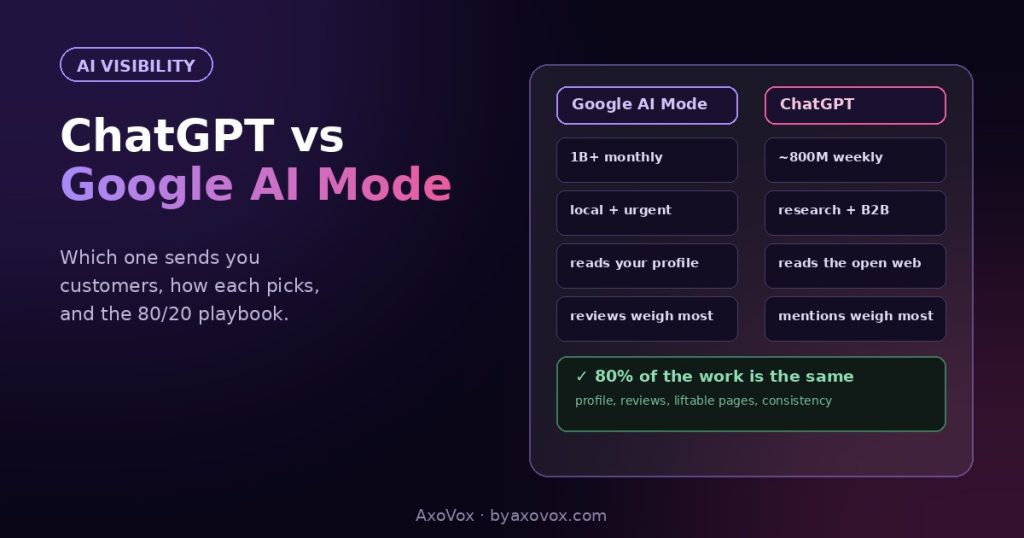 Both AI systems name specific businesses, neither shows a page two, and they don’t pick the same way — a business can be recommended constantly in one and invisible in the other without knowing. Where customers ask what, how each decides, and the one playbook with two tilts.
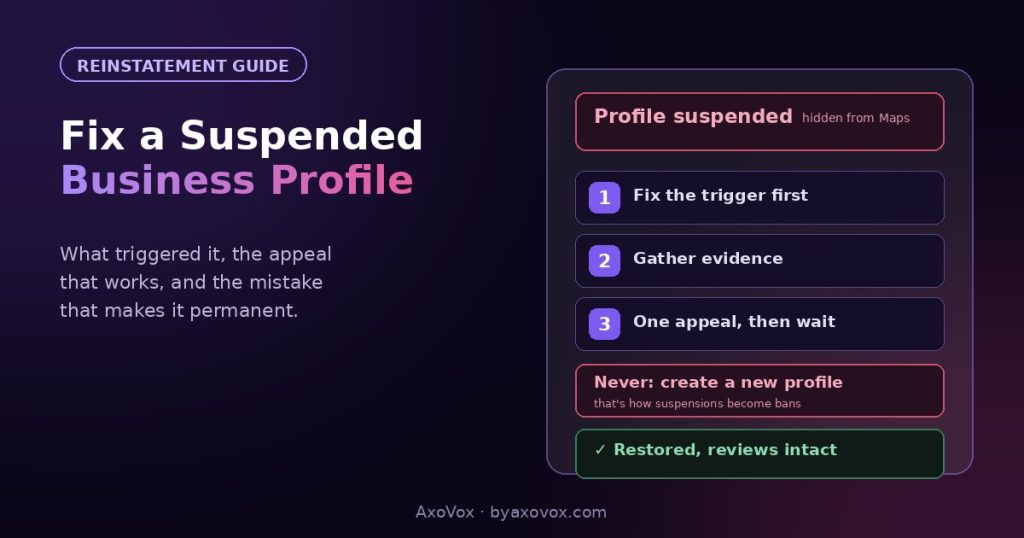 Yesterday: on the map, 74 reviews, steady calls. Today: suspended. Most reinstatement succeed when done right, and the worst move is the tempting one creating a fresh profile, which converts a fixable problem into a ban. The triggers, the appeal, the evidence, and the wait.
 Your website already ranks for keywords – dozens, maybe hundreds and most owners have no idea which ones. Google’s own free report lists every search your site appears for, with positions and clicks. Where it lives, how to read it, and the three moves it unlocks.
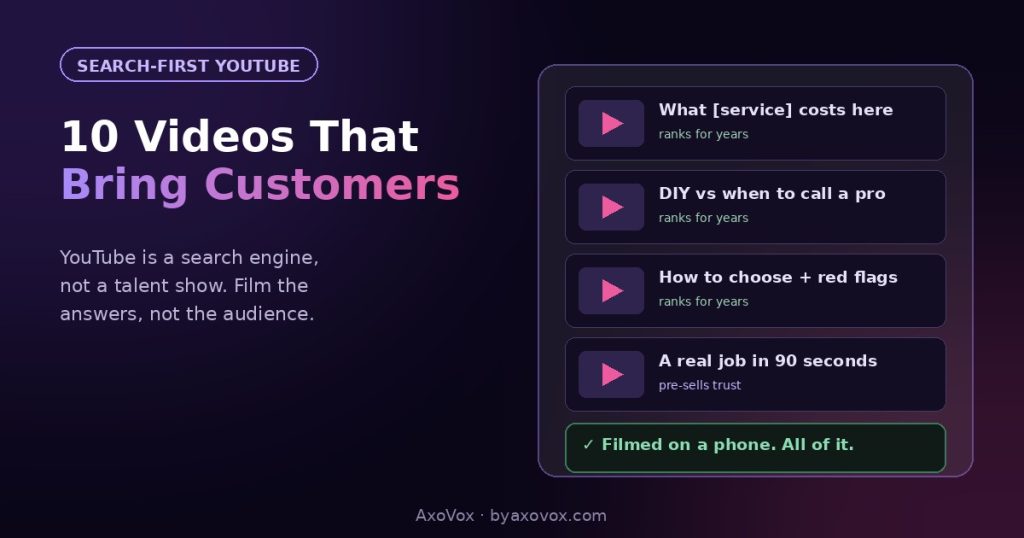 Most YouTube advice is written for people who want to become YouTubers. A business doesn’t need an audience — it needs to be the answer. The search-first strategy: the 10-video plan mined from customer questions, the phone-only production bar, and what to skip without guilt.
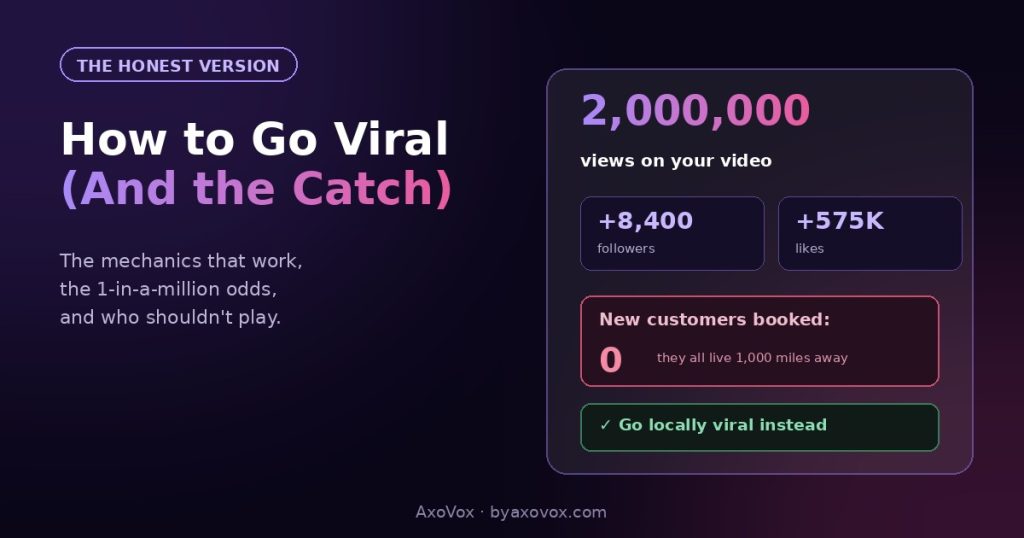 The mechanics that raise the odds are real and learnable: the 2-second hook, one strong emotion, a share trigger, a trend bent to your niche. Then the question viral-tips articles never ask – would a million strangers’ views be worth anything to YOUR business? For many, the answer changes the plan.
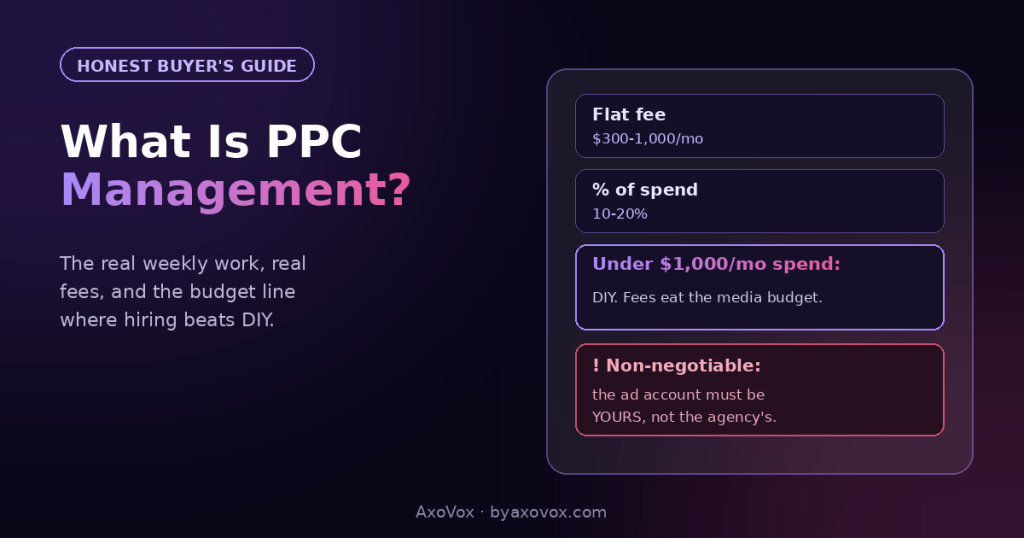 PPC management is paying a specialist to run your ads so the budget buys customers instead of lessons. The useful part comes after the definition: the actual weekly work, real fee ranges, the budget line where hiring beats DIY, and the red flag that should end any sales call.
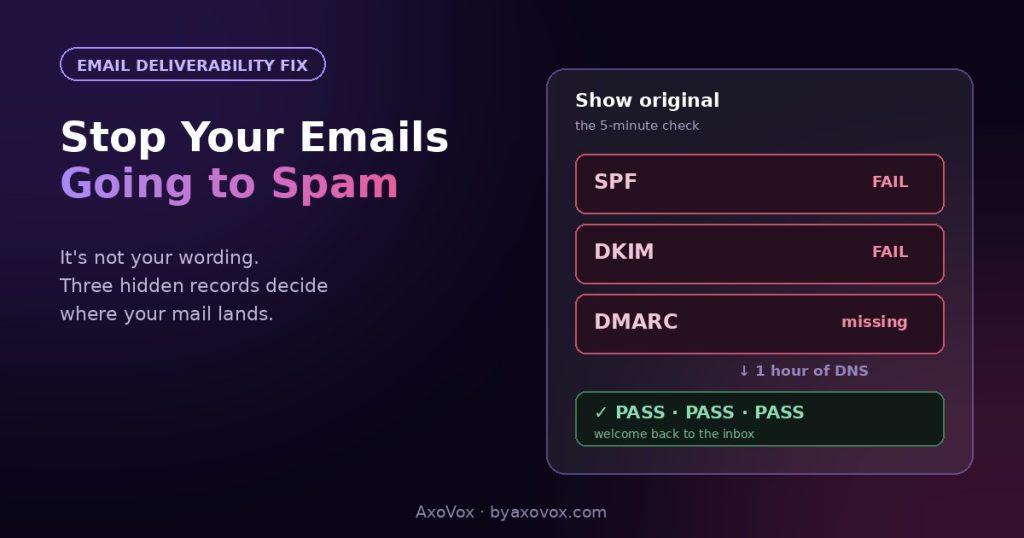 The customer swears the quote never arrived. The newsletter gets four opens. It’s usually not your wording — since 2024, Gmail and Yahoo enforce sender authentication, and unauthenticated mail gets junked no matter how politely it’s written. The 5-minute check and the one-hour fix.
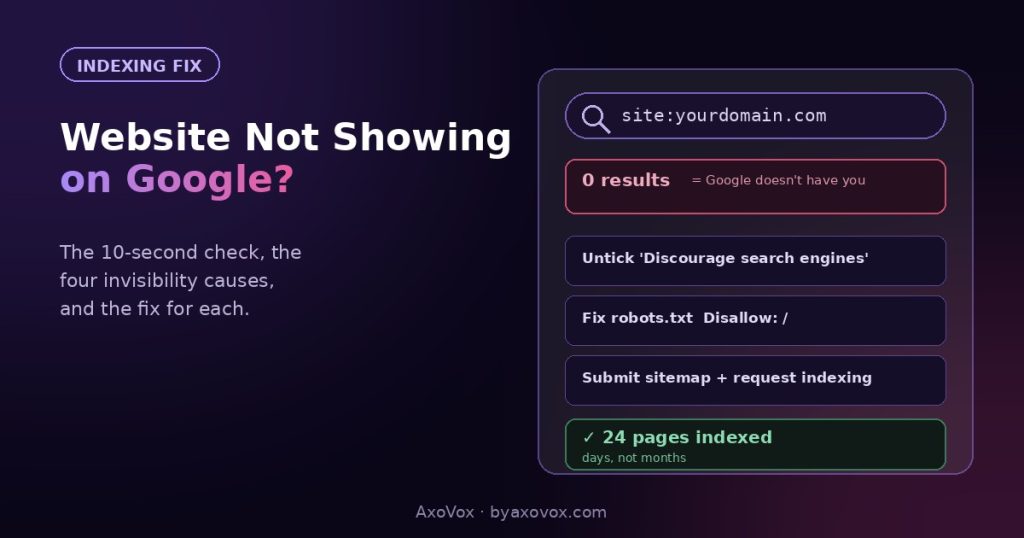 Ranking problems and indexing problems get confused constantly, and the difference decides everything. The 10-second site: search that tells you which one you have, the four ways sites stay invisible – including the WordPress checkbox that hides thousands of them and the fix for each.
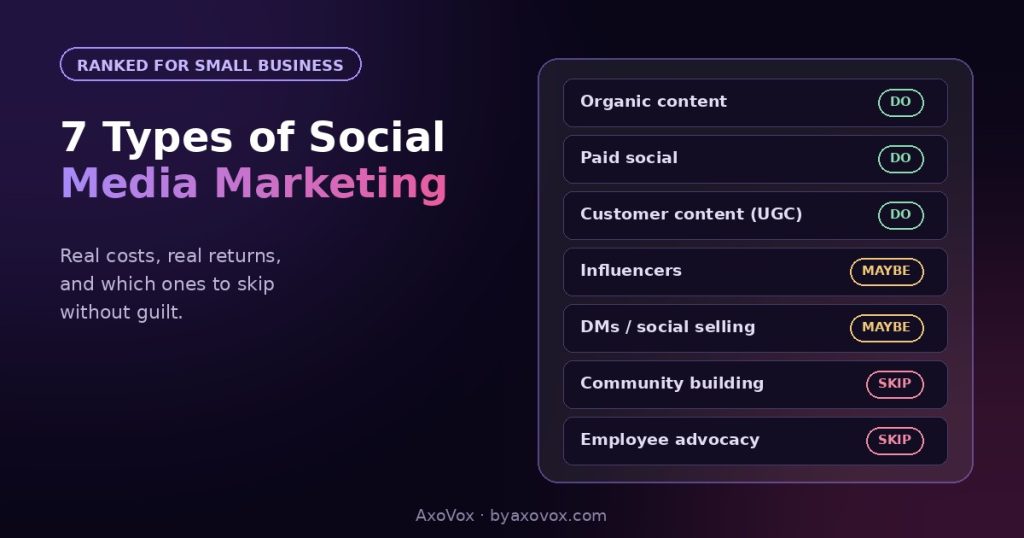 There are seven distinct types of social media marketing: organic content, paid social ads, influencer partnerships, user-generated content, community building, social selling, and employee advocacy. Every agency article lists them. Almost none answers the question a small business actually has: which ones are worth MY hours and MY budget, and which ones can I skip… Read more: 7 Types of Social Media Marketing: Which to Do, Which to Skip
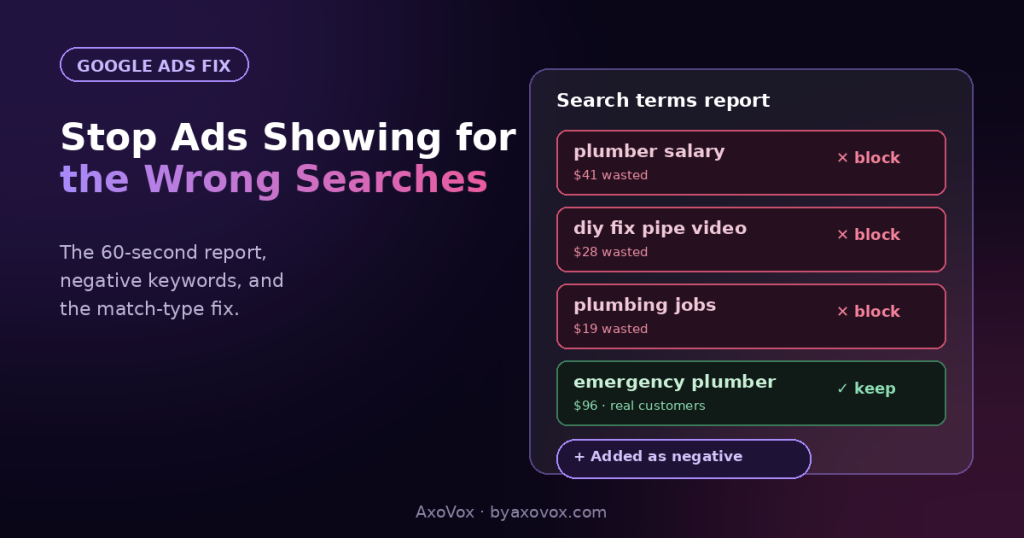 A photographer’s ad clicked by camera shoppers. A plumber paying for “plumber salary” searches. The platform knows exactly which searches spend your money — the list is just one level deeper than the screens you see. Where it lives and the two fixes.
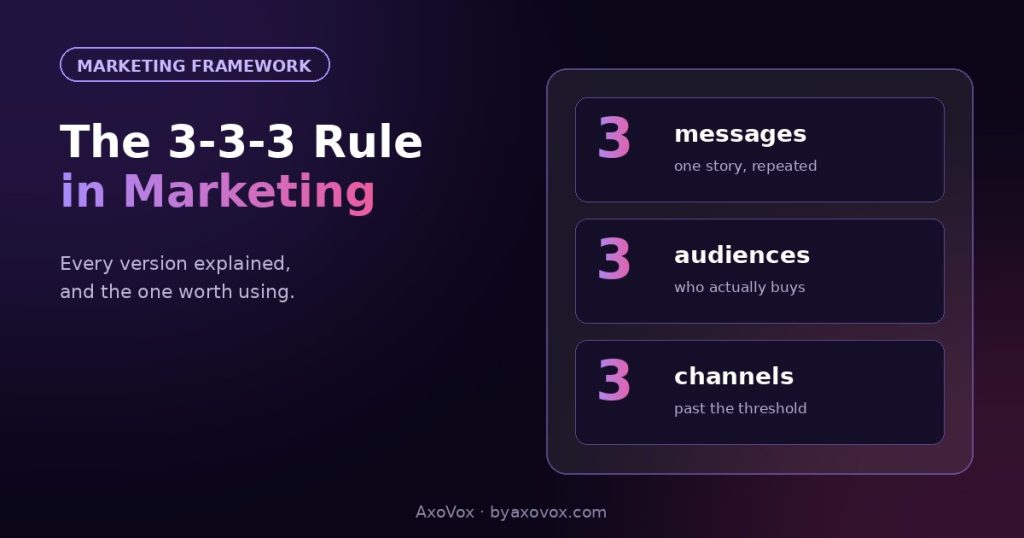 Three messages, three audiences, three channels — that’s the common version. The part every other article skips: there is no official 3-3-3 rule. Four different frameworks share the name. All of them, side by side, plus the worked example and when to break the rule entirely.
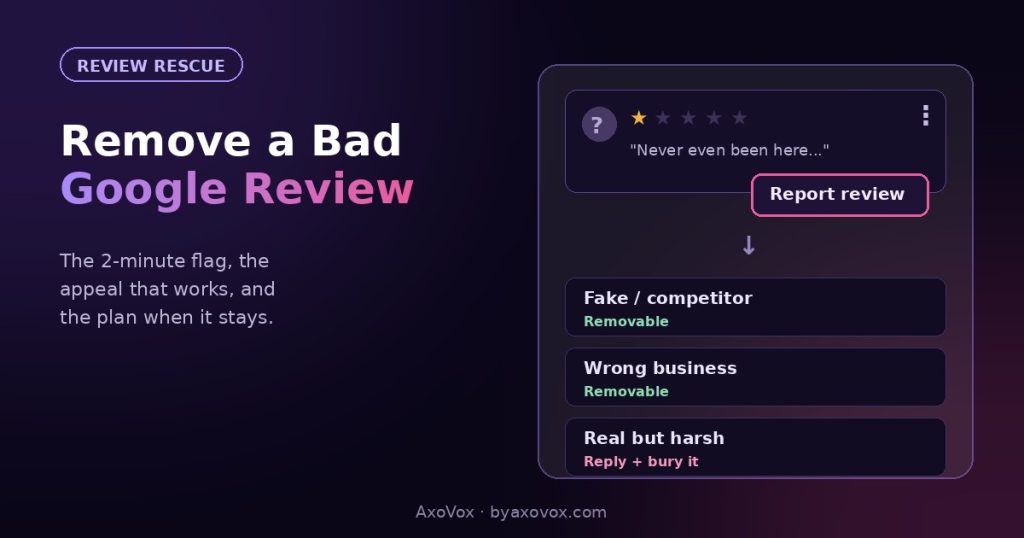 You can’t delete a Google review — no button for that exists at any price. But fake reviews, competitor hits, and wrong-business reviews get removed all the time when they’re reported right. The 2-minute flag, the appeal that gets read, and the math that makes surviving reviews small.
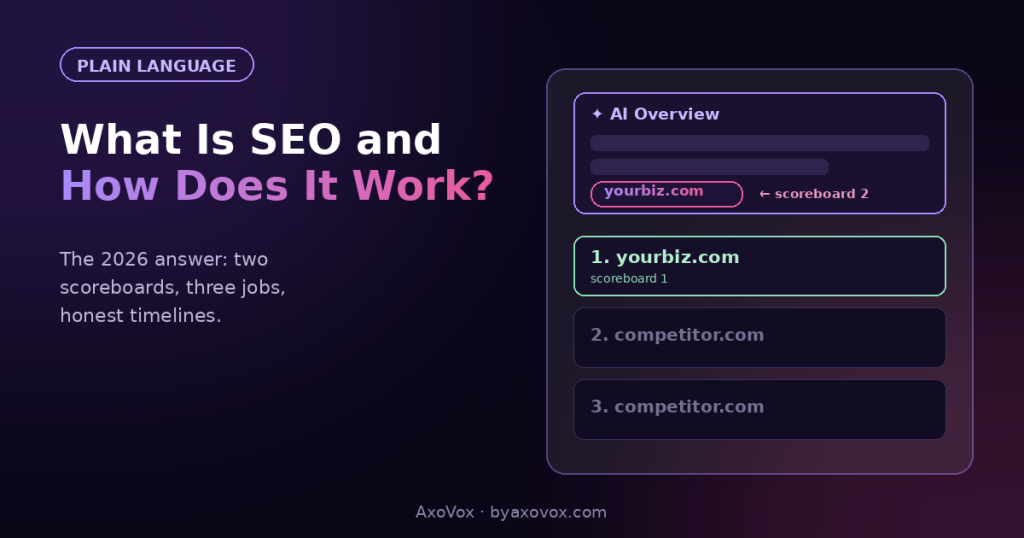 SEO is making your website the answer Google shows when customers search for what you sell. That’s the definition. The rest is how it works in 2026, when Google doesn’t just rank pages anymore — it writes answers and cites a few sources. The three jobs, the AI layer, and honest timelines.
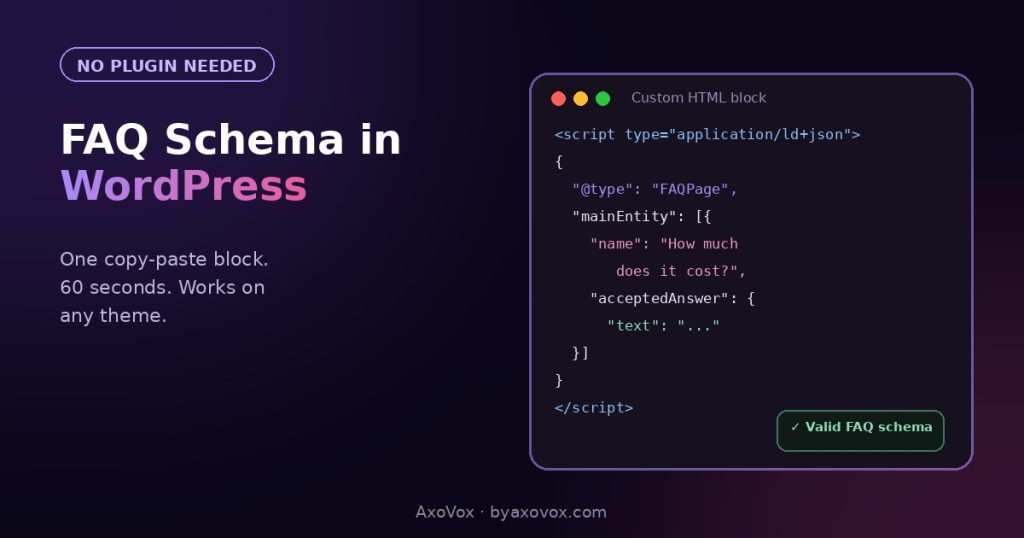 Every guide says install another plugin. You don’t need one: FAQ schema is a single block of text pasted into a Custom HTML block, and WordPress handles it natively. The 60-second method, a template to steal, and the fixes when validation fails.
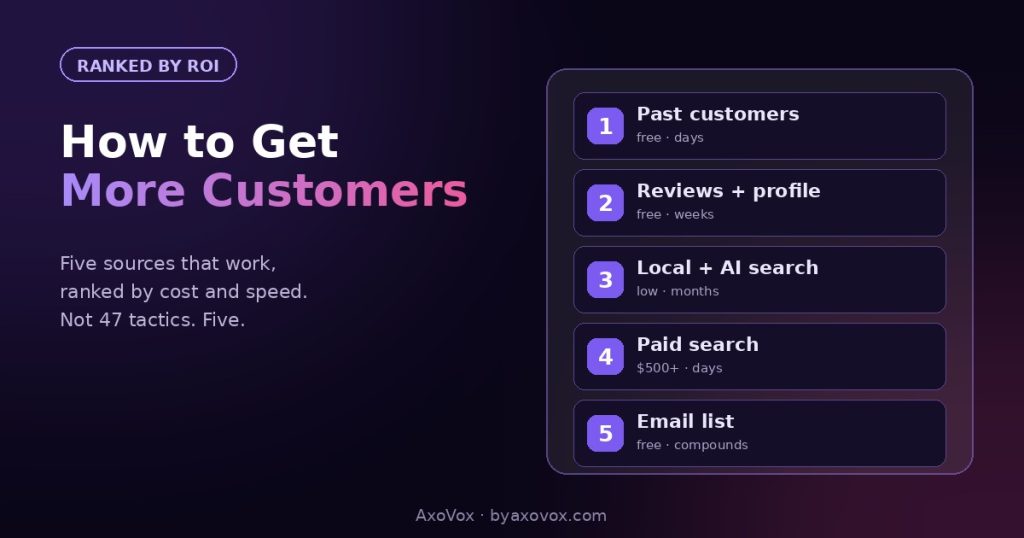 Every “get more customers” article lists 47 tactics. Nobody has 47 hours. So here’s the opposite: the five sources that reliably produce customers for small businesses, ranked by what they cost and how fast they pay, with honest numbers on each. Do them roughly in order. Stop when you’re busy. The ranking at a glance… Read more: How to Get More Customers (Ranked by What It Costs and How Fast It Works)
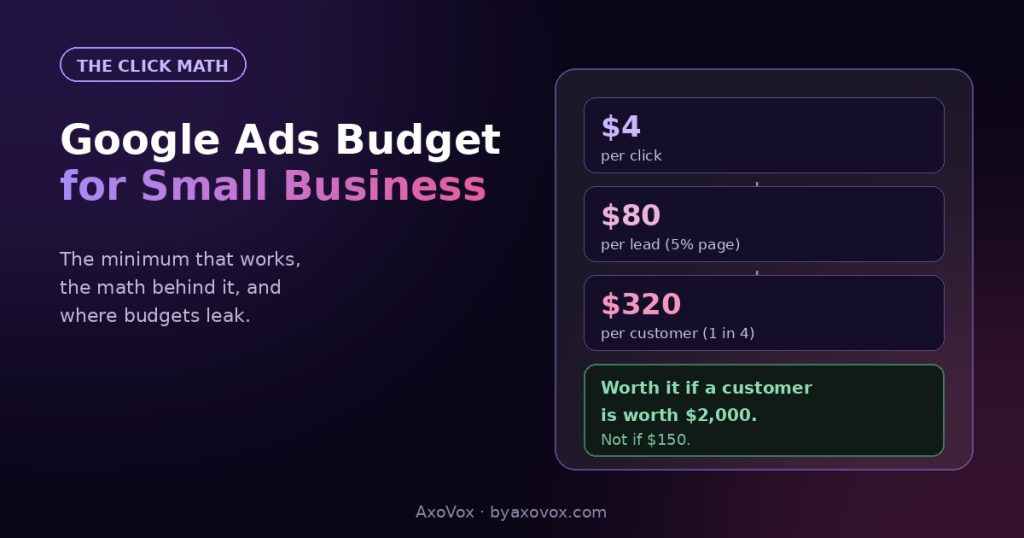 Google will happily take $300 a month or $30,000. Neither tells you if the account can work. The real question: can you afford enough clicks to learn anything? The click math, the working minimum, and the spending order.
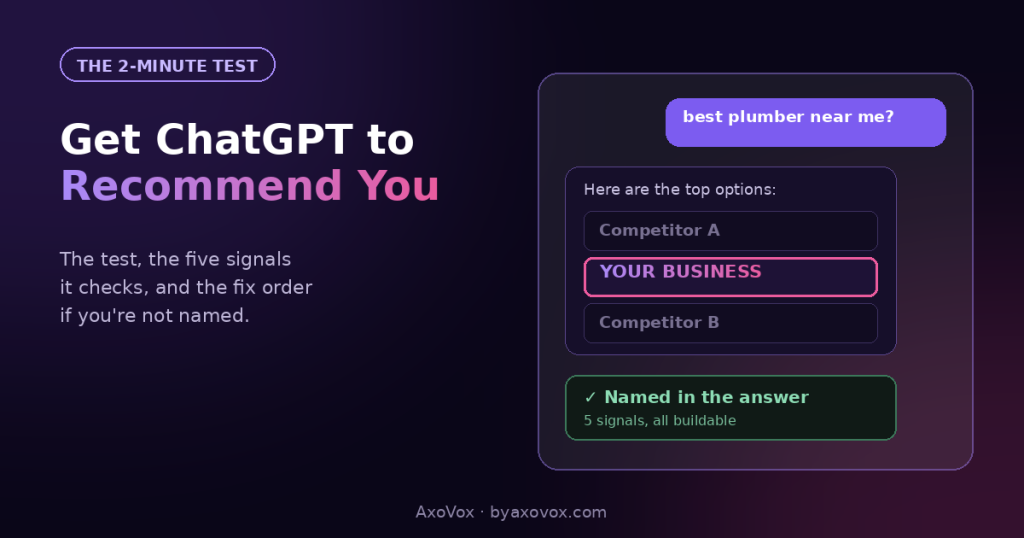 Somebody just asked ChatGPT for the best business in your category, and it answered with three names in four seconds. The 2-minute test to see if you’re one of them, the five signals that decide it, and the fix order if you’re not.
 “It depends” is true and useless. Here are the actual benchmarks: the 7-12% rule, the three questions that move your number, what each budget tier realistically buys, and the honest cases where spending less is right.
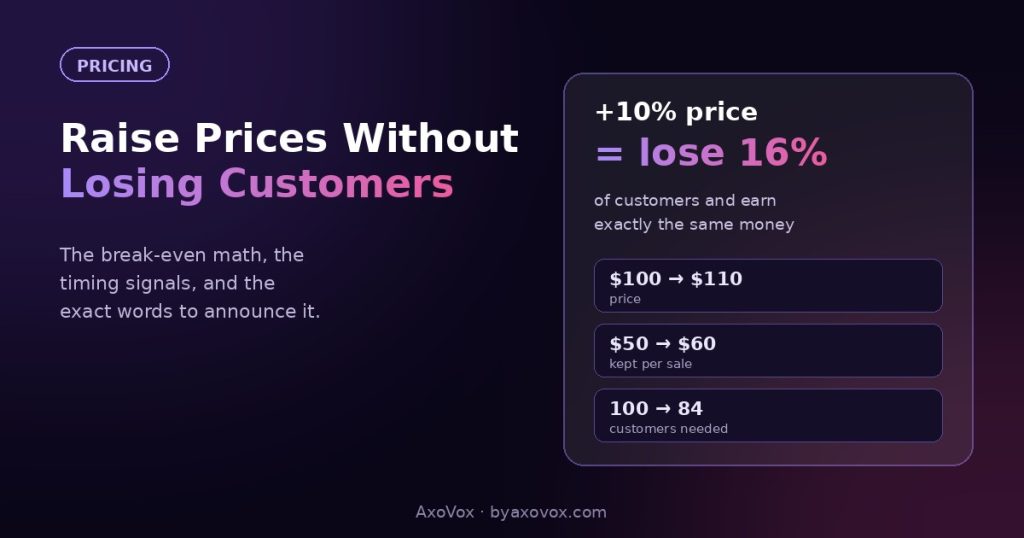 Raise prices, lose customers — fair fear, wrong math. At 50% margins, a 10% raise lets you lose 16% of your customers and earn exactly the same money. The break-even math, the five timing signals, and the copy-paste announcement email.
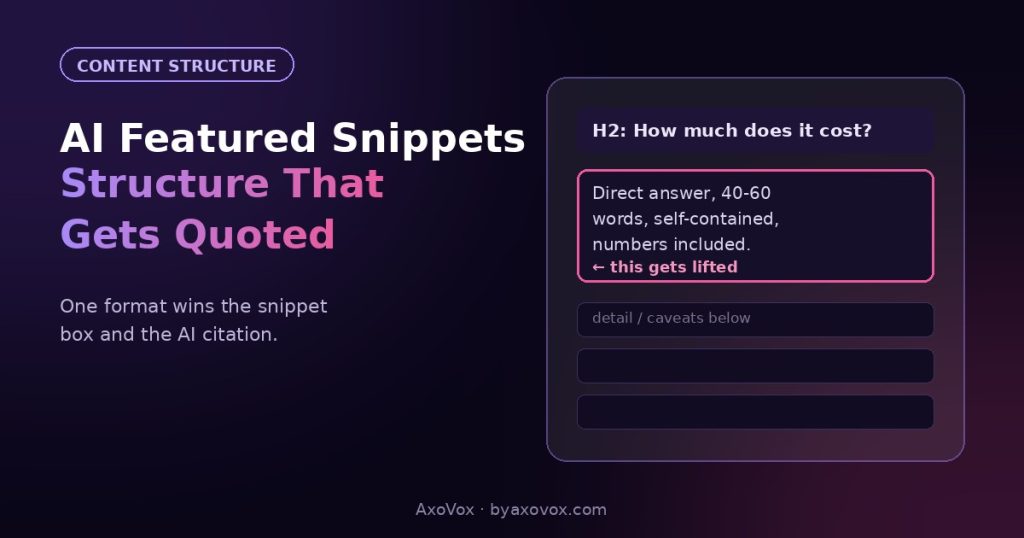 Featured snippets and AI citations get filled by the same hunt: a machine looking for a passage it can lift cleanly. One structural discipline wins both. Here’s the exact format, with a before-and-after you can copy.
 Every AI tool list assumes you have a marketing team and a big budget. You don’t. Here’s the spending order that actually fits a small business: what’s free and genuinely enough, what the first $50 should buy, and why nothing past $100 deserves your money without proof.
 There’s no language setting inside AI Mode. It follows your Google Search language. Here’s the 30-second fix on desktop and mobile.
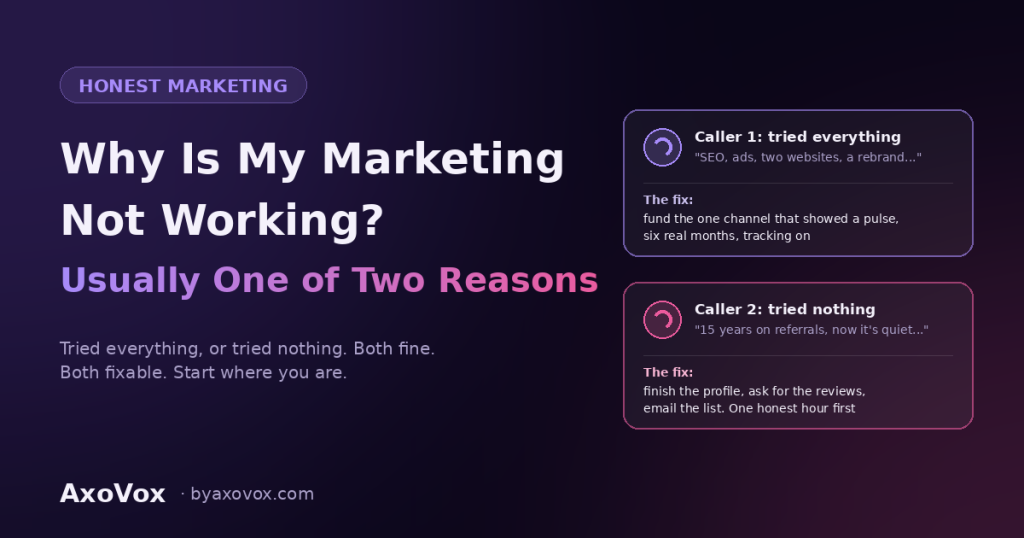 Two kinds of businesses call us: the ones who tried everything and nothing worked, and the ones who tried nothing and know it. Both fine. Both fixable. But they need opposite first moves, and the one thing they share is believing their situation is uniquely bad. It isn’t. Here’s where each one starts.
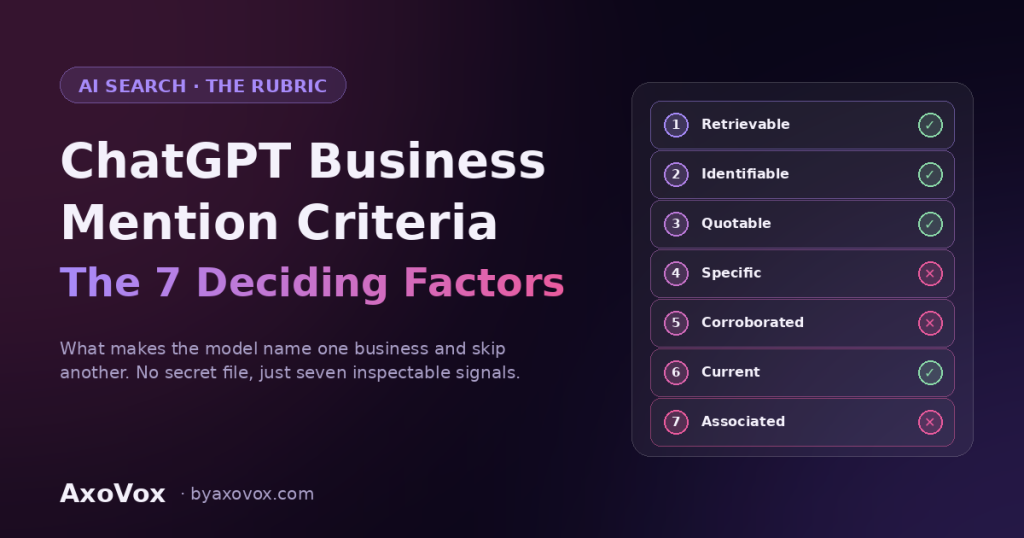 No secret ranking file decides which businesses ChatGPT names — just seven inspectable criteria: retrievable, identifiable, quotable, specific, corroborated, current, and associated. What each one weighs, a self-check for every one, and the four things people think matter that don’t.
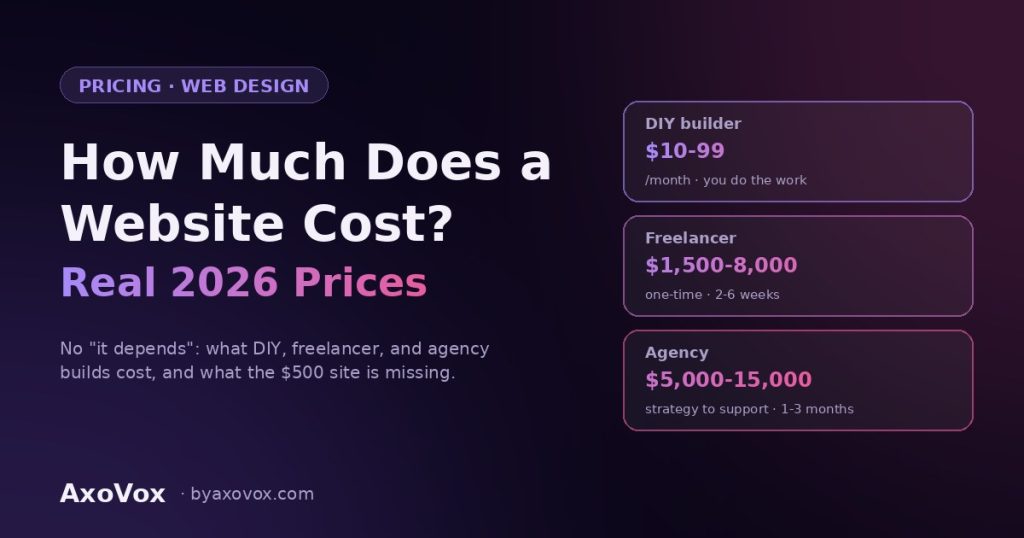 A small business website in 2026 costs $10-99 per month on a DIY builder, $1,500-8,000 one-time with a freelancer, or $5,000-15,000 with an agency, plus $1,000-6,000 per year in running costs almost nobody budgets for. Everyone asks this question, every provider answers “it depends,” and both sides leave annoyed. So here are the actual numbers,… Read more: How Much Does a Website Cost in 2026? (Real Prices)
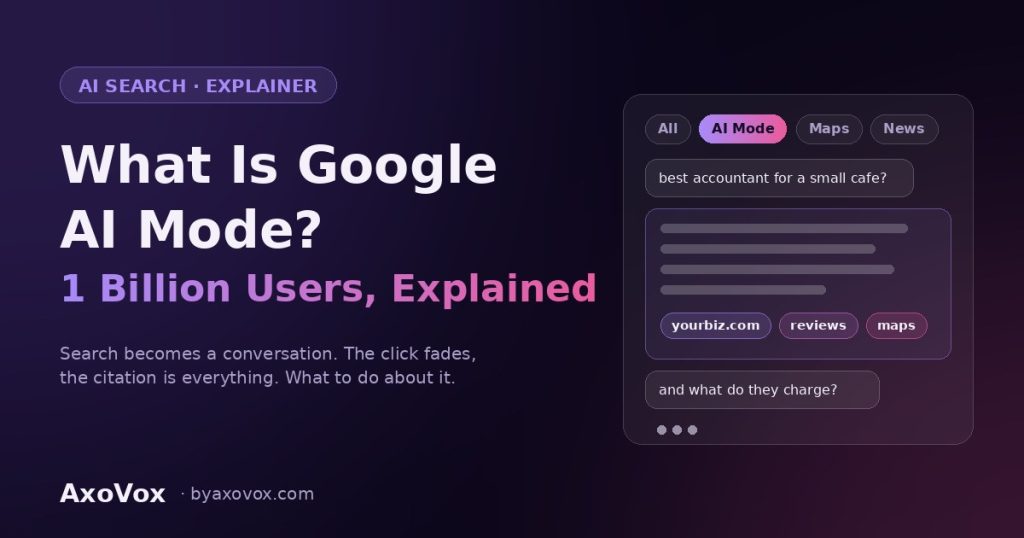 Google AI Mode passed a billion users: search as a conversation, with Google’s index behind it. What it is in plain language, how it differs from AI Overviews, why ‘position 3’ no longer exists in an AI answer, and the work that gets your business cited before competitors notice the window.
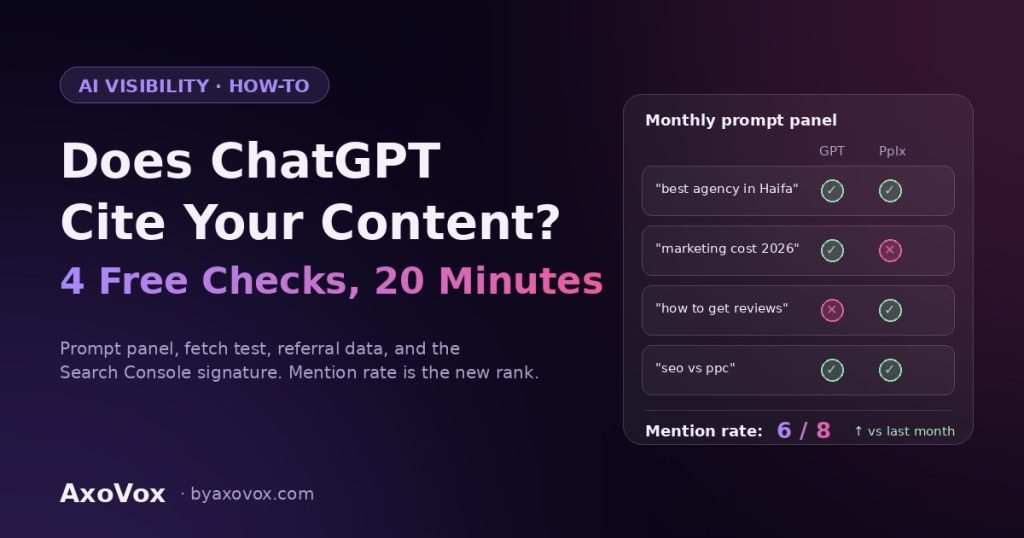 Whether ChatGPT and Google AI cite your content stops being a mystery in twenty minutes a month: a ten-prompt panel, a two-minute fetch test, the GA4 referral report, and the Search Console signature. Four free checks, and what each result tells you to fix.”
 One marketer with AI is a boost; a whole team without a system is five subscriptions, five voices, and one confused audience. The team layer that fixes it: one shared brief, a prompt library, the one-sentence review rule, and the 30-day rollout that sticks.”
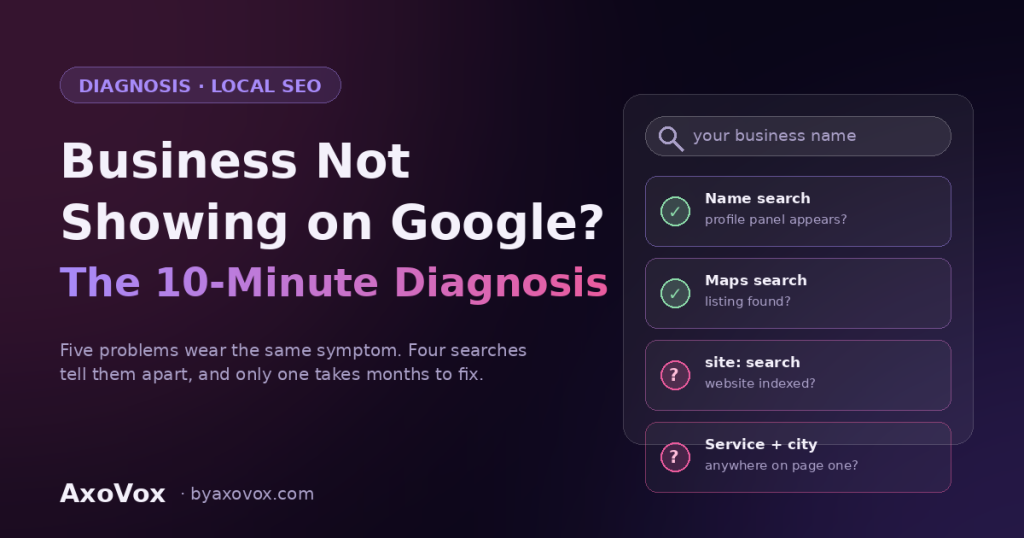 Not on Google’ is five different problems wearing one symptom: not indexed, buried, a Business Profile issue, the proximity filter, or testing wrong. Four searches tell them apart in ten minutes, and only one of the five takes months to fix.”
 Email returns $36-42 per dollar and most small businesses still don’t have a list, because ‘the newsletter someday’ never survives a busy week. The actually-starting version: one free tool, one magnet worth an address, three welcome emails written once, and a twenty-minute monthly habit.
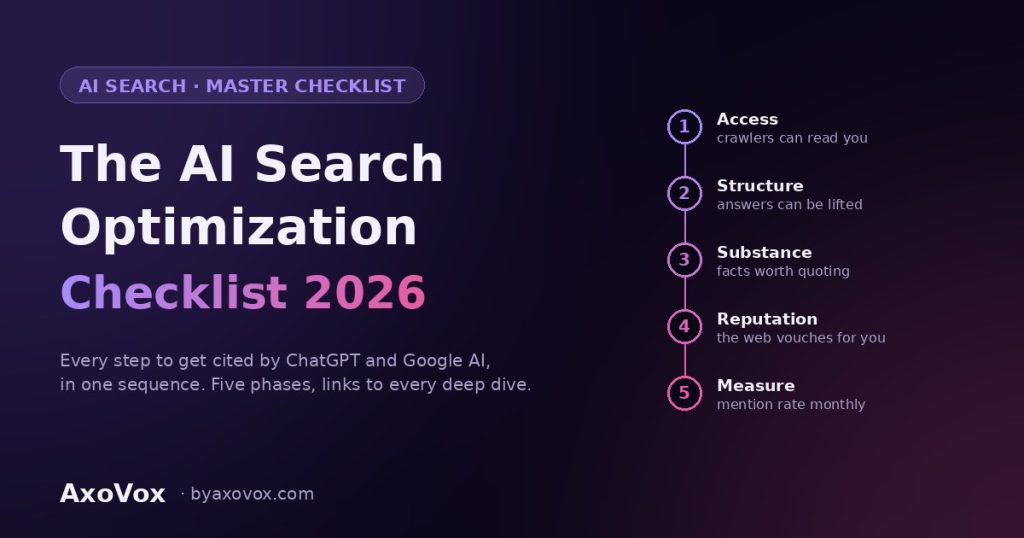 Every step to get cited by ChatGPT, Perplexity, and Google AI, in one sequence: crawler access, liftable structure, facts worth quoting, the reputation models trust, and the monthly measurement that proves it’s working. Five phases, with links to the deep dive on each.
 Here’s the strange thing about ChatGPT and small business marketing: 58% of small businesses now use generative AI, content and marketing is the #1 use case — and almost everyone is using it at maybe 20% of its capability. We know because we see the inputs: one-line prompts, zero business context, first draft published. Then… Read more: How to Use ChatGPT for Marketing: What Actually Works (2026)
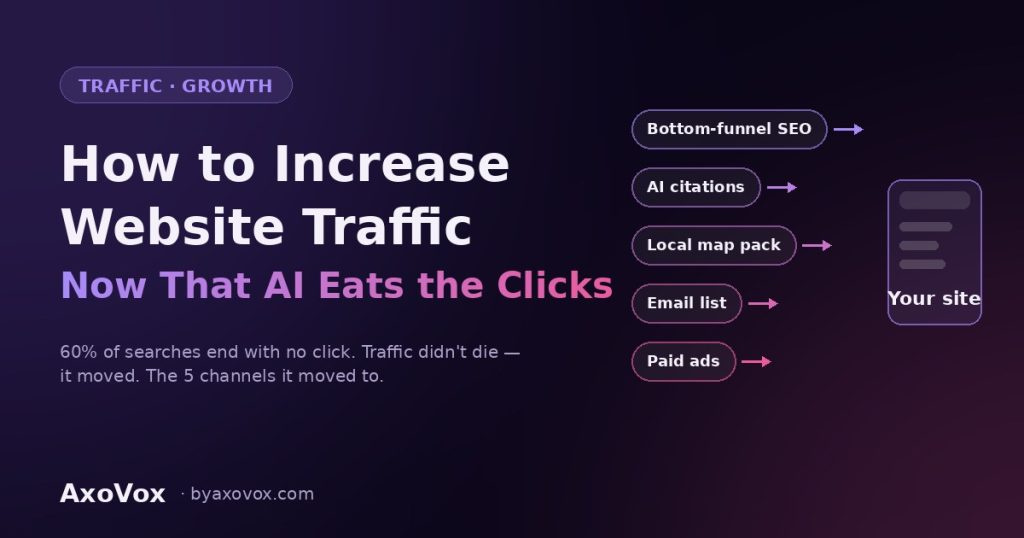 60% of searches now end with no click — the old traffic playbook is dying while it’s still being sold. Where traffic actually comes from in 2026: the clicks AI can’t take, AI citations, the local map pack, email you own, and paid you control.”
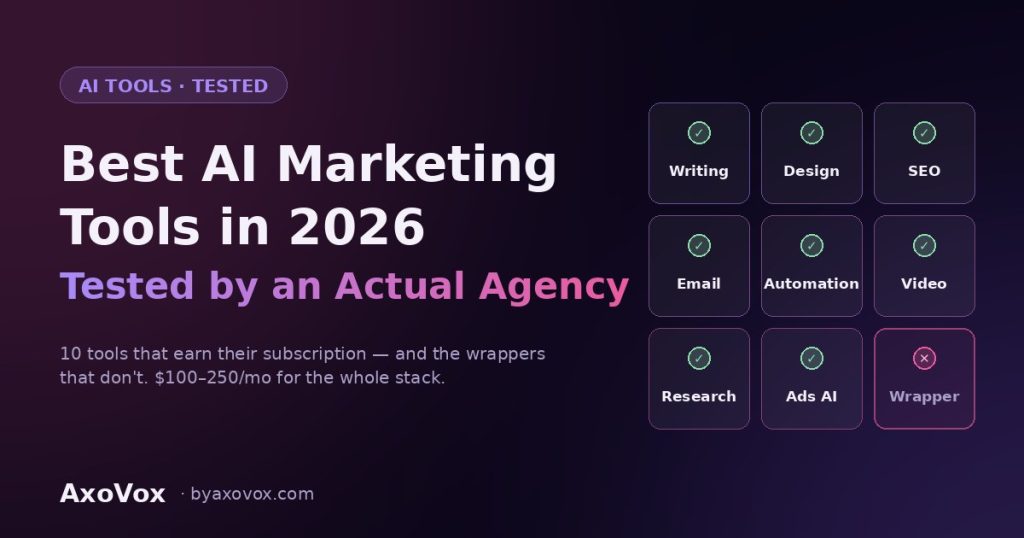 We run an agency, which means we test every ‘game-changer’ AI tool clients forward us. Most are wrappers. These ten aren’t – the full stack, real prices ($100–250/mo total), the free ones nobody uses, and the category we refuse to buy.
 Every ‘free’ marketing idea pays in hours, so this list is ranked by payoff-per-hour, not padded to fifty. The four that matter most, eleven amplifiers, and the free stuff we’d skip. Zero dollars, honestly priced.
 46% of Google searches are local and the map pack takes 44% of the clicks. The full 2026 checklist, ordered by ranking weight: Business Profile, reviews, citations, local content, community links — and the AI answers now covering most local searches.”
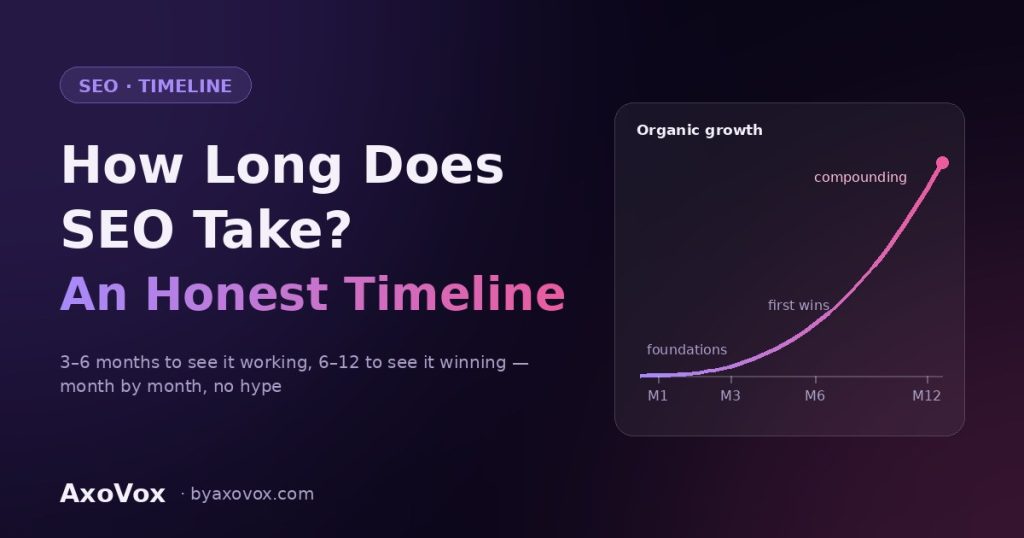 3–6 months to see it working, 6–12 to see it winning, 12+ for competitive terms — the honest month-by-month SEO timeline, what speeds it up, the new AI-citation fast lane, and what a ’30-day guarantee’ really means.”
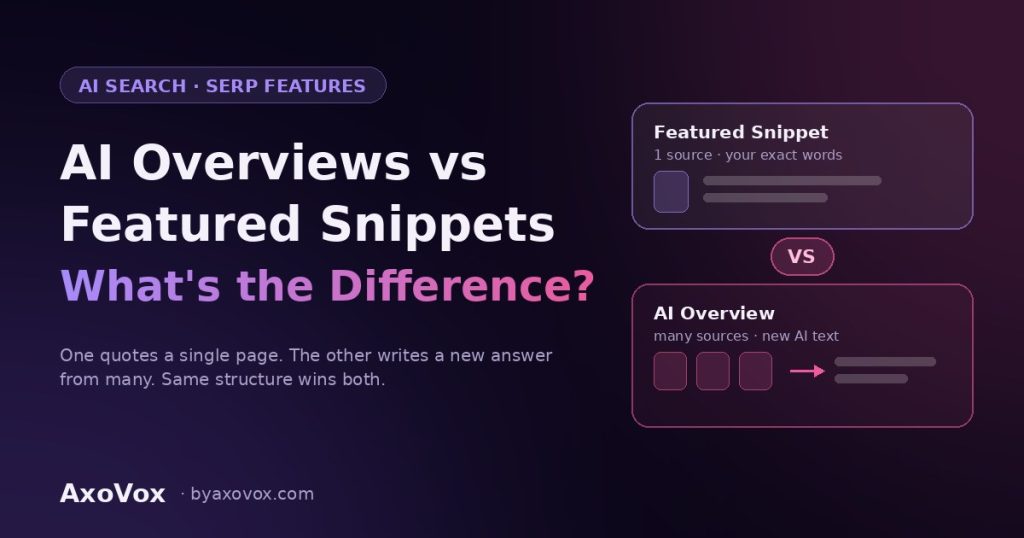 Featured snippets quote one page word-for-word; AI Overviews write a new answer from many sources — and in 2026 they show up on nearly half of all searches, commercial queries included. How each feature works, which sends more traffic, and why the same content structure wins both boxes.
 The businesses with the most Google reviews aren’t luckier, they ask more people, at the right moment, with a link that takes one tap. That’s the whole system: ask everyone, ask at peak happiness, remove every step between “sure” and “posted.” Below is the exact ask, the timing, what’s illegal (more than you’d think), and… Read more: How to Get More Google Reviews
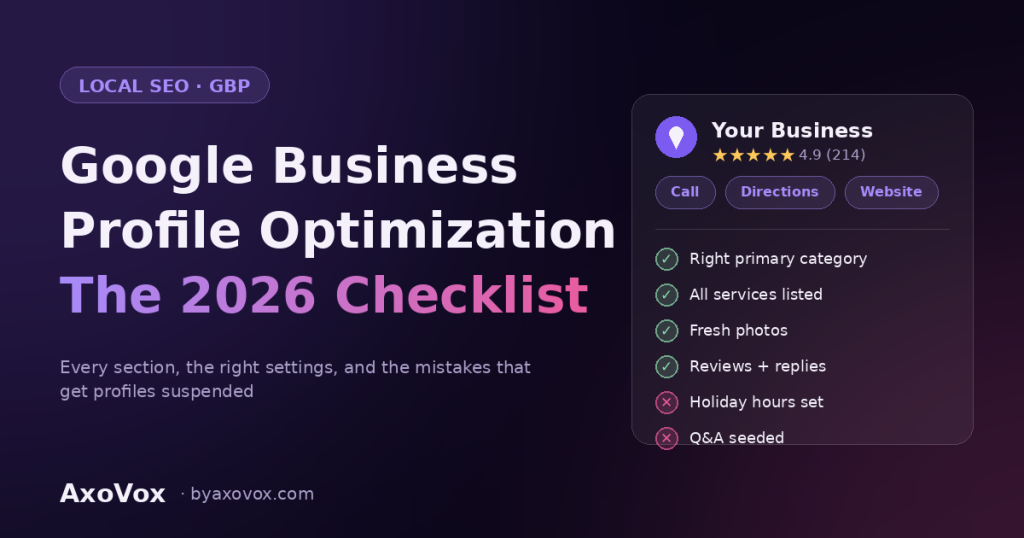 Your Google Business Profile decides who wins the map pack — and most profiles are barely half-finished. This 2026 checklist covers every section in working order: categories, services, photos, reviews, Q&A, and the settings that get profiles suspended. Fifteen minutes a month keeps you ahead of nearly every competitor in your city.
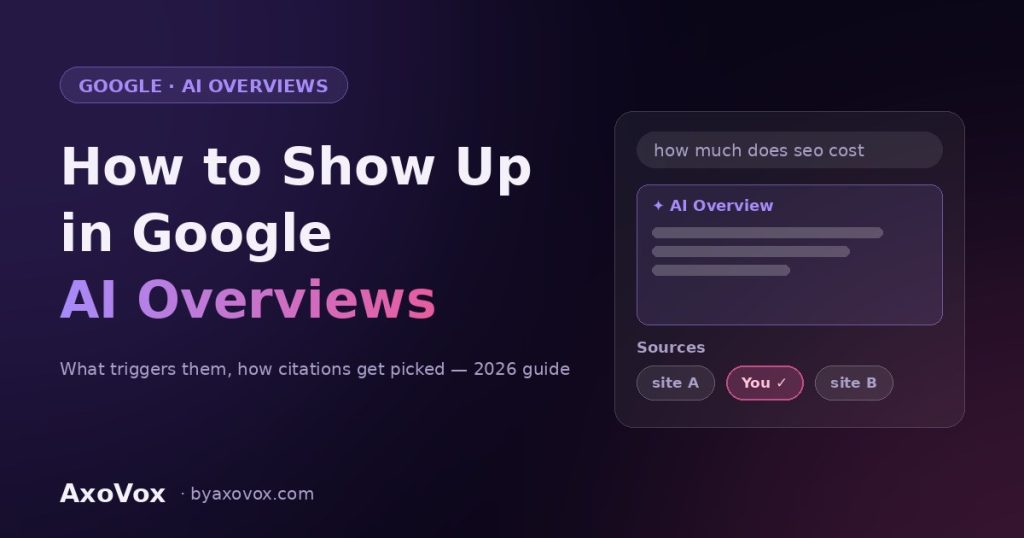 Google’s AI Overviews don’t just summarize the top 3 results — they pull quotable passages from across the index, which means being citable can beat being top-ranked. This playbook covers what triggers an Overview, how Google picks its sources, and the six steps that get your pages into the box: liftable answers, schema, freshness, and the authority signals that separate you from content-mill sludge.
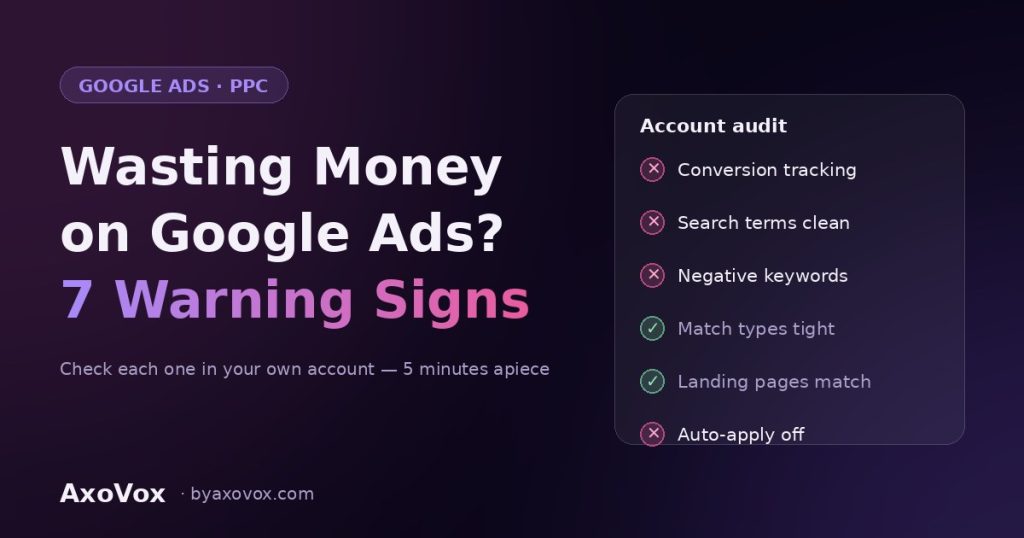 Most wasted ad spend hides in the same five places — and every one is visible inside your own account. These seven signs come with the exact click path to check each: conversion tracking, junk search terms, stale negatives, unsupervised broad match, homepage landing pages, auto-apply, and reports that brag about clicks. Twenty minutes tells you where your budget is going.
 An honest answer from an agency: when hiring one is worth $1,500+/month, when a freelancer beats one, and when you should keep your money and do it yourself. Includes the founder-time math nobody does, the four signs you shouldn’t hire anyone yet, and the five questions to ask before signing any contract.
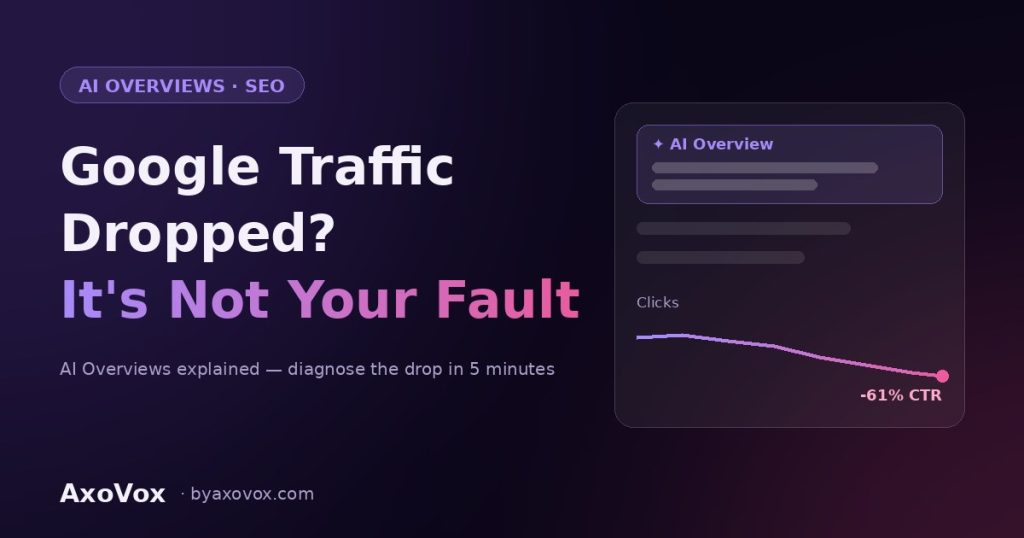 Rankings stable but clicks falling? That’s the AI Overviews signature. First rule out the boring causes — broken tracking, technical issues, seasonality — then run the 5-minute Search Console diagnosis that confirms where your clicks went. Plus the four moves that win them back, and the four panic reactions to avoid.
 Rankings stable but clicks falling? That’s the AI Overviews signature. First rule out the boring causes (broken tracking, technical issues, seasonality), then run the 5-minute Search Console diagnosis that confirms where your clicks went. Plus the four moves that win them back, and the four panic reactions to avoid.
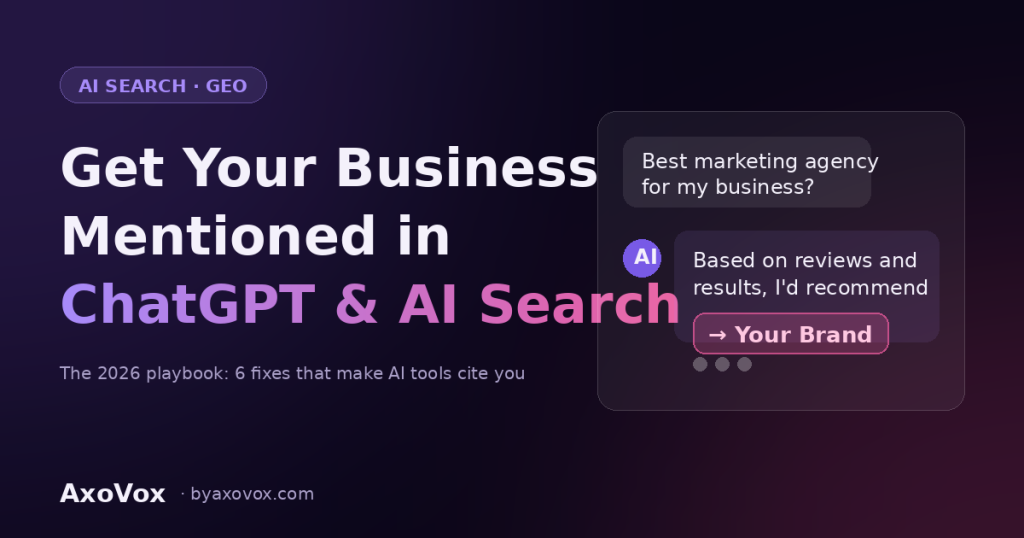 AI tools recommend some businesses and ignore the rest. Here’s why: crawler access, answer-first structure, third-party mentions, and freshness decide who gets cited by ChatGPT, Perplexity, and Google AI. The six fixes in order, from a 30-minute robots.txt check to the earned mentions that do the heavy lifting.
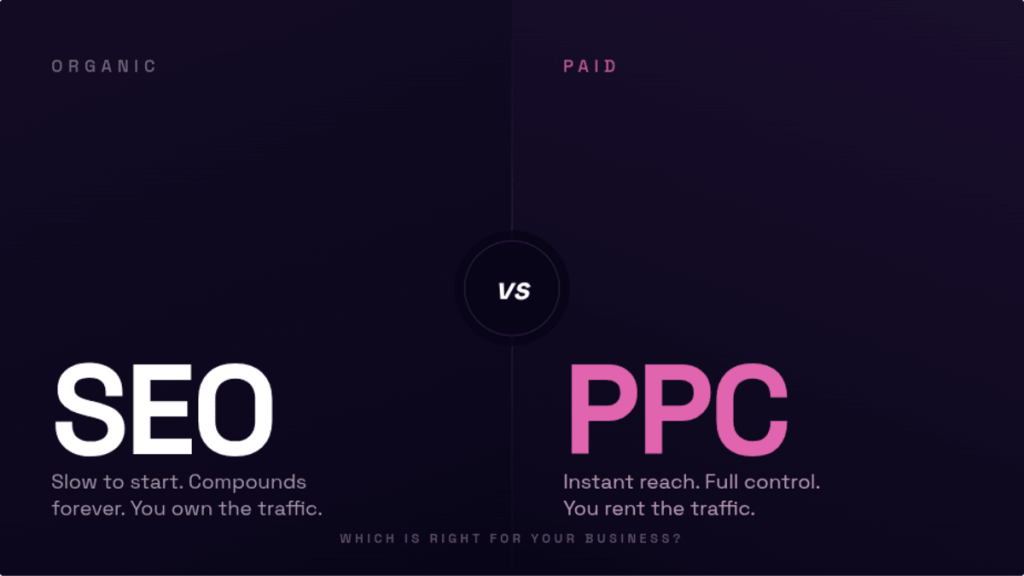 PPC buys traffic today; SEO builds traffic that compounds. When to choose which, what each actually costs, the 2026 twist (AI Overviews cutting clicks on both), and why the strongest strategy runs the two together instead of picking a side.
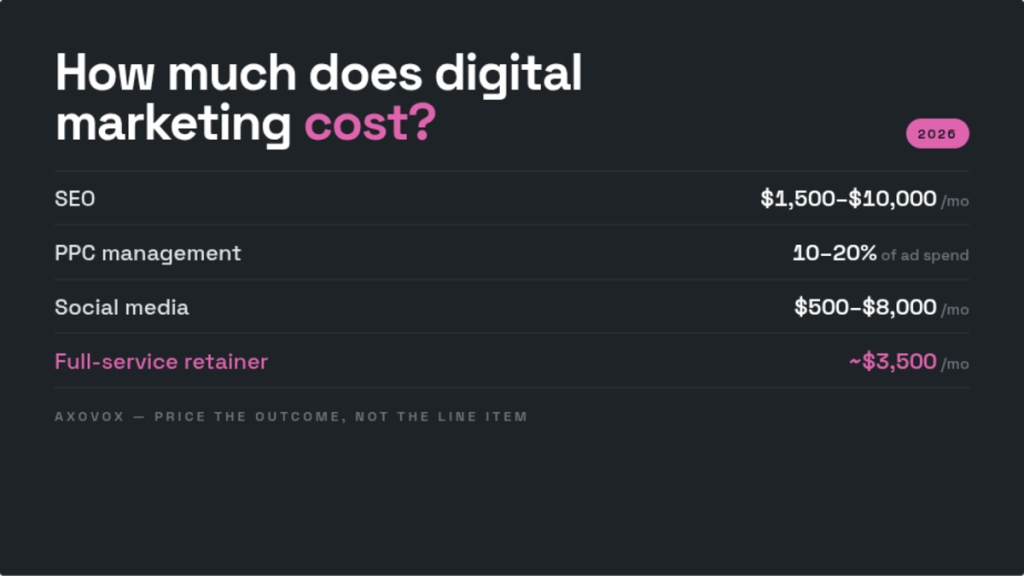 Most small businesses spend $1,500-$5,000 a month on digital marketing, and almost nobody publishes the numbers. Real 2026 ranges for SEO, ads, social, and email, how to size your budget with the SBA’s 7-12% revenue rule, and why the $500 “full-service” agency is the most expensive thing you can buy.
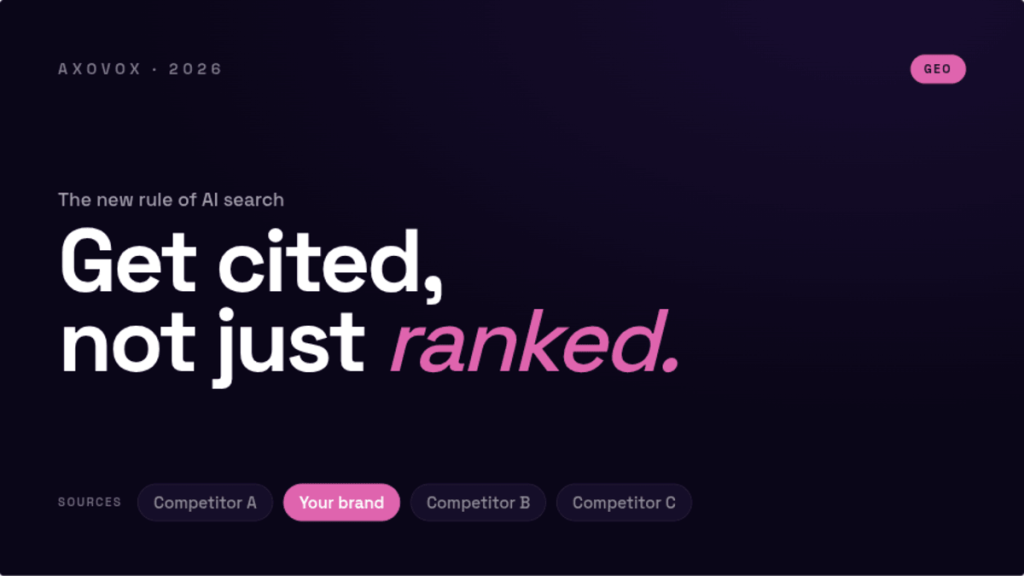 A growing share of buyers ask ChatGPT or read Google’s AI summary and act on whatever it recommends, without clicking anyone’s site. If your brand isn’t in that answer, you don’t exist for that buyer. What generative engine optimization actually is, how AI decides who to cite, and the checklist that puts you in the answer.
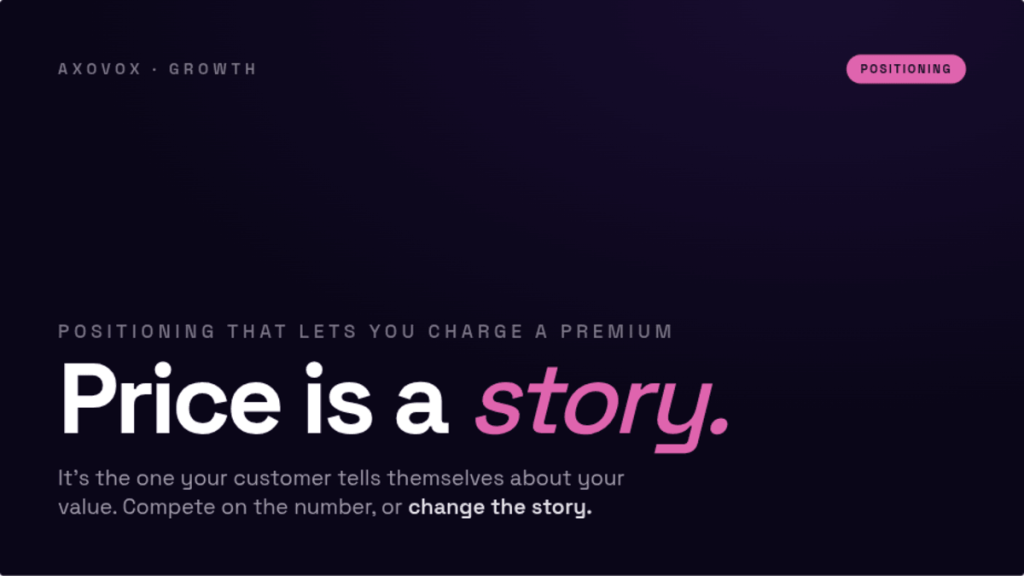 Two businesses sell the same thing; one charges triple and has a waitlist. The difference isn’t the product, it’s the story. Why you’re probably underpriced, the math behind it (a 1% price increase lifts profit ~8%), and the positioning that lets you raise prices and lose only the customers you never wanted.
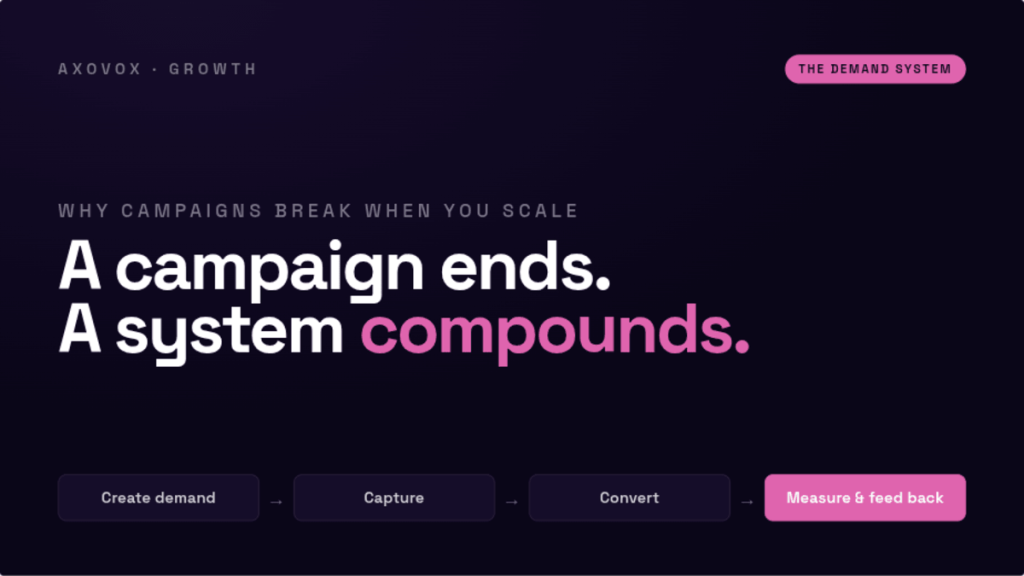 Most brands don’t have a marketing problem, they have a marketing collection problem: disconnected tactics that each worked once and none of it compounds. Why campaigns break exactly at the moment you scale, the 95:5 rule behind it, and the four-job system that gets cheaper the longer it runs.
 Half the ‘free’ AI tools are trials wearing a costume. The four flavors of free, the six tools that survive 30 days of real use, the $0 stack that runs a small business’s marketing, and the friction rule for when paying starts making sense.