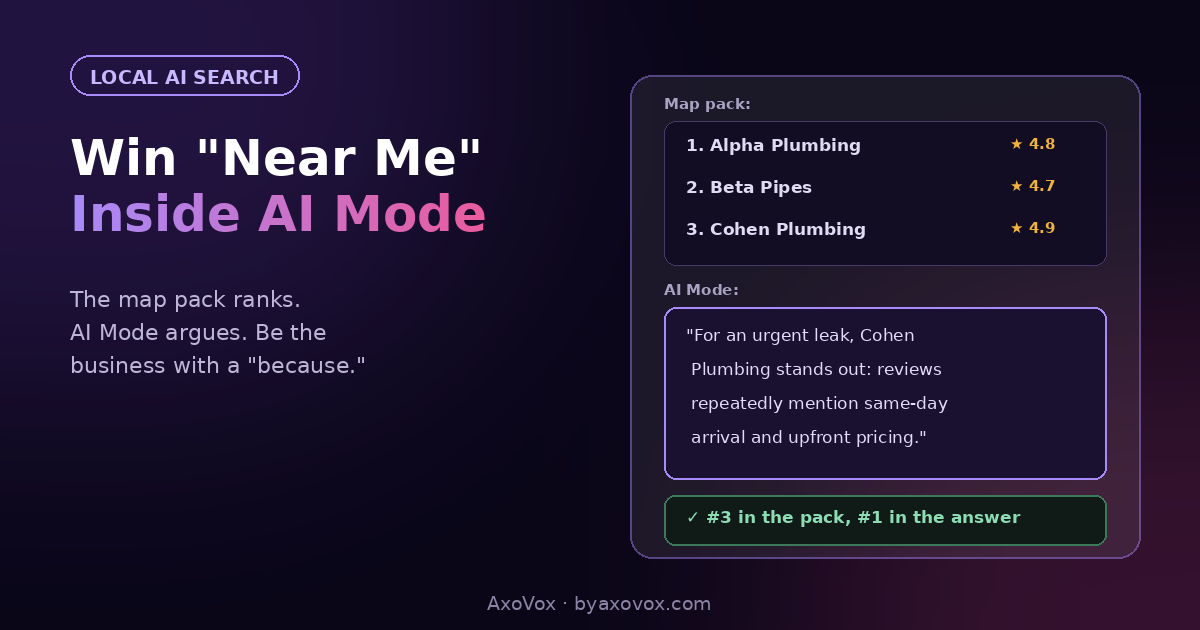
For fifteen years, winning “plumber near me” meant one thing: crack the map pack’s three spots. Now a billion people can ask the same question inside AI Mode, and the answer comes back different: two or three businesses, named in a paragraph, with reasons attached. “X is well-reviewed for emergency work; Y is noted for transparent pricing.” Sometimes the map-pack winners. Often not.
The difference isn’t cosmetic, it’s mechanical. The map pack ranks; AI Mode argues. The pack orders businesses by the classic trio, proximity, prominence, relevance, and shows a list. AI Mode fans the question out into sub-queries (who’s open now, who handles emergencies, who’s well-reviewed for X, what do people say about pricing), reads profiles, reviews and websites as evidence, and then writes a recommendation it can justify. Which creates the opening: a business the pack ranks third can be the AI’s first pick, if the evidence for a specific reason is stronger. The pack rewards standing; AI Mode rewards being the answer to a “because.”
Here’s how it picks, and how to become pickable.
See your local verdict (5 minutes)
Open AI Mode and ask like a real customer, three ways: “best [service] near me” (with location on), “[service] in [city] open now”, and one with a constraint: “[service] in [city] that’s good with [older buildings / urgent jobs / fair pricing]”. Note who gets named and, crucially, the reason attached to each name. Those reasons are the sub-queries being won, your competitors’ and, where you’re absent, the ones you’re losing.
What AI Mode weighs that the pack doesn’t (much)
- Review TEXT, not just review math. The pack counts stars and volume; the AI reads the sentences. “Came at 11pm and fixed it in an hour” is retrievable evidence for the emergency sub-query; forty unadorned 5-star ratings are mostly silence.
- Your pages as testimony. A service page that states prices, response times and service areas gives the AI quotable facts; a “Welcome to our website” page contributes nothing to any sub-query.
- Attributes and specifics. Open-now hours, services listed on the profile, the Q&A section, all readable claims the answer can lean on.
- Justifiability. The AI must write a reason. Businesses that are demonstrably good at something specific are easy to justify; businesses that are generically fine are hard to write about, and get skipped for someone with a sharper story.
What still matters from the old world: a verified, complete Business Profile, real proximity, and review recency. The foundation didn’t change; the judge did.
Becoming the pick, step by step
Step 1: choose your “because” (30 minutes, once)
- Pick the one or two constraints you genuinely win: fastest emergency response, transparent pricing, old-building expertise, gentle-with-kids, whatever’s true. The AI recommends along dimensions; own one
- Audit your current evidence for it: does anything public actually SAY it? Usually the answer is “we’re great at this and nothing on the internet mentions it”
Step 2: seed the evidence (the review layer)
- Change your review ask from “please leave a review” to “if you can, mention [what we did], it helps people with the same problem find us.” Specific asks produce the sentences AI retrieves, and they survive the filters better too
- Respond to reviews echoing the dimension naturally (“glad the same-day visit helped”), responses are indexed text on the profile, and the templates make it a ten-minute weekly habit
Step 3: seed the evidence (your pages)
- Build or rewrite the service page to answer the local sub-queries in liftable form: price ranges, response time, exact service areas, “what happens when you call”, each under its own question heading with the answer in sentence one, the fan-out structure applied locally
- State the “because” in plain text on the page and in the profile description. Machines can’t infer your specialty from vibes
- Fill the profile’s services, attributes and Q&A; every filled field is one more retrievable claim
Step 4: verify monthly (5 minutes)
- Re-run the three questions from the purple box, log who’s named and for what reason
- When a competitor owns a reason, read their evidence (their reviews and pages will show it) and decide: contest that dimension or double down on yours
The honest part: proximity and profile health still gate everything
AI Mode’s local answers draw on the same Google local data the pack uses, so the old fundamentals are entry requirements, not optional: a suspended or thin profile, wrong categories, or a location genuinely far from the searcher keeps you out of consideration before any evidence is read. The new game is played AFTER the old game qualifies you, which is also the good news: most of your local competitors stopped at qualifying, and nobody in the average market has built reason-level evidence yet. First mover on the “because” usually owns it for a long while.
If you’re still not named
The pack shows you, AI Mode doesn’t. The classic gap: standing without evidence. Your reviews are stars without sentences and your pages are brochures. Steps 2-3 are precisely this fix.
AI Mode names you but for the wrong thing, or with stale facts. It’s reading old evidence; find and fix the source, the same origin-hunt as wrong AI facts generally.
A worse-rated competitor keeps being picked. Read the reason the AI gives them: they’ve won a sub-query with explicit evidence. Beat the evidence, not the rating.
You serve an area without a storefront. Service-area businesses compete fine, but the pages must carry the geography (“serving X, Y and Z, typical arrival 45 minutes”), since there’s no pin doing the talking.
Different people get different answers. Expected: location, time of day and phrasing shift the fan-out. Judge trends across your monthly checks, not any single answer.
The one-line strategy
The map pack asks “who ranks here?”; AI Mode asks “who can I justify?” Be the business with a true, specific, publicly-evidenced “because”, in review sentences, on liftable pages, across a complete profile, and you’re not gaming the answer, you’re supplying it. That’s the whole edge, and in most local markets right now, it’s sitting unclaimed.
Common questions
How does AI Mode choose local businesses for “near me” questions?
It fans the question into sub-queries (open now, good for emergencies, fair pricing), reads profiles, review text and business websites as evidence, and names two or three businesses with reasons attached. It draws on Google’s local data, so proximity and profile health gate entry, but the picks are justified by specific evidence rather than rank order.
Is ranking in the map pack the same as being recommended by AI Mode?
No. The pack orders by proximity, prominence and relevance; AI Mode writes a justified recommendation. Pack winners with generic evidence are routinely skipped for a lower-ranked business that demonstrably owns a specific reason, and vice versa.
Do Google reviews affect AI Mode recommendations?
Strongly, and differently than before: the AI reads review text, so sentences describing specifics (“came at 11pm”, “quoted exactly what it cost”) become retrievable evidence, while bare star ratings contribute much less. Asking customers to mention what you did is the highest-leverage change.
How do I optimize my website for local AI search?
Answer the local sub-queries in liftable form on your service pages: price ranges, response times, exact service areas and process, each under a question heading with the answer first. State your specialty in plain text; machines can’t infer it.
Can a service-area business without a storefront win in AI Mode?
Yes, with the geography carried explicitly in text: areas served, typical arrival times, and local review evidence. Without a pin, the pages and reviews do the locating.
Why do AI Mode’s local answers change between searches?
Location, phrasing and time shift which sub-queries fire and which evidence wins them. Evaluate monthly trends across consistent test questions rather than any single answer.