You wrote a solid page for “bathroom renovation cost.” Google’s AI Mode answers that question every day, cost ranges, timelines, what affects the price, when to hire whom, and quotes four other sites while your page sits in the classic results below, unquoted. The frustrating part: your page covers the topic. So why does the AI keep shopping elsewhere?
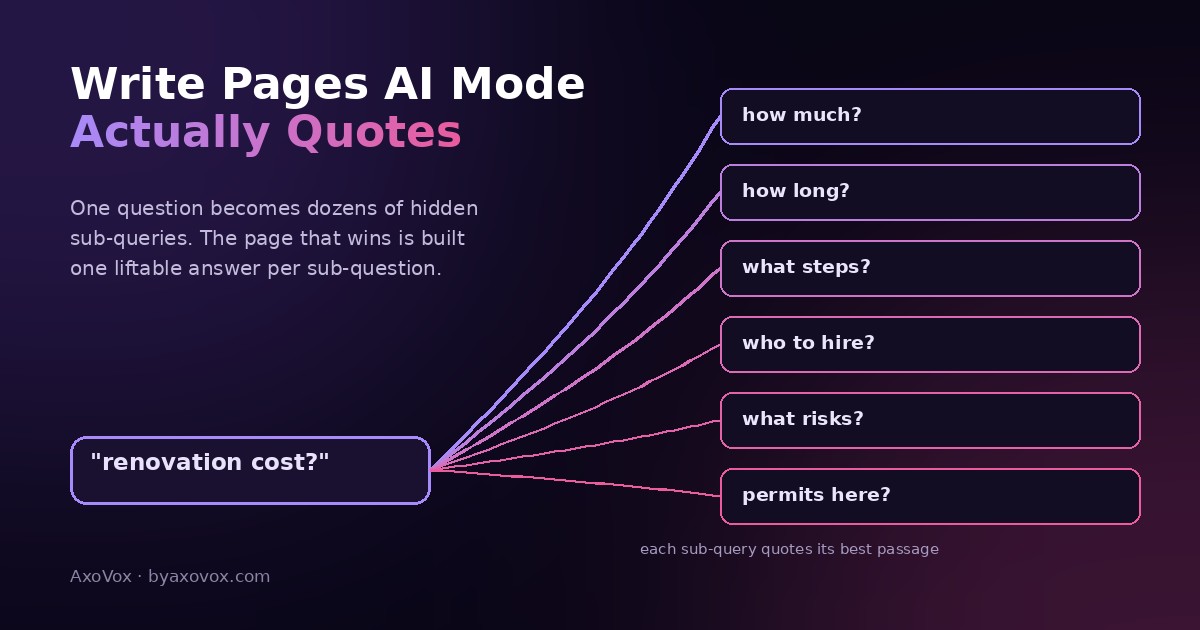
Because AI Mode doesn’t search the way your page was written for. When someone asks it a real question, Google’s systems run what they officially call query fan-out: the question is decomposed into multiple sub-queries, sometimes dozens, issued simultaneously across the index, one hunting cost data, one hunting timelines, one hunting risks, one hunting local factors. Then the AI assembles its answer from the best passage it found for each sub-query, and cites whoever supplied each piece.
Read that again, because it’s the whole strategy: the unit of competition is no longer the page. It’s the passage. Your page isn’t competing to answer “bathroom renovation cost”; it’s competing, section by section, to be the best answer to each hidden sub-question. A page built as one flowing essay gives the fan-out nothing to grab. A page built as a set of self-contained answers gives it a dozen hooks. Here’s how to build the second kind.
See the fan-out with your own eyes (5 minutes)
Open AI Mode and ask your money question the way a customer would: “how much does [your service] cost in [city] and how do I choose someone good?” Now read the answer structurally: notice it has facets, a cost part, a timing part, a how-to-choose part, a warnings part, each often citing a different source. That facet list IS the fan-out, made visible. Screenshot it: you just captured the sub-questions your page needs to win.
Step 1: map the sub-questions before writing a word
Build the fan-out map (30 minutes, once per topic)
- Start from the buyer’s real question, then write every sub-question it implies. For any service topic the same families recur: cost (ranges, what changes the price, cheap vs expensive), time (how long, what delays it), process (steps, what happens first), choice (how to pick, red flags, DIY vs pro), risk (what goes wrong, guarantees), local (permits, prices here, who serves this area)
- Harvest what Google already reveals: People Also Ask boxes and autocomplete for your topic are fan-out fragments in plain sight
- Ask the machine to draft its own homework: prompt AI Mode or ChatGPT with “what sub-questions would you research to answer [the question] thoroughly?” The output maps surprisingly close to the real fan-out
- Pick the 8-12 sub-questions a real buyer cares about. That’s your page outline, done
Step 2: write each section as a liftable chunk
- One H2 or H3 per sub-question, phrased the way people ask it (“How long does a bathroom renovation take?”), not cleverly (“The timeline tango”)
- First sentence under each heading = the direct answer, with a number or concrete fact in it. Explanation after, never before. The AI lifts openers; buried answers don’t get excavated
- Make every section survive being read alone. The fan-out retrieves passages out of context: a section that says “as mentioned above, this depends” is dead on arrival; a section that restates its subject and answers it is quotable
- Concrete beats eloquent everywhere: ranges, timeframes, prices, counts. Synthesized answers are built from facts, and vague sections have none to contribute
Step 3: reinforce and maintain
- Add FAQPage or relevant schema so the structure is machine-legible twice over
- Keep one page deep rather than ten pages thin: fan-out rewards a page that wins many sub-queries at once, and splitting facets into separate thin posts just multiplies your chances of losing each one
- Refresh the numbers on a schedule; sub-queries about cost and “in 2026” favor current pages
- Verify it’s working in Search Console’s Generative AI report: cited pages accumulate AI impressions, and your fan-out pages should climb that table within weeks
The reframe that should change your roadmap
Under fan-out, you don’t need to outrank anyone on the head query to get quoted. The retrieval runs per sub-query, so a page sitting at position 7 for “bathroom renovation cost” can still supply the AI’s timeline paragraph, its permit warning, and its red-flags list, if those sections are the best passages for those sub-questions. We’ve watched exactly this on our own pages: the answer-first sections get cited while bigger sites’ vaguer pages get skipped. Small sites can’t out-authority giants, but they can absolutely out-structure them, and fan-out is the mechanism that pays structure. The full pattern library is in our content structure guide.
If your page still isn’t quoted
You cover everything but never get cited. Re-read your sections coldly: is the answer in sentence one, or three paragraphs in? Is each section self-contained? Coverage without extractability is the classic miss, and it’s a rewrite of openers, not a rewrite of the page.
A worse site keeps getting quoted over you. Check what their cited passage does that yours doesn’t: usually a cleaner direct answer, a fresher date, or a concrete number where you have prose. Beat the passage, not the site.
Simple queries never show your page in AI answers. Expected: simple factual questions may not trigger much fan-out at all. Your fan-out pages win on the complex, multi-part questions, which happen to be the buyer-intent ones anyway.
Worried that answering 12 sub-questions on one page cannibalizes your other posts. Sections and pages play different games: the deep page competes in fan-out retrieval; dedicated posts still win their own full queries. Interlink them and they reinforce, the hub-and-spoke logic of the AI Mode explainer‘s ecosystem.
Cited last month, gone this month. Answers rebuild constantly and competitors publish. Refresh numbers, add the sub-question you’re missing (read the current AI answer to find it), and re-request indexing.
The one-sentence version of this whole article
Every heading a real sub-question, every first sentence a real answer, every section able to stand alone, every claim carrying a number, and everything on one deep page: that’s writing for the fan-out, and it’s the closest thing to a mechanical advantage a small site has in AI search. It also, not coincidentally, produces pages humans actually enjoy using, which is why this isn’t a trick that will expire with the next update.
Common questions
What is query fan-out in Google AI Mode?
Google’s official technique of decomposing one question into multiple sub-queries, sometimes dozens, issued simultaneously across its index and data systems, then synthesizing the best-retrieved passages into a single cited answer. Complex questions fan out extensively; simple factual ones may not.
How do I optimize a page for query fan-out?
Map the sub-questions a buyer’s query implies (cost, time, process, choice, risk, local), give each its own question-phrased heading with a direct, number-bearing answer in the first sentence, make sections self-contained, add schema, and keep the coverage on one deep page rather than several thin ones.
Do I need to rank #1 to be quoted in AI Mode?
No. Retrieval runs per sub-query at passage level, so a mid-ranking page can supply the AI’s answer for specific facets if its sections are the best passages for them. Structure and directness routinely beat raw authority on individual sub-questions.
How do I find the sub-questions AI Mode uses?
Ask your question in AI Mode and read the answer’s facets, harvest People Also Ask and autocomplete, and prompt an AI directly with “what sub-questions would you research to answer this thoroughly?” Between the three, you’ll map the meaningful fan-out.
Is one long page better than several short posts for AI search?
For a single buyer question, yes: fan-out rewards one page winning many sub-queries simultaneously, while thin single-facet posts each fight alone. Keep dedicated posts for topics that are full questions in their own right, and interlink.
How do I know if AI Mode is quoting my pages?
Search Console’s Generative AI performance report shows impressions your pages earn inside AI Overviews and AI Mode; rising impressions on a rebuilt page is the confirmation. Manual spot-checks of the live answers complete the picture.