Featured snippets and AI answers look like different features. One is the box Google has shown for a decade; the other is the new generative layer in AI Overviews and ChatGPT. But they get filled the same way: a machine scans pages for a passage it can lift cleanly, and quotes the one that needs the least surgery. Which means one structural discipline earns you both, and most business content fails it for the same reason, the answer is buried.
The stakes grew while nobody was watching. Around 60% of Google searches now end without a click, and the #1 organic position’s clickthrough has slid from 31.7% to about 23.4% on queries where AI answers appear. The clicks that remain increasingly go to whoever is quoted inside the answer. This guide is the structure that gets you quoted, with before and after examples you can copy.
What both systems are scanning for
Strip away the branding and both features run the same hunt: find a passage that answers the query, in a format matching the query’s shape, from a page credible enough to cite. Three format cues decide most picks.
Proximity. The answer sits directly under a heading that restates the question. Not four paragraphs of context first. Machines read heading, then next block; if the answer isn’t there, they move to a page where it is.
Shape match. “What is” questions get quoted from definition paragraphs of 40-60 words. “How to” queries get lifted from numbered steps. “Best” and “vs” queries get pulled from lists and comparison tables. Write the answer in the shape the question implies, and you’ve done half the work.
Self-containment. The passage makes sense alone, without the sentences around it. Pronouns pointing backwards (“this approach also…”) break lifting; a quoted fragment that starts mid-thought is useless to the machine, so it picks a cleaner one.
The block format, with examples
Here’s the pattern applied to a real question a service business would target.
“Pricing a kitchen renovation involves many factors and every project is unique. At BuildCo, we’ve spent 15 years perfecting our process, and our satisfied clients across the region know that quality comes first. When considering your renovation journey, it’s important to think about materials, scope, and timeline…”
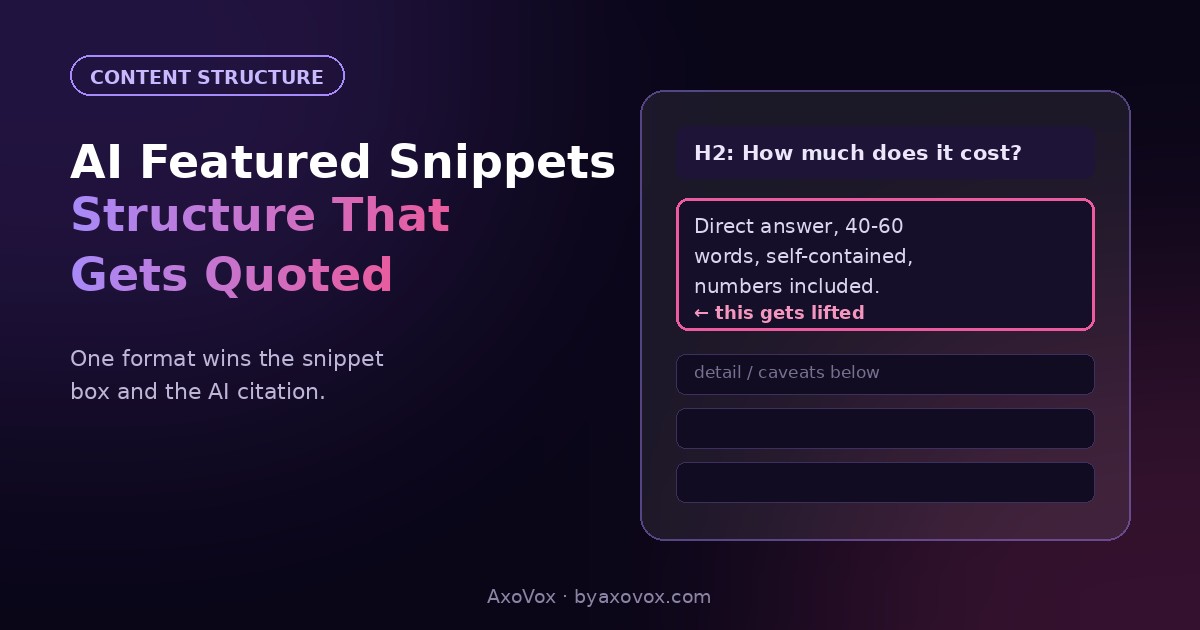
H2: How much does a kitchen renovation cost?
“A mid-range kitchen renovation costs $25,000-45,000 in 2026, covering cabinets, counters, appliances and labor. Budget remodels run $10,000-20,000; high-end projects exceed $60,000. Labor is typically 30-40% of the total.”
Then the detail, the caveats, and the BuildCo process below.
Same information lives on both pages. Only the second is quotable, becuase the answer leads and stands alone. Notice it also serves human skimmers better, which is why this format wins clicks even when no snippet exists.
Restructuring a page without rewriting it
You rarely need new content. Take your highest-traffic informational page and run four edits: turn the implicit questions into literal H2s; move each answer to the first block under its heading; convert any process buried in prose into a numbered list; and add a summary table if the page compares anything. An hour of restructuring routinely outperforms a week of new writing, and it’s the same edit our ranking guide puts near the top of its leverage list.
Then mark it up. FAQPage schema on the question blocks, HowTo on the steps. Schema doesn’t create the snippet, but it confirms to the machine that what looks like an answer is one. Our free tools include a generator that writes the FAQ markup for you.
Where the two systems part ways
The overlap is about 80%, but the differences matter at the margin. Classic featured snippets pull from one page, so it’s winner-take-all and position matters more. AI answers synthesize several sources, so there are more citation slots per query, and corroboration counts: the AI prefers claims other credible sources agree with. AI systems also weight freshness harder, with cited pages skewing heavily toward content updated within two years.
Practically: the structure work above serves both, the evidence work (mentions, reviews, profile signals) mostly serves the AI layer. For the fuller comparison of the two features themselves, see our AI Overviews vs featured snippets breakdown.
Frequently asked questions
Do featured snippets still matter now that AI Overviews exist?
Yes, though differently. On many queries the AI Overview replaced the snippet slot, but snippets still appear on plenty of searches, and the structure that wins them is the same structure AI citations reward. You’re optimizing once for both outcomes.
What’s the ideal length for a snippet-ready answer?
40-60 words for definition-style paragraphs. Steps and lists can be longer overall, but each item should be one clean line. Past 60 words, machines truncate, and truncated answers get picked less.
Does adding FAQ schema guarantee a snippet or citation?
No. Schema is confirmation, not causation. It removes ambiguity about your content’s structure, which raises the odds when your answer is already competitive. Weak answers with perfect markup still lose.
Should I write answers differently for ChatGPT than for Google?
Not at the structure level. Both reward direct, self-contained, well-shaped answers. ChatGPT adds more weight on your presence beyond your own site, which is an evidence problem, not a formatting one. Check where you stand with our free AI visibility checker.
Can I lose a featured snippet after winning it?
Constantly, that’s normal. Snippets rotate as competitors restructure and content ages. The defense is the same as the offense: keep the answer current, keep it clean, and check quarterly.
Want your pages audited for quotability? Talk to AxoVox and we’ll show you which of your existing pages are one restructure away from a citation.
Featured snippets and AI answers look like different features. One is the box Google has shown for a decade; the other is the new generative layer in AI Overviews and ChatGPT. But they get filled the same way: a machine scans pages for a passage it can lift cleanly, and quotes the one that needs the least surgery. Which means one structural discipline earns you both, and most business content fails it for the same reason, the answer is buried.
The stakes grew while nobody was watching. Around 60% of Google searches now end without a click, and the #1 organic position’s clickthrough has slid from 31.7% to about 23.4% on queries where AI answers appear. The clicks that remain increasingly go to whoever is quoted inside the answer. This guide is the structure that gets you quoted, with before and after examples you can copy.
What both systems are scanning for
Strip away the branding and both features run the same hunt: find a passage that answers the query, in a format matching the query’s shape, from a page credible enough to cite. Three format cues decide most picks.
Proximity. The answer sits directly under a heading that restates the question. Not four paragraphs of context first. Machines read heading, then next block; if the answer isn’t there, they move to a page where it is.
Shape match. “What is” questions get quoted from definition paragraphs of 40-60 words. “How to” queries get lifted from numbered steps. “Best” and “vs” queries get pulled from lists and comparison tables. Write the answer in the shape the question implies, and you’ve done half the work.
Self-containment. The passage makes sense alone, without the sentences around it. Pronouns pointing backwards (“this approach also…”) break lifting; a quoted fragment that starts mid-thought is useless to the machine, so it picks a cleaner one.
The block format, with examples
Here’s the pattern applied to a real question a service business would target.
“Pricing a kitchen renovation involves many factors and every project is unique. At BuildCo, we’ve spent 15 years perfecting our process, and our satisfied clients across the region know that quality comes first. When considering your renovation journey, it’s important to think about materials, scope, and timeline…”
H2: How much does a kitchen renovation cost?
“A mid-range kitchen renovation costs $25,000-45,000 in 2026, covering cabinets, counters, appliances and labor. Budget remodels run $10,000-20,000; high-end projects exceed $60,000. Labor is typically 30-40% of the total.”
Then the detail, the caveats, and the BuildCo process below.
Same information lives on both pages. Only the second is quotable, becuase the answer leads and stands alone. Notice it also serves human skimmers better, which is why this format wins clicks even when no snippet exists.
Restructuring a page without rewriting it
You rarely need new content. Take your highest-traffic informational page and run four edits: turn the implicit questions into literal H2s; move each answer to the first block under its heading; convert any process buried in prose into a numbered list; and add a summary table if the page compares anything. An hour of restructuring routinely outperforms a week of new writing, and it’s the same edit our ranking guide puts near the top of its leverage list.
Then mark it up. FAQPage schema on the question blocks, HowTo on the steps. Schema doesn’t create the snippet, but it confirms to the machine that what looks like an answer is one. Our free tools include a generator that writes the FAQ markup for you.
Where the two systems part ways
The overlap is about 80%, but the differences matter at the margin. Classic featured snippets pull from one page, so it’s winner-take-all and position matters more. AI answers synthesize several sources, so there are more citation slots per query, and corroboration counts: the AI prefers claims other credible sources agree with. AI systems also weight freshness harder, with cited pages skewing heavily toward content updated within two years.
Practically: the structure work above serves both, the evidence work (mentions, reviews, profile signals) mostly serves the AI layer. For the fuller comparison of the two features themselves, see our AI Overviews vs featured snippets breakdown.
Frequently asked questions
Do featured snippets still matter now that AI Overviews exist?
Yes, though differently. On many queries the AI Overview replaced the snippet slot, but snippets still appear on plenty of searches, and the structure that wins them is the same structure AI citations reward. You’re optimizing once for both outcomes.
What’s the ideal length for a snippet-ready answer?
40-60 words for definition-style paragraphs. Steps and lists can be longer overall, but each item should be one clean line. Past 60 words, machines truncate, and truncated answers get picked less.
Does adding FAQ schema guarantee a snippet or citation?
No. Schema is confirmation, not causation. It removes ambiguity about your content’s structure, which raises the odds when your answer is already competitive. Weak answers with perfect markup still lose.
Should I write answers differently for ChatGPT than for Google?
Not at the structure level. Both reward direct, self-contained, well-shaped answers. ChatGPT adds more weight on your presence beyond your own site, which is an evidence problem, not a formatting one. Check where you stand with our free AI visibility checker.
Can I lose a featured snippet after winning it?
Constantly, that’s normal. Snippets rotate as competitors restructure and content ages. The defense is the same as the offense: keep the answer current, keep it clean, and check quarterly.
Want your pages audited for quotability? Talk to AxoVox and we’ll show you which of your existing pages are one restructure away from a citation.