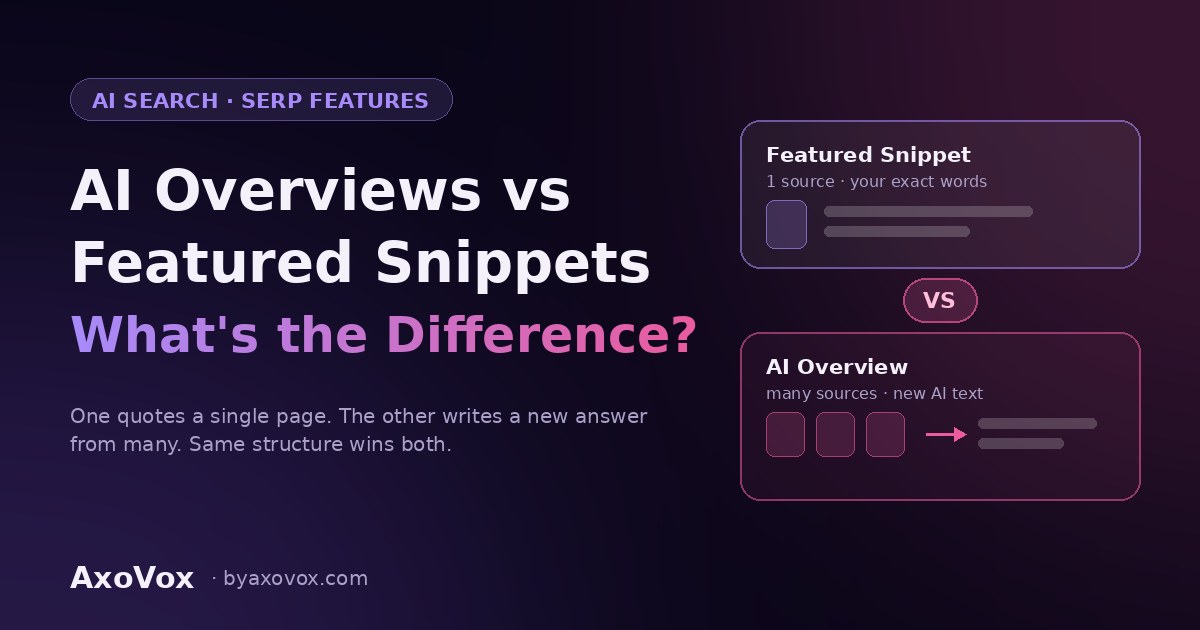
The core difference: a featured snippet is your exact text, quoted from one page. An AI Overview is a new answer, written by Google’s AI from many pages at once. Snippets extract; Overviews synthesize. Both sit above the regular results, both are winnable without ranking #1, and, usefully, the same content structure wins both. Here’s how they differ, when each appears, and where to focus.
What a featured snippet is
Featured snippets have been around since 2014: Google lifts a passage, a paragraph, list, or table, verbatim from a single page and displays it in a box at the top of the results, with a prominent link to that page. It’s often called “position zero.” Nothing is rewritten; if your words are in the box, they’re your words, and the click goes to you. Snippets still appear in 2026, mostly on quick, definitional queries, “what is a title tag,” “how many grams in an ounce”, and on searches where no AI Overview triggers.
What an AI Overview is
An AI Overview is generated, not extracted. Google’s AI reads passages from many sources, writes a new summary answering the question, and attaches citations, typically shown as link cards beside or beneath the text. Your content might inform three sentences of the answer without a single sentence being quoted exactly. And they’re everywhere now: as of early 2026, AI Overviews appear on roughly 48% of tracked queries per BrightEdge, a 58% jump year over year (though estimates range from ~25% to over 60% depending on who’s measuring, so take any single number with salt). We covered the full selection mechanics in how to show up in Google AI Overviews.
The 2026 numbers worth knowing
A few facts that frame this whole comparison, from this year’s research:
- AI Overviews stopped being an “informational only” feature. In January 2025, about 91% of Overview-triggering queries were informational; by late 2025 that fell to 57%, with commercial queries growing to roughly 19%, product comparisons and even brand searches now trigger them regularly (QuickSEO’s 2026 data roundup).
- Question phrasing is the trigger. Queries starting with who/what/why/how are about 3.2x more likely to show an Overview than statement-style searches, and single-word queries trigger one only ~6% of the time (Searchlab’s stats compilation).
- Position 1 still loses clicks when an Overview shows up, its CTR drops from about 31.7% to 23.4%. Meanwhile Seer Interactive’s 2026 update found brands cited inside Overviews earn on the order of 120% more organic clicks per impression than uncited brands on the same queries (full data breakdown here).
- The most-cited sources aren’t who you’d expect: user-generated platforms lead, with Reddit alone accounting for around 21% of citations. Which tells you something about what “authority” means to these systems, real people talking beats polished brand pages more often then it should.
- Scale check: AI Overviews passed 2.5 billion monthly users across 200+ countries and 40 languages. This isn’t an experiment anymore, its the default search experience for half the planet’s queries.
The differences that actually matter
| Featured Snippet | AI Overview | |
|---|---|---|
| Sources | One page | Many pages |
| Text | Your exact words, quoted | New text, written by AI |
| Your visibility | One prominent link | One card among several citations |
| Click behavior | Still earns meaningful clicks | Fewer clicks overall; cited brands claim most of what remains |
| Typical triggers | Short, definitional queries | Questions of all kinds, now including commercial and comparison searches |
| When both qualify | The AI Overview usually takes the spot; the snippet steps aside | |
Which one should you optimize for?
Trick question, the work is the same. Both systems hunt for the same thing: a clear question with a direct, self-contained answer right under it. The page that wins featured snippets is exactly the kind of page AI Overviews cite, because both are lifting liftable passages. Concretely:
- Question-phrased H2s and H3s, worded the way people actually search.
- A direct 40-60 word answer immediately below each heading, complete enough to stand alone.
- Format matched to the answer shape: paragraph for definitions, numbered list for processes, table for comparisons. Google displays snippets in these exact formats, and Overviews render the same shapes.
- Facts over adjectives, numbers, dates, specifics. Both systems skip vague marketing language.
The practical difference is expectations. A snippet win is binary and visible: your box, your link, your traffic. An Overview citation is probabilistic and shared: you’re one of several sources, the answer varies between searches, and the click-through is thinner, the trade-offs we unpacked in why your Google traffic dropped.
The strategic read for 2026
Don’t treat snippets as the old thing and Overviews as the new thing. They coexist by query type: plenty of searches, especially quick lookups and many commercial queries, still show snippets and no Overview. A sane content plan targets the question, not the feature: write the liftable answer once, and let Google decide which box to put it in. Either way, you’re above the traditional results, and above competitors who buried their answer in paragraph six.
Frequently asked questions
Did AI Overviews replace featured snippets?
No, they coexist. Featured snippets still appear on queries that don’t trigger an Overview, especially short definitional and quick-answer searches. When a query qualifies for both, the AI Overview typically takes the top spot and the snippet doesn’t show.
Can my page appear in both?
Yes, on different queries, and being snippet-worthy strongly overlaps with being citation-worthy, since both reward direct, self-contained answers. On a single query you’ll generally see one or the other, not both at once.
Which one sends more traffic?
Featured snippets, per appearance, one prominent link beats one card in a citation carousel. But Overviews now appear on close to half of queries, and the 2026 data is striking: brands cited inside them earn roughly 120% more organic clicks per impression than brands left out. The winning position is: snippet where Overviews don’t trigger, citation where they do.
How do I win a featured snippet?
Rank on page one for the query, then out-structure the current snippet holder: a cleaner question heading, a tighter 40-60 word answer, the right format (paragraph, list, or table) for the question. Snippets change hands on structure more often than on authority.
Are featured snippets still worth targeting in 2026?
Yes, precisely because attention has moved to AI. Competitors chasing Overview citations often abandon snippet optimization, while snippets still deliver clean, single-source visibility on the many queries where no Overview appears. Less competition, same technique, real clicks.
The bottom line
Featured snippets quote one page; AI Overviews write a new answer from many. Different mechanics, same fuel: questions as headings, direct answers underneath, facts instead of fluff. Build content that way and you’re entered in both contests automatically, which is the cheapest two-for-one in SEO right now.
Want to know which of your queries show snippets, which show Overviews, and where you stand in each? Send us your domain, we’ll map the features across your keywords and show you the fastest wins in each box.