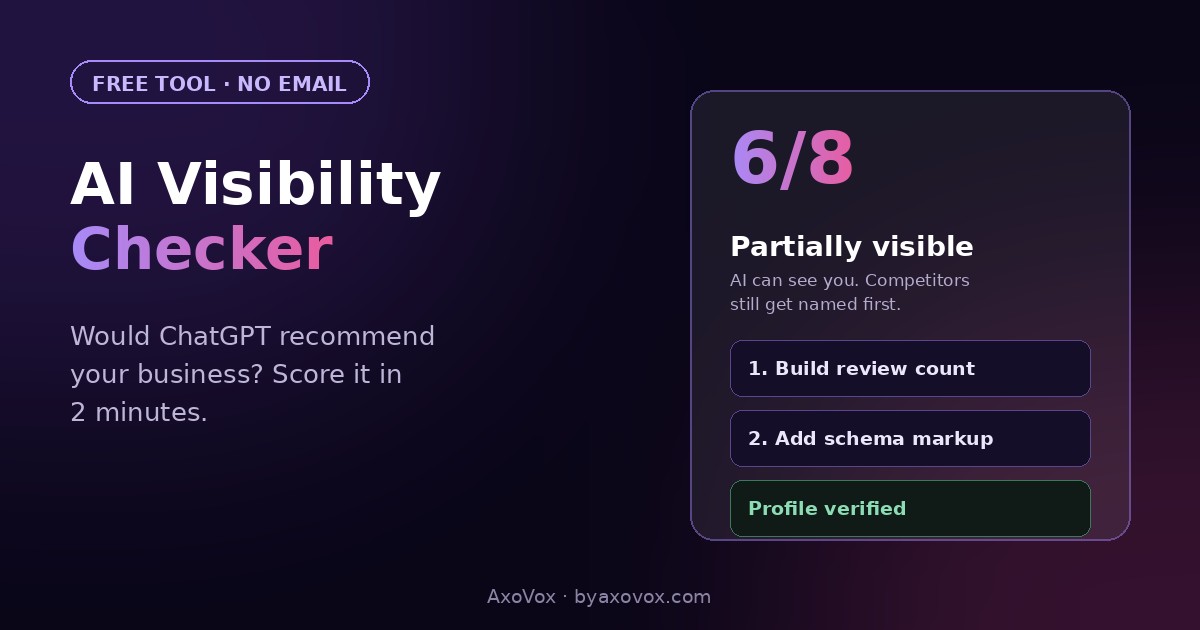
When someone asks ChatGPT or Google’s AI for “the best [what you do] near me,” the answer either includes you or it doesn’t. There’s no page two. This checker scores the eight signals AI systems actually lean on when they decide which businesses to name, the same criteria we broke down in our ChatGPT mention criteria guide. Answer honestly, get your score and the exact fixes to do first. Runs in your browser, nothing stored, no email gate.
1. Google your exact business name. Does a Business Profile panel appear?
Use an incognito window. The panel is the box with your hours, reviews and map pin.
2. Search site:yourdomain.com. Do your pages show up?
If Google hasn’t indexed you, no AI built on Google’s index can cite you either.
3. Do you have 20 or more Google reviews with a recent one this quarter?
Review count and recency are two of the strongest “real business” signals AI checks.
4. Does your site answer real questions in plain language?
Pages that state prices, timelines and direct answers get quoted. Pure sales copy doesn’t.
5. Is your business mentioned anywhere besides your own website?
Directories, local press, industry sites, guest posts. AI cross-checks sources before naming you.
6. Does your site use schema markup (FAQ, LocalBusiness, or both)?
Not sure? Paste your homepage into Google’s Rich Results Test. If it finds nothing, that’s a no.
7. Have you published or meaningfully updated content in the last 90 days?
Most pages AI cites are recent. A site frozen since 2023 reads as abandoned.
8. Ask ChatGPT: “best [your service] in [your city]”. Do you appear?
The direct test. Try it in a fresh chat so your history doesn’t help you.
Do these first, in this order:
Fix the top items, wait a few weeks, then run the check again. AI visibility moves in weeks-to-months, not days.
What this checker actually measures
AI assistants don’t rank pages. When ChatGPT or AI Mode names a business, it’s stacking evidence:
- An indexed site it can actually read
- A verified profile that proves you exist
- Reviews from real people, recent ones
- Mentions on sites you don’t control
- Content clear enough to quote
Each question above maps to one evidence type. One point each, on purpose: the signals compound rather than substitute. Brilliant content with zero reviews and zero outside mentions reads to an AI like an unverified claim.
Miss the foundational ones (indexing, profile) and nothing else matters yet. That’s why the fix list comes back ordered.
One hidden blocker: your own firewall
Plenty of sites block AI crawlers by accident. GPTBot, ClaudeBot and PerplexityBot get stopped at the CDN or in robots.txt, and then the AI literally can’t read the content you want cited. Decent score but you never appear anywhere? Check there first.
Self-audit vs. tracking platforms
This checker answers “why am I not showing up and what do I fix.” A different tool category answers “how often am I showing up right now”:
- Semrush: free AI Search Visibility Checker, scores brand mentions across engines vs competitors
- Ahrefs: free version, no signup
- Frase: tests live customer prompts against your domain, reports share of voice and sentiment
- Moz: custom tracking dashboards per topic
- Loamly: runs batches of real buyer questions across four platforms, maps which citations competitors take from you
- Bing Webmaster Tools: official AI Performance section showing which conversational queries pull from your pages
Three metrics they track, worth knowing by name:
- Citation share: how often the AI links you as a source
- Brand sentiment: whether it describes you positively or neutrally
- Competitor gaps: specific prompts where a rival gets named instead of you
Useful once there’s visibility to measure. Scored under 7 here? Fix the foundation first. Tracking zero mentions with a dashboard is watching zero with better graphs.
How the tiers break down
- 0-3, Invisible. AI can’t confirm you exist as a real, current business. Good news: the fixes are mechanical and fast. Claim the profile, fix indexing, start collecting reviews.
- 4-6, Partially visible. You exist to the machines but lose to competitors with fuller evidence. Most established small businesses land here, and it’s where a few focused months move you the most. Our guide to getting cited by AI covers this stage.
- 7-8, Citable. Evidence base built. Now it’s maintenance: fresh content, review velocity, more independent mentions. The ChatGPT visibility playbook has the advanced moves.
Frequently asked questions
How accurate is a self-check like this?
It’s directional, not a lab test. Nobody outside the AI companies knows the exact weighting. But every question here reflects a pattern that shows up consistently in which businesses get named, so a low score reliably predicts invisibility even if a high score doesn’t guarantee mentions.
Which AI systems does this apply to?
ChatGPT, Google AI Overviews and AI Mode, Perplexity, Gemini, Claude. They differ in the details but lean on the same evidence: indexed content, verified profiles, reviews, and independent mentions. Fixing your score improves you everywhere at once.
How long until fixes show up in AI answers?
Indexing and profile fixes can register in days. Reviews and content clarity take weeks. Independent mentions and authority take months. The tool tells you what to fix first partly because the slow items should start earliest.
Do I need to pay for anything to fix a low score?
The first five questions can all be fixed for free with your own time: Google Business Profile is free, indexing is free, asking customers for reviews is free. Schema and content work take skill or budget, but their are no required subscriptions anywhere in this list.
How is this different from the Semrush or Ahrefs AI visibility checkers?
Those tools measure output: how often AI engines already cite you, your citation share, sentiment, competitor comparisons. This one audits input: the eight evidence signals that determine whether you’re citable at all. Run this first, fix what’s missing, then use a tracking tool to watch the mentions arrive.
Why does my competitor show up in ChatGPT and I don’t?
Run this check as if you were them. Almost always they win on one or two specific signals: more reviews, more independent mentions, or clearer answer-style content. Once you see which signal it is, you know exactly what to build.
Want us to run the full audit and build the fix plan for you? Talk to AxoVox. And if you’re not ready for an agency yet, the free guides linked above will get you a long way on your own.