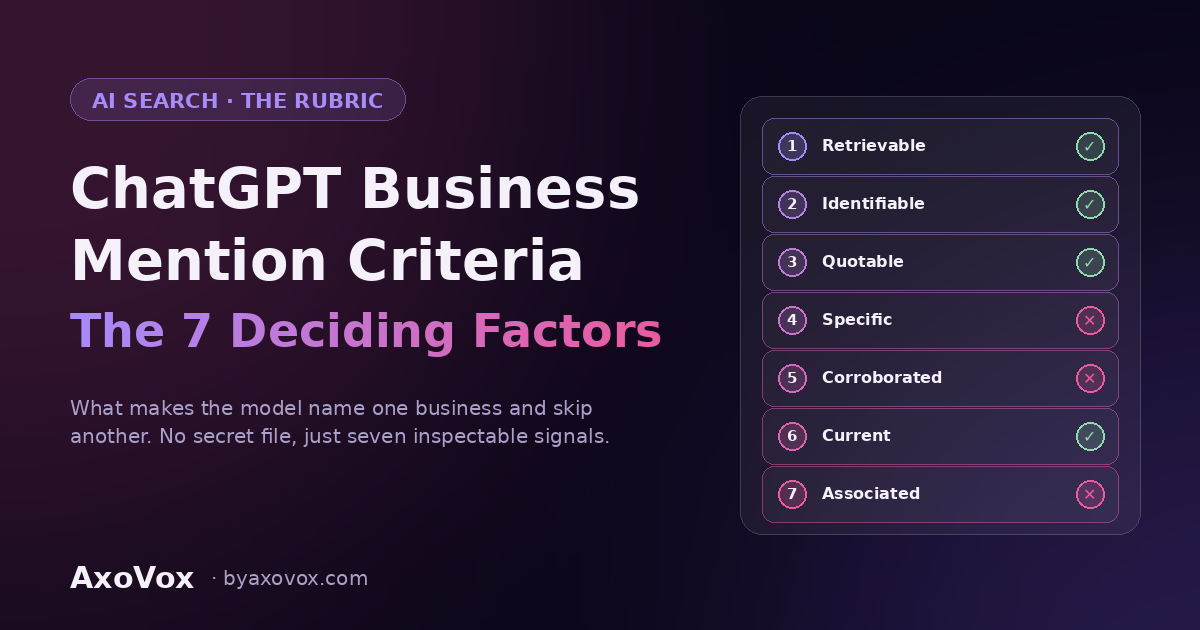
When ChatGPT decides which businesses to mention, it weighs seven criteria: whether it can read your site at all, whether it can tell exactly who you are, whether your answers are liftable, how fact-dense your pages are, what the rest of the web says about you, how fresh the evidence is, and how strongly your name co-occurs with your service and area. No one criterion decides it alone, and the ones business owners assume matter most usually matter least. Here’s each factor, how the model evaluates it, and a quick self-check for every one.
First, how a mention actually happens
When someone asks ChatGPT for a recommendation with web search active, the model runs searches, reads the pages and profiles it can access, and assembles an answer from what it found, naming the businesses the evidence supports. That means the “criteria” aren’t a secret ranking file inside OpenAI; they’re the properties that make a business easy to find, easy to verify, and safe to recommend during that retrieval. Which is good news: every one of them is inspectable from the outside, and most are fixable.
Criterion 1: retrievability — can the model read you at all?
What’s weighed: whether AI crawlers (GPTBot and friends) can access your pages, and whether the content is server-rendered rather than hidden behind JavaScript.
Why it’s first: it’s binary. A blocked or unreadable site scores zero on everything else by default, and CDN default settings block AI bots more often than owners realize.
Self-check: ask ChatGPT or Perplexity to summarize your homepage URL. A clean summary passes; anything else fails.
Criterion 2: entity clarity. Does it know exactly who you are?
What’s weighed: consistent name, location, and service descriptions across your site, profiles, and directories, plus structured data telling machines “this is a business, here’s what it does, here’s where.”
Why it matters: a model won’t confidently recommend an entity it can’t confidently identify. Mismatched names and addresses read as uncertainty, and uncertainty gets skipped.
Self-check: is your business name, city, and core service written identically on your site, your Google profile, and your top three directories?
Criterion 3: liftable answers. Can it quote you?
What’s weighed: question-shaped headings with direct, self-contained answers underneath, in formats a model can extract cleanly.
Why it matters: AI answers are assembled from passages. A page that buries its answer in paragraph six contributes nothing quotable, however good the buried answer is.
Self-check: pick your most valuable page; is there a two-to-three sentence answer to its core question within the first screen?
Criterion 4: fact density. Is there anything specific to say about you?
What’s weighed: concrete numbers, prices, dates, named methods, and verifiable specifics versus adjectives and slogans.
The evidence: Princeton’s GEO research measured it directly: adding statistics lifted AI citation visibility by roughly a third, quotations by more. “Quality service at fair prices” is, to a model, empty air.
Self-check: count the concrete facts on your homepage. If a competitor’s name could be swapped in without changing a word, the page fails this criterion.
Criterion 5: third-party corroboration — does the web vouch for you?
What’s weighed: reviews and ratings, directory presence, press mentions, and community discussion, with forums carrying surprising weight (Reddit alone accounts for around a fifth of AI answer citations).
Why it’s the heavyweight: your own site says what you claim; third parties say what’s true. Models lean toward the second, which is why an averagely-written business with 200 recent reviews outranks a beautifully-written one with 12 in AI answers, almost every time.
Self-check: ask the AI who it recommends in your category and city, then open the sources it cites. If they’re review platforms and directories you’re weak on, you’ve found the gap.
Criterion 6: freshness. Is the evidence current?
What’s weighed: recency of your content, your reviews, and your mentions. The large majority of AI-cited pages were published or updated within two years, and recently refreshed pages get cited several times more often.
Why it matters: a model recommending businesses can’t afford to name closed shops and stale offers, so recency doubles as a proof-of-life signal.
Self-check: when were your key pages last meaningfully updated, and when was your last review? If both answers are “last year,” this criterion is dragging you.
Criterion 7: topical association. Are you attached to the question?
What’s weighed: how consistently your name appears alongside your service and area across the web: your content cluster, your profile categories, your mentions, your reviews’ wording.
Why it matters: a model retrieving for “emergency plumber in Haifa” surfaces the entities most strongly associated with exactly that phrase-space. One page about a topic is a whisper; a cluster plus reviews plus mentions using the same language is a signal.
Self-check: search your business name plus your core service. If the connection only exists on your own website, the association is too thin to retrieve.
What’s NOT in the criteria (despite what you’ve been sold)
- Ad spend. ChatGPT doesn’t know or care what you spend on Google Ads; there’s no budget lever into organic AI answers.
- Keyword stuffing. Repeating “best plumber Haifa” fifteen times adds no facts, and fact-seeking retrieval skips it.
- Asking nicely. Submitting your business “to ChatGPT,” emailing OpenAI, or prompting it to remember you does nothing; there’s no index to submit to, only a web to be evident in.
- Domain age and size alone. The old-SEO comfort blanket: research keeps showing top-ranking and AI-cited sources overlap far less than assumed, which is exactly why small businesses that meet the seven criteria get named over bigger names that don’t.
Scoring yourself honestly
Run the seven self-checks above; most businesses pass two or three. The pattern we see in audits: criteria 1-4 (the on-site half) are a focused week of work, criterion 5 is a program measured in months, and 6-7 are habits. If you want the scoring done systematically, our guide to checking whether AI cites you turns it into a monthly twenty-minute routine, and the conceptual background on why retrieval works this way is in the GEO explainer. The fix-by-fix playbook remains the main guide; this page is the rubric it’s graded against.
Frequently asked questions
Does ChatGPT have an official list of business mention criteria?
No published checklist exists, and anyone selling “guaranteed inclusion” is selling smoke. The criteria here are reverse-engineered from how retrieval-based answers demonstrably work: what models can access, extract, verify, and safely repeat. They’re stable because they follow from the mechanism, not from a policy that might change.
Which criterion matters most?
Retrievability is the gate (fail it and nothing else counts), but third-party corroboration is the heavyweight among businesses that pass the gate. In practice, reviews plus consistent profiles move mention rates more than any on-site polish, which is inconvenient for everyone hoping the fix was a homepage rewrite.
Are ChatGPT’s criteria the same as Google AI Overviews’ criteria?
Heavily overlapping: both retrieve liftable, fact-dense, corroborated, fresh content. The differences are at the edges (Google leans on its own index, profile data, and maps; ChatGPT’s browsing spreads wider across the open web), which is why work meeting these seven criteria improves your visibility in both, plus Perplexity and friends.
How long until meeting the criteria produces mentions?
The on-site criteria can influence answers within weeks, since browsing-enabled tools read the live web. The corroboration and association criteria build over months. Businesses starting from zero typically see first occasional mentions in one to three months of honest work, and consistency from there.
Can a brand-new business meet these criteria?
Mostly, and faster than old-school SEO would suggest: retrievability, clarity, liftable answers, and fact density are day-one achievable. The new-business gap is corroboration, which is why early reviews and a handful of legitimate directory and community mentions matter more in year one than any amount of content.
The bottom line
Seven criteria, all inspectable, most fixable: readable, identifiable, quotable, specific, corroborated, current, and associated. There’s no submission form and no shortcut, which is precisely what makes it winnable; the criteria reward evidence, and evidence can be built. Your competitors are mostly failing five of the seven without knowing the list exists. Now you know the list.
Want your score on all seven, with the gaps ranked by impact? Send us your domain and city. We’ll grade you against every criterion and show you which fixes move your mention rate first.