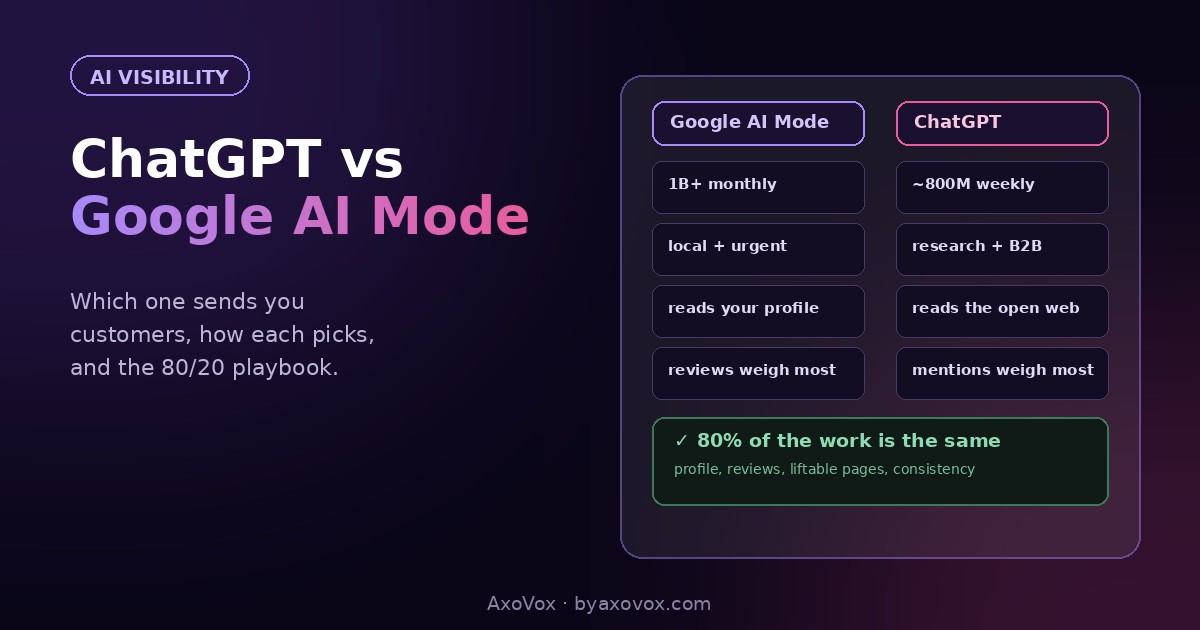
Two AI systems now answer “who should I hire” questions at scale: Google’s AI Mode, past a billion monthly users, and ChatGPT, around 800 million weekly. Both name specific businesses in their answers. Neither shows a page two. And they don’t pick the same way, which means a business can be recommended constantly in one and invisible in the other without ever knowing.
Tech reviews compare these two on features. This comparison does the only thing that matters for a business: where your customers actually ask which question, how each system decides who to name, and what to do about each. Short version up front: the work overlaps about 80%, the 20% that differs is worth knowing precisely, and you can test your own standing in both before finishing your coffee.
The side-by-side that matters to a business
| Google AI Mode | ChatGPT | |
|---|---|---|
| Scale | 1B+ monthly users, built into Search | ~800M weekly users, destination app |
| Where answers come from | Google’s live index + Business Profiles, Maps and reviews | Training data + live web search across the open web |
| Local strength | Very strong: plugged into profiles, hours, distance, review counts | Moderate: knows businesses through web mentions, not a map system |
| Typical business query | “best electrician near me”, service + city | “how do I choose…”, comparisons, research, B2B and specialists |
| What it leans on to name you | Your Business Profile, reviews, indexed pages | Mentions on sites you don’t control, quotable pages, consistency |
| Can you track it? | Partly: AI features data in Search Console | Barely: test manually, watch “how did you hear about us” |
Where customers actually ask what
The split follows habit, not features. Google’s AI meets people mid-search: someone already typing “emergency plumber ramat gan” gets AI Mode and AI Overviews wrapped around the behavior they’ve had for twenty years, which is why local, urgent, and near-me intent concentrates there. It’s the default door, and defaults win the impatient.
ChatGPT gets the conversations: the questions people used to ask a knowledgeable friend. “How do I choose an accountant for a two-person company?” “We’re renovating, what should we budget and who does this kind of work?” Longer, earlier in the decision, more context. Research-heavy services, B2B, specialists and considered purchases show up here disproportionately, and the person asking often arrives at Google later just to confirm the name ChatGPT gave them, a two-step path where the recommendation already happened before the search you can see.
Neither owns “recommendations.” They own different moments of the same customer, which is the real answer to “which one matters”: for a local service business, Google’s AI is the volume game and ChatGPT is the influence game, and the influence game is growing fastest exactly where jobs are biggest.
How each one decides who to name
Google’s AI has home-field advantage: it reads Google’s own graph. Your Business Profile completeness, review count and recency, your indexed pages and their structure, proximity, categories. It behaves like local search with a synthesizer on top, and the same evidence that wins the map pack largely wins the AI answer, with one addition: liftable, answer-first page structure decides who gets quoted, and we’ve watched position-7 pages outquote position-1 pages on that alone. The mechanics live in our AI Overviews playbook and the AI Mode explainer.
ChatGPT has no map and no review database of its own, so it behaves like a cautious referee reading the open web: does this business appear in directories, local press, industry lists, community threads? Do multiple independent sources agree it exists and does good work? Are its pages quotable, with concrete claims a model can lift? That’s why off-site mentions and consistency punch harder here, and why a business that exists only on its own website reads as an unverified claim. The full signal list is in the mention criteria breakdown, and the fix order in the ChatGPT recommendation guide.
The overlapping 80%: a complete verified profile, steady reviews, plainly-written pages that answer cost/time/scope questions, consistent name-address-phone everywhere, and being indexed at all. Do that and both systems can find you. The differing 20%: Google’s side rewards profile depth and page structure hardest; ChatGPT’s side rewards independent mentions hardest. Weight accordingly: local-first businesses tilt toward the profile, reputation-first businesses tilt toward getting talked about off-site.
Test yourself in both, five minutes
Google side: turn on AI Mode, ask “best [your service] in [your city],” then a follow-up like a real buyer (“which one for an older building?”). ChatGPT side: fresh or temporary chat so your history doesn’t flatter you, same two questions. Log who gets named in a note, repeat monthly, and treat a competitor’s name as a diagnosis: they beat you on a visible signal, and it’s almost always findable by searching their name plus your city.
For the structured version, our free AI visibility checker scores the eight foundation signals both systems verify and returns the fix list in order. Two minutes, no email, and it tells you which side of the 20% you’re weakest on.
The move: one playbook, two tilts
Don’t run two strategies; run the shared 80% and tilt. Every business: profile complete, review engine on, service pages answering real questions in liftable structure, consistent details, indexed. Local-tilt (trades, clinics, restaurants): go deep on the Business Profile and review velocity, your customers’ AI moment happens inside Google. Reputation-tilt (B2B, consultants, specialists, big-ticket): chase the independent mentions, directories, local press, industry lists, one or two guest articles, because ChatGPT’s referee wants witnesses. And both tilts feed the other system anyway, which is the quiet beauty of this comparison: there’s no wrong door, only unbuilt evidence.
Frequently asked questions
Do more people use ChatGPT or Google AI Mode?
Google AI Mode reports over a billion monthly users versus ChatGPT’s roughly 800 million weekly, but the totals matter less than the moments: local and urgent recommendation queries concentrate in Google’s AI, while research, comparison and B2B questions lean toward ChatGPT.
Does ChatGPT recommend local businesses?
Yes, by combining training knowledge with live web search, and its picks lean on evidence across the open web: directories, press, reviews it can see, and quotable pages. It has no map system of its own, which is why off-site mentions weigh more heavily than they do in Google’s AI.
How is Google AI Mode different from ChatGPT for businesses?
Google’s AI reads Google’s own data: Business Profiles, Maps, reviews and the search index, making profile depth and page structure the biggest levers. ChatGPT verifies through independent web sources, making mentions and consistency the biggest levers. About 80% of the underlying work overlaps.
Can I track traffic from ChatGPT and AI Mode?
Partially. Search Console now reports on Google’s AI features, and some ChatGPT visits appear as referrals, but much of the influence is invisible: people get a name from AI, then search it directly. The “how did you hear about us” question on your forms catches what analytics miss.
Which should a small business optimize for first?
The shared foundation first, since both systems verify the same core evidence. Then tilt by customer type: local-urgent businesses go deeper on the Google Business Profile and reviews; research-and-reputation businesses chase independent mentions. A visibility check shows which side is weaker today.
Will optimizing for one hurt the other?
No, they’re mutually reinforcing: reviews and profile depth make ChatGPT’s referee more confident, and off-site mentions strengthen the entity Google’s systems trust. Every piece of evidence works both doors.
Want to know which of the two is already naming your competitors, and exactly what they built that you haven’t? Ask us, we run the check as part of any first conversation, free.