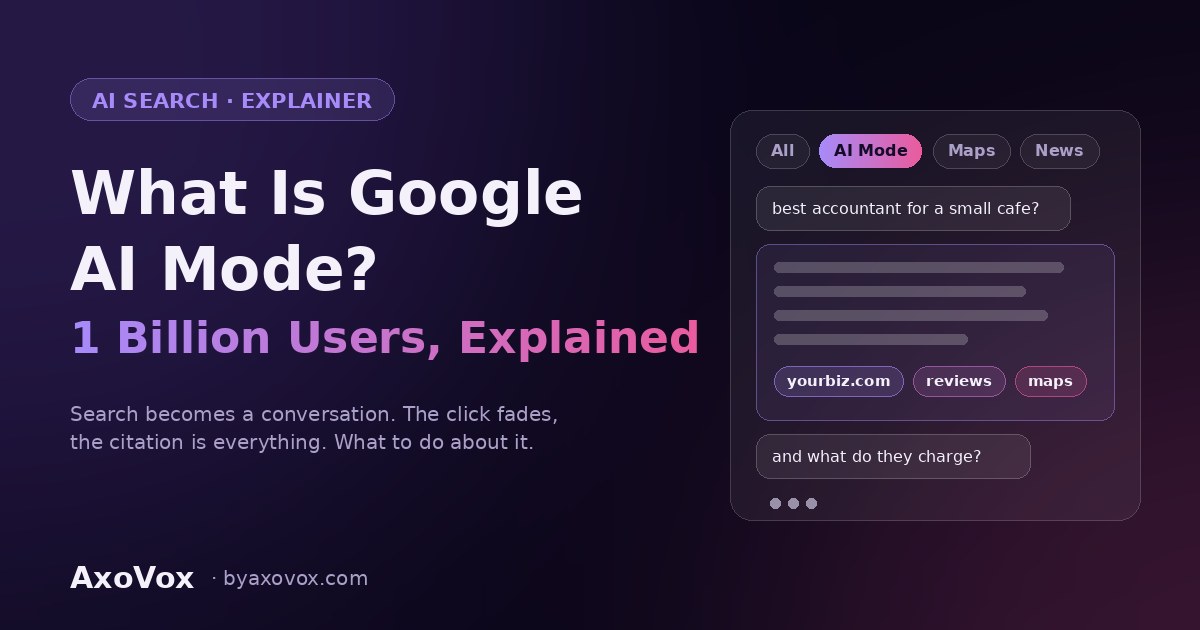
Google AI Mode is a conversational tab inside Google Search: you ask a question in normal language, get a full AI-written answer built from Google’s live index, and keep asking follow-ups like a chat. It launched to everyone in the US in May 2025, and by Google’s I/O announcement in May 2026 it had passed 1 billion monthly users across nearly 200 countries, with usage more than doubling every quarter. In plain terms: a ChatGPT-style experience with Google’s index behind it, one tap away from every search box. Here’s what it is, how it differs from AI Overviews, and what it changes for a business trying to be found.
Which languages and countries does AI Mode support?
AI Mode launched in English only, in the US, and that early limitation is still what most people search for. It’s long gone. As of 2026, AI Mode works in over 200 countries and territories and supports dozens of languages, closing in on 100 after Google’s big multilingual expansion.
The rollout went in waves: English first, then Hindi, Indonesian, Japanese, Korean and Brazilian Portuguese, then Spanish, then a single update that added 35+ languages at once, including most European languages plus Arabic and Hebrew. If you search in a supported language, the AI Mode tab shows up and answers in that language.
One notable exception: France. Regulatory friction has kept both AI Overviews and AI Mode out of the French market for now, even though French as a language is supported elsewhere.
Why this matters for your business: AI Mode isn’t an English-only experiment anymore. If your customers search in Spanish, Hebrew, German or Portuguese, they’re getting conversational AI answers too, and the same visibility rules apply in every language. Google also reports that AI Mode queries run about three times longer than classic searches, becuase people ask full questions instead of typing keywords. Your content needs to answer those questions, whatever language they arrive in.
What AI Mode actually is, without the buzzwords
Open Google, and next to the classic results tabs there’s an AI Mode tab. Type or speak a question, even a messy multi-part one (“compare CRM options for a 5-person service business and tell me which has the best free tier”), and instead of ten links you get a written answer with sources, plus a chat box for follow-ups. Under the hood it runs Google’s Gemini model and a technique called query fan-out: your one question becomes many parallel searches, and the answer is stitched from the best passages found across them. It’s free, works in 98 languages, and increasingly handles images, shopping, and even task-like requests. Google’s own head of Search called it the biggest change to the search box in more than 25 years, and for once the corporate quote undersells it.
Is Google AI Mode conversational?
Yes, and that’s the defining difference from normal search. AI Mode holds a conversation: you ask, it answers, and then you ask follow-ups without starting over. It remembers the context of the thread, so “what about for a small budget?” works as a next question because it knows what “what” refers to.
Under the hood it also converses with the web on your behalf. The fan-out described above runs again on every turn, so each follow-up retrieves fresh sources. That’s why one AI Mode session can replace what used to be five or six separate searches, and why those three-times-longer queries happen: people write full questions when they know a follow-up is possible.
AI Mode vs AI Overviews: the two-sentence version
AI Overviews interrupt a normal search with a summary on top; you’re still on the results page. AI Mode is the page: a conversation that happens instead of the results, with follow-ups that never show you a classic link list at all. Google is deliberately building a ramp between them: tap a follow-up question under an AI Overview and you land in AI Mode. If you want the deeper mechanics of the Overview side, that’s our AI Overviews playbook, and the boxes’ relationship to old-school featured snippets is in this comparison.
Why this matters for your business (the honest version)
Three shifts, in order of importance:
- The click gets rarer, the mention gets everything. Industry reporting through 2026 describes AI-written answers becoming the primary result for a growing share of queries, with classic links pushed down the page. In a conversational answer there is no “position 3”: you’re either part of the answer, cited and named, or you’re absent. The middle ground is disappearing.
- Complex questions come to Google now. People ask AI Mode the long, specific, comparison-shaped questions they used to break into five searches or take to ChatGPT. Content that answers whole questions (with the sub-questions covered) is what fan-out retrieval rewards.
- Follow-ups multiply your chances. A conversation has many turns, and each turn retrieves again. A business with strong answers across a topic can be cited in turn three even if it missed turn one, which is exactly the argument for topic clusters over single pages.
How to show up in AI Mode
The genuinely good news: there is no separate “AI Mode SEO.” It retrieves from the same index with the same appetite as the rest of Google’s AI surfaces, so the checklist is the one you’ve seen from us before: crawlable pages, question-shaped headings with direct 40-60 word answers, real numbers instead of adjectives, visible authorship, fresh updates, and the off-site reputation (reviews, mentions, community presence) that makes a model trust you. The full sequence lives in our AI search optimization checklist, the conceptual backdrop is the GEO explainer, and once you’re working at it, here’s how to check whether AI Mode and friends actually cite you. One AI Mode-specific emphasis: breadth. Because of fan-out and follow-ups, covering a topic’s ten sub-questions across a cluster beats one heroic page every time.
Should you panic?
No, but you should hurry a little. AI Mode is opt-in today and not yet the default everywhere, which means most of your competitors are ignoring it, and citation share in these systems is rewarding early movers with wildly outsized visibility. The window where “did the checklist” counts as a competitive edge is open right now; at a billion users and doubling quarterly, it won’t stay open long. The businesses that adapted to the map pack early owned local search for years. Same movie, new theater.
Frequently asked questions
Is AI Mode replacing normal Google search?
It’s absorbing it gradually. AI Mode is still a separate tab rather than the forced default, but Google is making the handoff from regular search and AI Overviews into it ever smoother, and trade reporting through 2026 describes AI answers becoming the primary result for most queries. Plan for the direction, not the current toggle.
What’s the difference between AI Mode and ChatGPT?
The index. ChatGPT answers from its training plus web search; AI Mode is wired directly into Google’s live index, Maps data, and Shopping graph, which makes it stronger for local, product, and freshness-sensitive questions. From a visibility standpoint, both cite sources, and the same content wins both, so you don’t have to pick a side.
Does AI Mode show ads?
Google has been testing ads inside AI experiences, and the format keeps evolving. What’s stable: organic citations remain the core of the answers, and being cited is free. Whatever ad formats settle in, the mention-versus-absent dynamic is the one that decides whether AI Mode sends you customers.
Is Google AI Mode free? Where is it available?
Free, no subscription, available in nearly 200 countries and 98 languages as of Google’s 2026 announcements. Rollout pace varies by region and language, so if you don’t see the tab yet, you likely will soon.
How is AI Mode different from AI Overviews for my SEO?
Same fuel, bigger engine. Both retrieve liftable passages from indexed pages; AI Mode adds fan-out breadth and multi-turn follow-ups, which reward covering a topic’s full question family rather than one keyword. If your content already wins Overview citations, you’re positioned for AI Mode; if it wins neither, the fix list is identical.
Is Google AI Mode conversational?
Yes. AI Mode works as a back-and-forth conversation: it keeps the thread’s context so follow-ups work naturally, re-runs its background searches on every turn, and synthesizes each answer with linked sources.
Can I see how my business appears in AI Mode?
Yes, manually: open the tab in an incognito session and ask the questions your customers would, then log which businesses and sources get named. Do it monthly alongside ChatGPT and Perplexity checks; the method and the spreadsheet are in our citation-checking guide.
The bottom line
AI Mode is Google turning search into a conversation, at billion-user scale, faster than any feature in the company’s history. For businesses the equation is stark and strangely hopeful: the click is fading, the citation is everything, and the work that earns citations is public, learnable, and currently being done by almost nobody in your market. That last part is the opportunity, and it has a clock on it.
Want to know how your business shows up in AI Mode today, and what it would take to be the answer? Send us your business name and your three most valuable customer questions. We’ll run them and show you exactly where you stand.