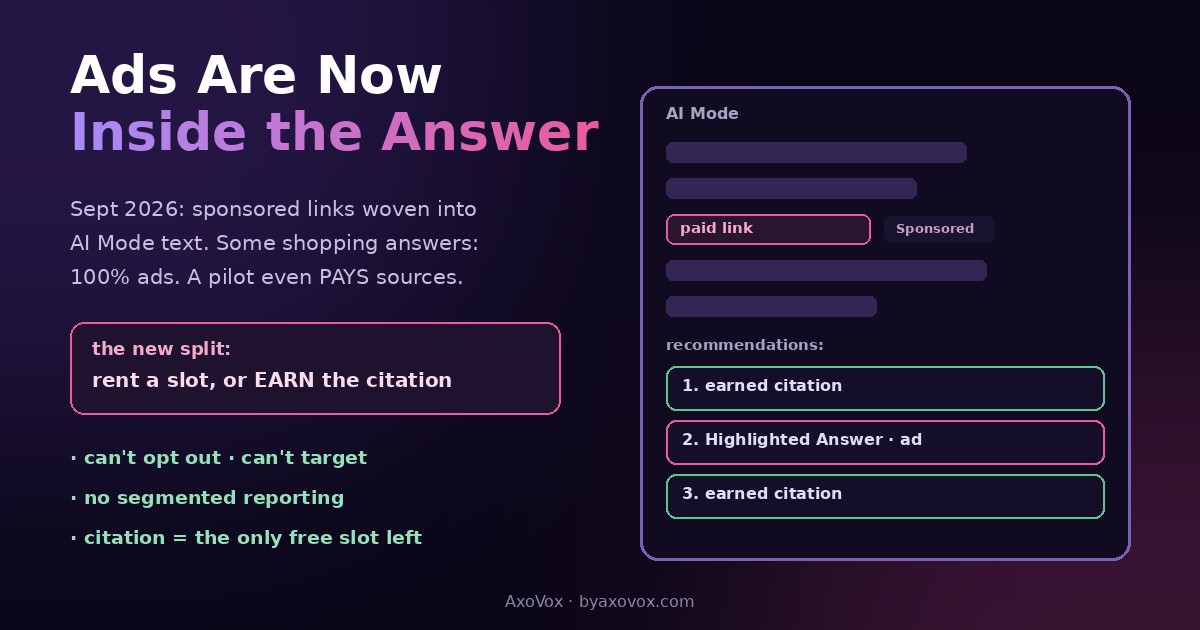
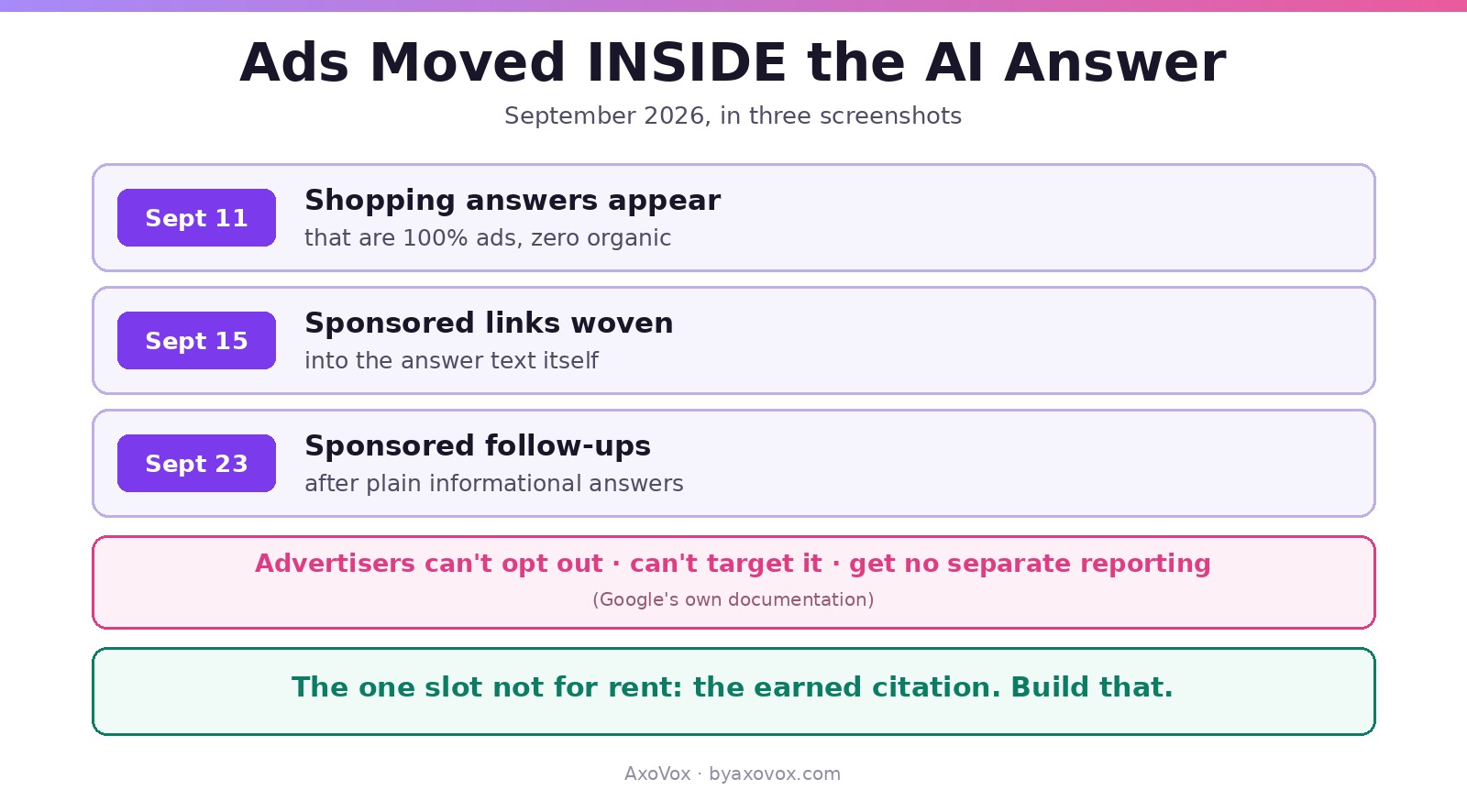
On September 15, SEO-watchers started posting screenshots of something new: sponsored anchor text woven directly INTO an AI Mode answer, a paid link living inside the sentence, wearing a small “Sponsored” label like a name tag at a party it wasn’t invited to. A few days earlier, some shopping questions in AI Mode had returned product lists that were ads top to bottom, no organic products at all. By the 23rd, sponsored suggestions were appearing as follow-up recommendations after plain informational answers.
None of this is a leak or a rumor; it’s the rollout of a plan Google announced onstage. The answer box spent two years eating the results page. September was the month the cash register got installed inside it.
How we got here, fast
Ads around and inside AI Overviews have been officially real for a while: text and Shopping ads from your existing Search, Shopping and Performance Max campaigns can serve with Overviews across 200+ markets. The May 2026 Google Marketing Live event announced the next layer, Gemini-generated formats built to sit inside AI Mode responses: Conversational Discovery ads that join the conversation when you research products, and Highlighted Answers, sponsored entries placed inside the AI’s own recommendation lists, each with an AI-written explainer alongside the advertiser’s creative.
September is when “announced” became “spotted in the wild”: the in-text sponsored links, the all-ad shopping answers, the sponsored follow-ups. Ads drawn from AI Max for Search, AI Max for Shopping and PMax, the same month AI Max became mandatory for Search campaigns. The machine assembled itself on schedule.
The three uncomfortable mechanics
Buried in Google’s own help documentation, three sentences every advertiser should read twice. You can’t opt out of your ads serving in AI Overviews. You can’t target those placements directly. And Google doesn’t offer segmented reporting when your ads show inside AI experiences; they’re folded into Top Ads. Translation: your budget already participates in the answer economy, you can’t steer it there or away from there, and you can’t cleanly see what it’s doing there. For a channel built on measurement, that’s a remarkable opening position.
The economics that actually changed
Until now, the AI answer had one currency: citation, earned with evidence, free at the point of appearance. Highlighted Answers introduces a second: the same list that recommends businesses can now contain entries that PAID to be recommendations, labeled, yes, but sharing the sentence structure, the AI explainer, the authority glow of the answer itself. And the all-ads shopping results show the ceiling: for some commercial questions, organic presence in the answer can round to zero.
There’s a carrot in the same bag, and it completes the picture: Google’s invite-only AI Contribution pilot, detailed September 17, pays a small group of publishers when their content meaningfully feeds an AI answer, with earnings in a Search Console panel. Hold the whole September in one frame: Google now charges for entry into the answer on one side and pays suppliers of the answer on the other. That’s not a search feature anymore; that’s a marketplace, with Google as the house.
| Slot in the answer | How you get it | What it costs |
|---|---|---|
| Organic citation | Evidence: liftable facts, consistency, access | Work, not media spend; the only slot you don’t rent |
| Highlighted Answer / in-text sponsored link | AI Max + PMax eligibility, Google’s relevance call | Media budget, blind-ish measurement, for now |
| Shopping placements inside answers | Clean feed + Shopping/PMax | Budget; sometimes the whole shelf is paid |
| Contribution payouts | Invite-only pilot for feeding answers | Being the kind of source answers need |
Before anyone torches a media plan
Proportion check: the in-text sponsored links are an early test, US-heavy; Highlighted Answers is in testing; labels are present throughout; and informational answers remain mostly ad-free today. Google itself keeps repeating “testing and tuning.” The mistake isn’t failing to react this week, it’s pretending the direction is ambiguous. It isn’t: every format announced in May shipped by September, and John Mueller has already said measurement for these surfaces will “evolve,” which is Google’s word for “not yet.”
Five moves, in order
- Find out where your ad budget already lives. You can’t segment AI placements, but you can bracket them: compare performance on query sets you KNOW carry AI answers (check manually) against ones that don’t. Crude beats blind
- Screenshot your money queries monthly. Ad formats in AI answers are changing weekly; your category’s ad load, and which competitor bought the Highlighted slot, is intel nobody’s dashboard shows yet
- Treat organic citation as the appreciating asset. It’s the one slot in the answer that isn’t for rent, it compounds, and the evidence work that earns it is unchanged. Paid slots arriving around it raises its value, not lowers it
- Watch your brand questions specifically. “Is [your brand] good” and “[your brand] alternatives” are exactly where a competitor’s Conversational Discovery ad wants to live; decide now whether you’ll defend those conversationally
- Baseline with the Generative AI report in Search Console before ad density grows: you want a clean “before” when you argue, to a client or to yourself, about what the ads changed
The strategic read
Google didn’t build a two-billion-user answer engine to leave it unmonetized, and August’s expansion plus September’s ad creep are one project: make the answer the whole page, then sell the page. For businesses the split is now explicit: rent visibility inside the answer through AI Max, or earn the citation with evidence, and the earned slot just became the scarce one. Budgets will chase the rented slots because budgets can; the durable advantage goes to whoever the answer would cite for free even if every ad disappeared tomorrow. Build that, and the ads are a tax on your competitors.
Common questions
Does Google show ads inside AI Mode and AI Overviews?
Yes. Ads from Search, Shopping and Performance Max campaigns serve with AI Overviews in 200+ markets, and September 2026 brought live tests of sponsored links woven into AI Mode answer text, sponsored follow-up suggestions, and shopping answers composed entirely of ads.
What are Highlighted Answers and Conversational Discovery ads?
The Gemini-powered formats Google announced at Marketing Live in May 2026: Conversational Discovery ads join product-research conversations in AI Mode, and Highlighted Answers place sponsored entries inside the AI’s recommendation lists, labeled, with an AI-generated explainer beside the advertiser’s creative.
Can I opt my ads out of AI Overviews?
No, per Google’s own documentation: you can’t opt out of serving there, can’t target the placements directly, and don’t get segmented reporting for them; they fold into Top Ads.
How do I know if my ads are showing in AI answers?
Not cleanly, yet. The workable bracket: manually identify which of your query sets carry AI answers, compare performance against sets that don’t, and screenshot your money queries on a schedule. Mueller has said measurement will evolve.
Are organic citations in AI answers going away?
No; external links inside Overviews actually rose sharply this autumn, and informational answers remain mostly ad-free. What changed is commercial queries: there, paid slots inside the answer now compete with, and in some shopping cases replace, organic presence.
What is Google’s AI Contribution pilot?
An invite-only program, reported September 17, that pays participating publishers when their content meaningfully contributes to answers in AI Overviews, AI Mode or Gemini, with earnings shown in a Search Console panel. Early, small, and the clearest sign the answer is a managed marketplace.
Should I move budget specifically to reach AI answers?
You can’t, directly: eligibility flows through AI Max and PMax rather than a bookable placement. The sane posture is keeping those campaigns healthy, bracketing their AI exposure yourself, and putting the deliberate investment into the citation you can’t buy.
Will ads make AI answers untrustworthy?
Labels exist and Google’s incentive is keeping answers useful; the real shift is subtler, recommendation lists where some entries earned their place and some bought it, which makes third-party evidence (reviews, citations across the open web) matter more as the tiebreaker users and models both lean on.