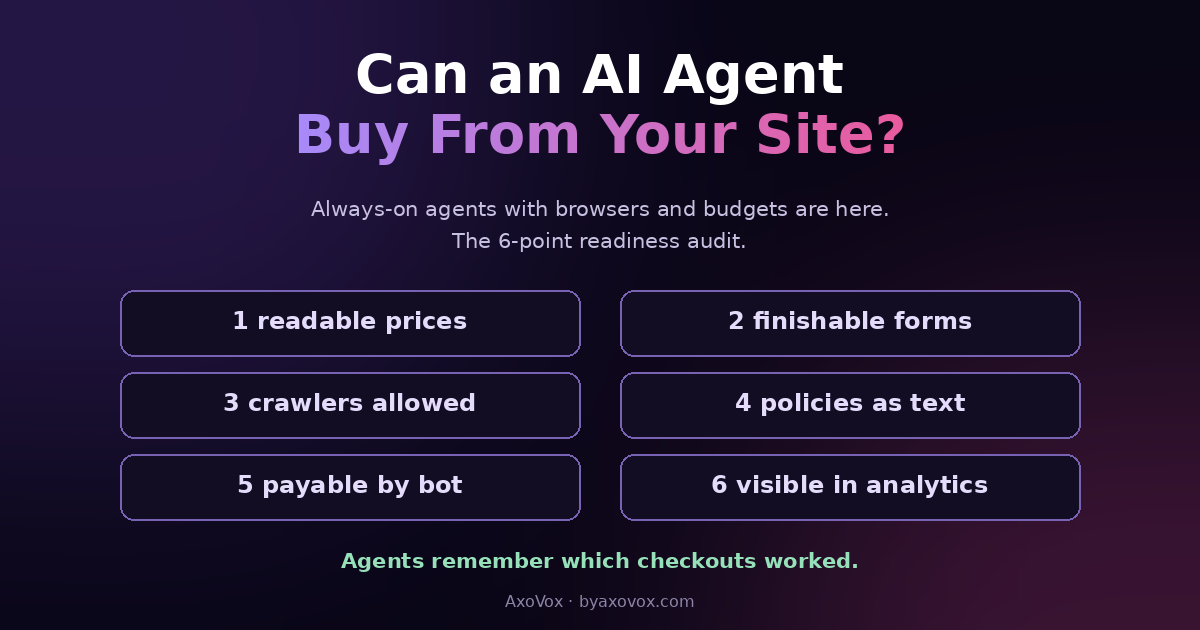
OpenAI opened its September keynote with a small story: an early tester forgot to invoice a client, and his AI agent noticed, prepared the invoice, and sent it after a one-tap approval. Cute anecdote, until you reverse the camera. Somewhere in that story there’s a BUSINESS that received an email written by software, got checked out by software, and never knew.
That reversed camera is this article. Dots launched September 29: always-on agents, each with its own cloud computer and browser, working after the owner closes the tab, wired into 4,000+ apps. Meta shipped Muse weeks earlier. And the payment rails predate both: ChatGPT’s Instant Checkout already lets people buy from Etsy and Shopify merchants inside the chat, over an open Agentic Commerce Protocol built with Stripe.
So your site now has two species of visitor, and only one of them has eyes. The question for anyone who sells, books, or takes leads online: when a delegated buyer with a browser and a budget lands on your site, does the transaction survive? Here’s the six-point audit I’ve started running on client sites. Most fail at least two.
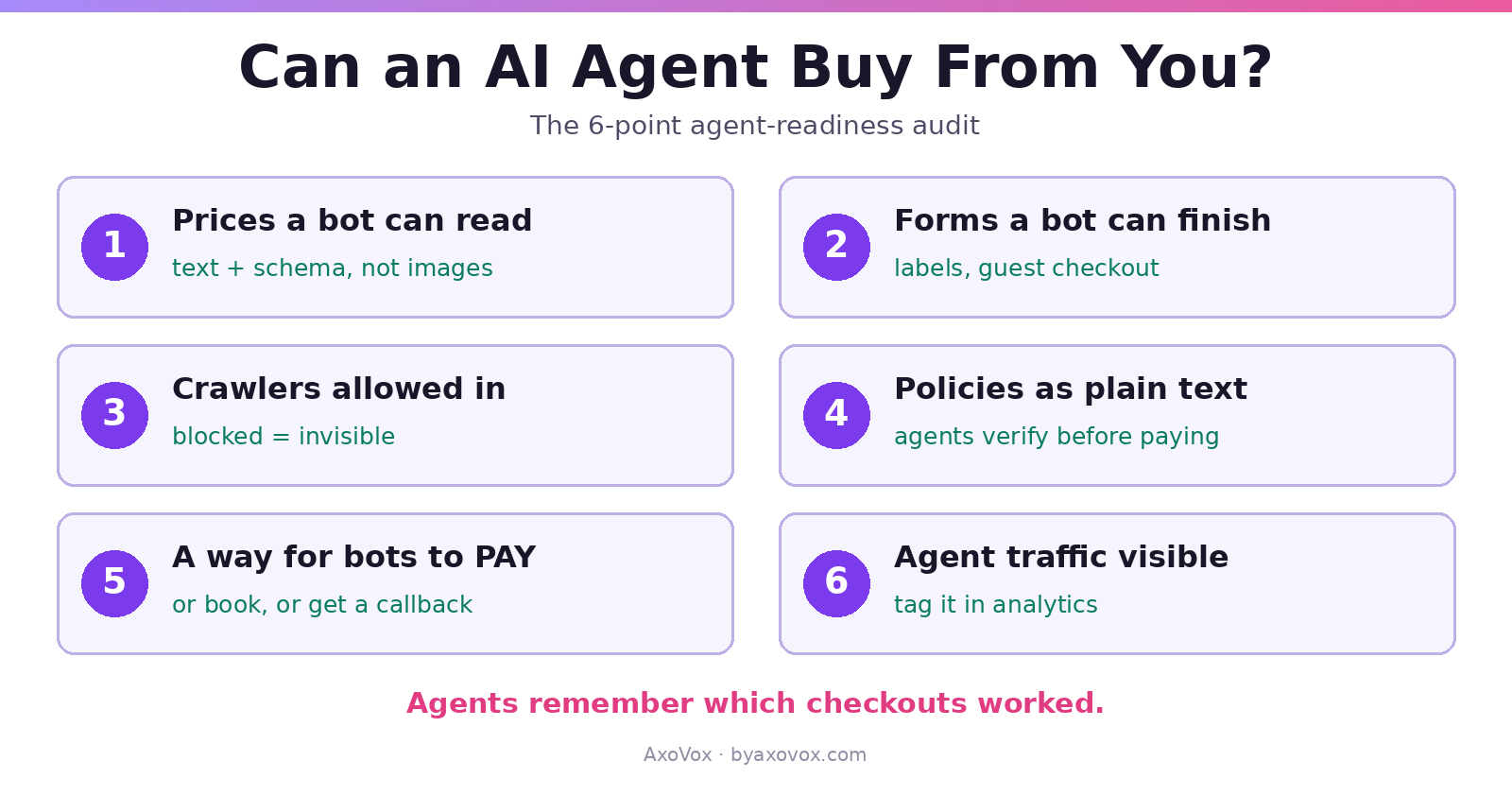
1. Can a machine read your prices?
Agents parse text and structured data; they don’t squint at JPEGs. Prices living inside images, menus as PDFs-of-photos, “request a quote” walls where a number could stand, rates rendered only after three JS interactions: each one is a transaction that dies at hello. Humans tolerate this friction; a bot comparing five vendors for its owner just reports the four that had numbers.
Schema.org Product and Offer markup graduates from SEO nicety to the literal API of your shop window here, the machine-readable layer the evidence principles already demanded, now with a wallet attached.
2. Can software finish your forms?
Agents fill forms the way careful software does: by field labels and structure. Unlabeled inputs, custom dropdowns that only respond to mouse theatrics, multi-step wizards that lose state, error messages that appear as red glow with no text: all of it strands the bot mid-checkout. The fixes are the accessibility checklist your developer postponed, proper labels, native elements, text errors, guest checkout. Accessibility, it turns out, was agent-readiness all along; screen readers and shopping bots read the same page.
3. Is your bouncer checking the wrong IDs?
Half the sites I audit still block AI traffic by accident, a firewall default, a 2023 robots.txt line, and the blocking now costs transactions, not just citations. The agent species to allow: OpenAI’s crawler and user-driven agents, Google’s, Perplexity’s, the named, verifiable bots. The species to keep fighting: anonymous scrapers. Those are different lists, and most security tools ship treating them as one.
CAPTCHA deserves its own sentence: a wall at the door challenges every legitimate agent; a challenge triggered by abuse signals catches abusers. Move the checkpoint.
4. Are your policies findable as text?
Before an agent commits its owner’s money, it verifies: shipping costs, return windows, cancellation terms, service areas. Policies buried in checkout-step tooltips or a PDF scan don’t exist to it, and agents are built cautious; missing terms read as risk, and cautious software recommends the competitor whose terms it could read. A plain /shipping and /returns page, linked in the footer, written in sentences, is now conversion infrastructure.
5. Can a bot PAY you?
The end of the audit is the till. If you’re on Shopify or the platforms wiring into the Agentic Commerce Protocol, chat-side checkout is arriving under you, keep your product feed clean and you inherit it. Custom-stack merchants should put ACP/Stripe agentic payments on the roadmap now, because “the agent found you, compared you, chose you, and then couldn’t pay” is the new abandoned cart, and it won’t show up in your funnel as anything but silence. Service businesses: your version is a booking flow a bot can complete, or at minimum a form that produces a confirmed callback.
6. Will you even know it happened?
Agent sessions look strange in analytics: fast, linear, no scroll depth, odd user agents, datacenter IPs. If your reporting treats them as junk traffic, you’ll optimize against your best new customers. Start tagging known agent user-agents in your analytics now, even crudely; the merchants who can SEE this channel in six months will be the ones who invested in it.
The honest caveats (this is week-one territory)
Agents misfire: OpenAI itself disclosed incidents during rollout, agents posting images they shouldn’t have, security breaches under investigation, and sensitive actions like password changes stay human-only by design. Dots is Pro/Business-tier, not yet in the EEA, and one-per-user at launch, so today’s agent traffic is a trickle, not a flood. That’s exactly the argument for auditing now: you’re fixing the ramp before the traffic, and every fix above, readable prices, finishable forms, findable policies, also converts humans better. The downside case is a better website.
The strategic read: agents have memory, and defaults compound
A human shrugs off a broken checkout and might return. An agent records “merchant X: task failed” and its owner never hears your name again; the delegation layer silently routes around you. The mirror image is the prize: be the site where the task SUCCEEDED, and you become the remembered default for a buyer who doesn’t comparison-shop twice. Early-mover advantage in most channels decays; in a channel with memory, it compounds.
Common questions
What is agentic commerce?
Transactions initiated or completed by AI agents acting for a person: researching options, filling checkouts, booking services, and paying through rails like the Agentic Commerce Protocol that powers ChatGPT’s Instant Checkout with Etsy and Shopify merchants.
Are AI agents really visiting websites today?
Yes, in growing numbers: OpenAI’s Dots and Meta’s Muse run always-on with their own browsers, ChatGPT’s agent mode drives sites on request, and Perplexity’s Comet ships an agent to every free user. Volume is early; direction isn’t.
How do I make my website agent-friendly?
The audit above: prices and stock as text plus Product schema, labeled finishable forms with guest checkout, verified AI crawlers allowed through, policies as plain findable pages, a payment or booking path software can complete, and analytics that can recognize agent sessions.
Should I remove CAPTCHA for AI agents?
Don’t remove it; relocate it. Door-wall CAPTCHAs block legitimate delegated buyers along with abusers, while abuse-triggered challenges (rate, behavior, risk signals) keep protection without taxing every transaction.
What is the Agentic Commerce Protocol?
An open standard, developed by OpenAI with Stripe, letting AI assistants complete purchases with merchants directly, the rails under ChatGPT’s Instant Checkout. Platform merchants largely inherit it; custom stacks integrate via their payment provider.
Can AI agents fill out lead forms and book appointments?
When the form is machine-finishable, yes, and it’s already happening with agent mode and always-on agents. Labeled fields, native elements and text-based errors are the difference between a booked job and a silent failure.
How do I see AI agent traffic in my analytics?
Segment by declared agent user-agents and watch for the signature: fast linear sessions, no scroll, datacenter origins. Crude tagging today beats perfect ignorance; this channel won’t appear in standard reports on its own.