Most YouTube marketing advice is written for people who want to become YouTubers: post constantly, chase subscribers, crack the algorithm, buy a microphone the size of a fist. A small business needs none of that, because a small business isn’t trying to build an audience. It’s trying to be the answer.
Here’s the reframe this whole guide runs on: for a business, YouTube is a search engine that happens to play video. People type “how to fix a leaking mixer tap,” “what does a kitchen renovation cost,” “how to choose an accountant for a small company,” and videos answering those questions rank for years, surface inside Google’s own results, and increasingly get cited in AI answers. The subscriber game is a talent show. The search game is marketing, and it’s winnable from a phone.
Why the search game beats the subscriber game
Three properties make search-first YouTube unusually good for small businesses.
It compounds. A video answering a real question earns views month after month with zero additional effort, the same economics as a ranking page, which is exactly what it is. Compare that to a social post’s 48-hour lifespan, and the hour spent filming starts looking like the best hour of the marketing week.
It double-lists. YouTube videos rank in YouTube search and in Google’s regular results, where video carousels sit on countless how-to and cost queries. One piece of work, two search engines, and since Google’s AI Overviews and AI Mode cite video sources too, the same video now has a third surface to appear on. That’s the same two-scoreboards logic behind everything in our SEO explainer, with a camera.
It pre-sells like nothing else. A customer who watched you explain their exact problem for four minutes arrives half-convinced; they’ve already met you, heard your accent, judged your competence, and chosen you over the faceless alternatives. Service businesses live and die on trust, and video transmits it at a rate text can’t touch.
What to film: mine your own inbox
Forget brainstorming content. Your video plan already exists in the questions customers ask you every week, and each one is a search someone types.
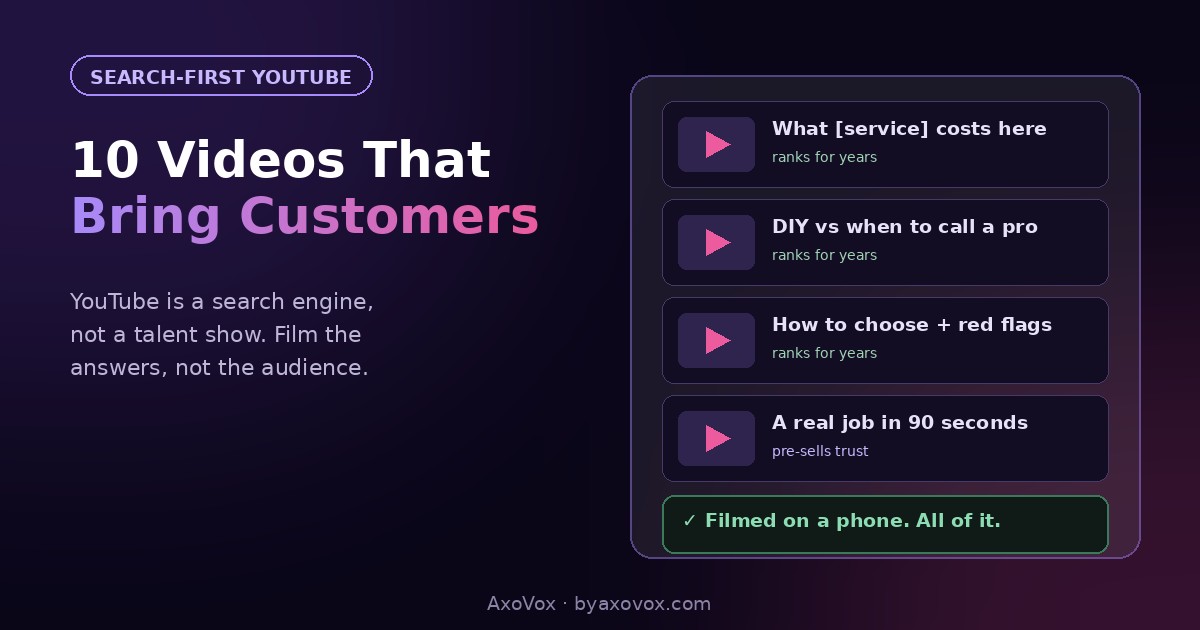
1. What [your service] costs in [your area], honestly, with ranges
2. How long [common job] actually takes, start to finish
3. The mistake most people make before calling you
4. [Common problem]: fix it yourself vs. when to call a pro
5. What happens on the first visit/consultation, filmed
6. How to choose a [your profession], including the red flags
7. A real job, start to finish, in 90 seconds
8. The 5 questions we get asked most, answered straight
9. [Seasonal problem] and what to do before it starts
10. Why we turn down some jobs (the honesty video, always a sleeper hit)
Notice the pattern: cost, time, trust, proof. The videos answer what buyers ask before hiring anyone, which means the viewers aren’t an audience, they’re pipeline. And yes, video #1 means naming prices on camera; the businesses that do own the query every competitor is afraid of.
The production bar, honestly
The bar is: a modern phone, daylight or a window, and quiet. That’s it. Prop the phone at eye level, look at the lens, talk like you talk to a customer, and keep it between 2 and 6 minutes. Screen recordings work for anything software-ish. Cut the fumbles with the free editor of your choice or don’t cut them at all; competence with a little roughness reads as more trustworthy than polish, the same reason raw beats produced in short-form video.
The sustainable cadence for a busy owner: one video every week or two. Twenty-six searchable answers a year, each working forever, beats a January burst of daily uploads followed by silence, because the algorithm forgives slowness and punishes disappearance far less than your own burnout does.
The optimization that actually matters
YouTube SEO has a hundred tips; five carry nearly all the weight. Make the title the search phrase itself (“What a Bathroom Renovation Costs in 2026”), not a clever pun. Say the same phrase out loud in the first fifteen seconds; YouTube transcribes everything and weighs it. Write two honest sentences of description with your city and a link to the relevant service page. Make the thumbnail three readable words on a clear image, designed for a phone screen. And add chapters for anything past three minutes, because chapters get pulled into Google results as jump links.
Then close the loop: embed each video on the matching page of your website. The page gets a trust asset and longer visits; the video gets views from your existing traffic; and both feed the same buyer. A cost video embedded on a pricing page is the strongest single placement in small-business video marketing.
What to skip without guilt
The daily-Shorts grind (repurpose clips from your long videos instead, as a discovery layer, not a strategy). Subscriber-count anxiety, since your buyers search, watch, and call without ever subscribing, and that’s the system working. Monetization dreams: AdSense pays creators pennies while one plumbing customer pays real money; you’re not building a channel, you’re building answers. And expensive gear, at least until video #20 proves the channel earns it. The hours all of that would eat belong to the ranked list in our customer sources guide, where video slots in as a trust-and-search layer, not a replacement for reviews and the profile.
Frequently asked questions
Is YouTube marketing worth it for a small business?
Yes, when played as search rather than as a subscriber game: videos answering real customer questions rank for years, appear in Google results and AI answers, and pre-sell viewers into warm leads. It’s the compounding logic of SEO with trust transmission text can’t match.
What should a small business post on YouTube?
Answers to the questions customers already ask: what things cost, how long jobs take, how to choose a provider, DIY-vs-pro guidance, and real jobs shown start to finish. Mine your inbox and your last twenty customer conversations; the plan writes itself.
How often should a small business post videos?
Every one to two weeks, sustained, beats daily bursts that end in silence. Search-driven videos keep earning regardless of upload frequency, so consistency you can maintain outranks intensity you can’t.
Do I need professional equipment for business YouTube videos?
No. A modern phone at eye level, window light, and a quiet room clear the bar. Slightly rough but competent reads as more trustworthy than polished; upgrade gear only after the channel proves itself.
How do small business videos show up on Google?
Google inserts video results on many how-to and cost searches, pulling from YouTube. Title the video as the search phrase, say the phrase early (YouTube transcribes everything), add chapters, and embed the video on the matching page of your site.
Do YouTube videos appear in AI answers?
Increasingly, yes: Google’s AI Overviews and AI Mode cite video sources among their references, and clear, question-answering videos are exactly the format they lift. The same clarity that wins search wins citations.
Want a video plan built from your actual customer questions, or an honest “your hours convert better elsewhere first”? Ask us, both answers are free.