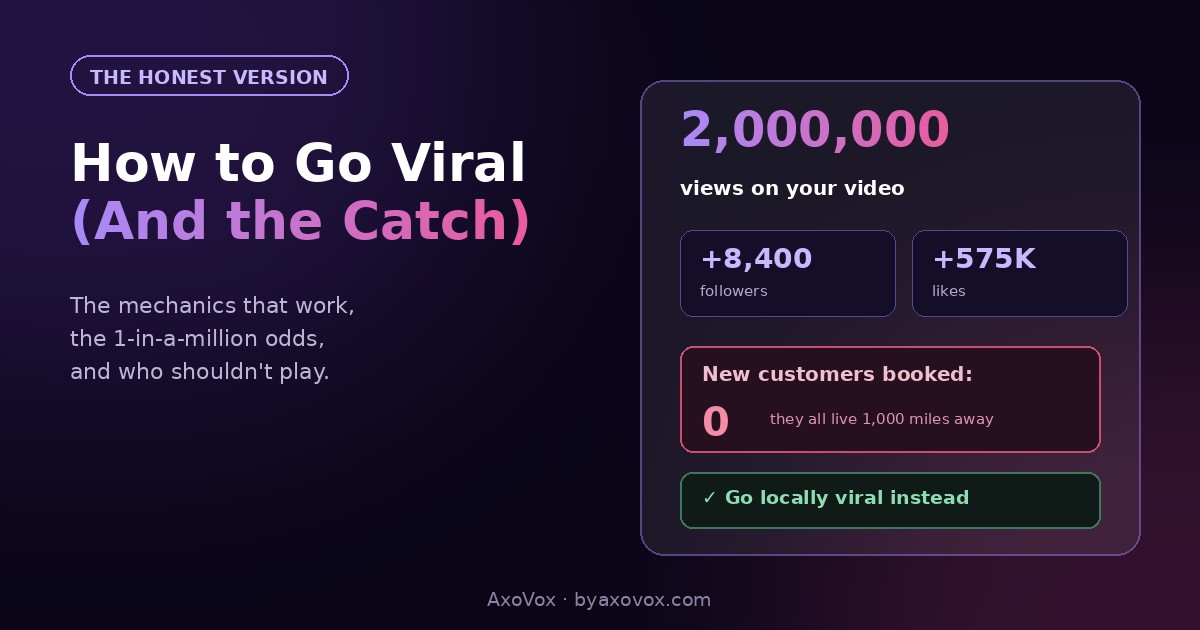
Going viral means your content spreads itself: shares beget shares, the algorithm notices the velocity and pours fuel on it, and something you posted on Tuesday has done more numbers by Friday than everything else you’ve ever made combined. It happens. It’s also, by one Stanford analysis, roughly a one-in-a-million event, against tens of millions of videos uploaded daily to TikTok alone.
This guide does both jobs honestly: the mechanics that genuinely raise those odds, because they exist and they’re learnable, and then the question the viral-tips industry never asks, which is whether a million strangers’ views are worth anything to your particular business. For a surprising number of businesses, the answer changes the whole plan.
The anatomy of content that spreads
Study what actually goes viral and the randomness has structure. Five elements recur:
A hook inside the first two seconds. Viral content wins or dies before viewers know they’re deciding. The opening frame poses a question, breaks a pattern, or starts mid-action. “Let me tell you about…” is a death sentence; “This cost me $4,000 to learn” is a hook.
One strong emotion, all the way up. Shares are emotional acts. Awe, laughter, outrage, “that’s SO me” recognition, satisfying-to-watch process videos. Mildly pleasant content gets likes; content that makes someone feel something gets sent to a friend, and sends are what algorithms now weight heaviest.
A share trigger. The viewer shares for their own reasons, not yours: it makes them look funny, smart, or helpful to their people. The question “who would send this, to whom, to say what about themselves?” predicts spread better than any production value.
A trend, bent. Riding an existing sound, format or moment borrows the algorithm’s current momentum, but carbon copies drown. The versions that pop take the trend somewhere it hasn’t been: your industry, your twist, your reveal.
Native, raw, and finished in under a minute. Phone-shot beats produced on most platforms; polish reads as advertising and advertising gets scrolled. Post when your audience is actually awake, reply to early comments fast (velocity in the first hour is the algorithm’s tell), and accept that even perfect execution buys a lottery ticket, not a result.
The part the viral-tips industry skips
Now the uncomfortable math. Suppose it works. A local plumbing company’s job-site video catches, and two million people watch it. The overwhelming majority live nowhere near the service area, will never need this plumber, and followed for entertainment, an audience that now expects more entertainment, from a business whose product is fixing pipes.
Reach without buyer intent is applause, not revenue. We’ve watched businesses land a genuine viral hit, gain thousands of followers, and book approximately zero additional jobs, then quietly burn months trying to feed an entertainment audience that was never going to convert. Views are not customer sources; they’re views.
Before chasing virality, answer one question: if a million random people saw your content, could more than a handful become customers? E-commerce with national shipping, a visual product, a course, a creator: yes, chase it, virality IS your distribution. A dentist, a plumber, an accountant serving one metro: almost certainly no, and the hours belong elsewhere.
The version that converts: locally viral
Here’s the reframe that makes the viral instinct useful for a local business. You don’t need a million strangers. You need three thousand neighbors, and “viral” inside a town is a completely achievable, regularly repeating event: the post that every local Facebook group shares, the before-and-after that makes the neighborhood rounds, the review story people retell.
The same five mechanics apply, aimed smaller: hooks, emotion, share triggers, but the emotion is local pride or local usefulness, and the share trigger is “everyone on our street should see this.” A dramatic transformation photo, a genuinely helpful “what this repair actually costs here” post, a customer’s own delighted video reshared with permission. That last one, customer-made content, is the reliable engine; it converts better than anything brand-made and costs only the asking, which is why it tops our social media types ranking.
Locally viral compounds where globally viral evaporates: the people who saw it can actually call you, and the same post feeds the review-and-reputation loop that brings customers on its own.
If you’re going to swing anyway
Fair enough, sometimes the business fits and sometimes the swing is just fun. The checklist that maximizes odds without wrecking the week: batch-film several attempts in one session rather than betting on one; open on the hook, no intros ever; one emotion per piece; steal trending formats and bend them to your niche; post at your audience’s active hours and camp in the comments for the first hour; and cap the experiment, a set number of attempts per month, so the lottery tickets never eat the marketing that reliably works. Virality is a bonus round. The boring compounding list stays the actual game.
Frequently asked questions
How do you go viral on social media?
Raise the odds with the recurring mechanics: a hook in the first two seconds, one strong emotion, a reason for viewers to share it (it makes them look good to their people), a trending format bent to your niche, and raw, native-feeling video under a minute. Then accept that virality remains roughly a one-in-a-million event per post.
What makes content go viral?
Shares, at velocity. Algorithms detect content being sent person-to-person faster than normal and amplify it. Emotion drives the sending: awe, humor, outrage, recognition, or satisfaction, which is why competent-but-mild content plateaus.
Is going viral good for business?
Only when reach matches your market. National e-commerce, courses and creators can convert a viral moment; local service businesses usually gain entertainment followers who will never buy. Reach without buyer intent is applause, not revenue.
How can a small local business go viral?
Aim for locally viral instead: the post every neighborhood group shares. Dramatic before-and-afters, genuinely useful local cost breakdowns, and resharing customers’ own content hit the same share mechanics at a scale where viewers can actually become customers.
How often should I try to make viral content?
Cap it: batch a few attempts monthly as a bonus round while the reliable channels (reviews, search visibility, email) run uninterrupted. The failure mode isn’t swinging and missing; it’s letting lottery tickets replace the compounding work.
Want a plan weighted toward what converts in your actual market, viral swings included where they fit? Talk to us. If your business is one where chasing views is the wrong game, we’ll say exactly that.