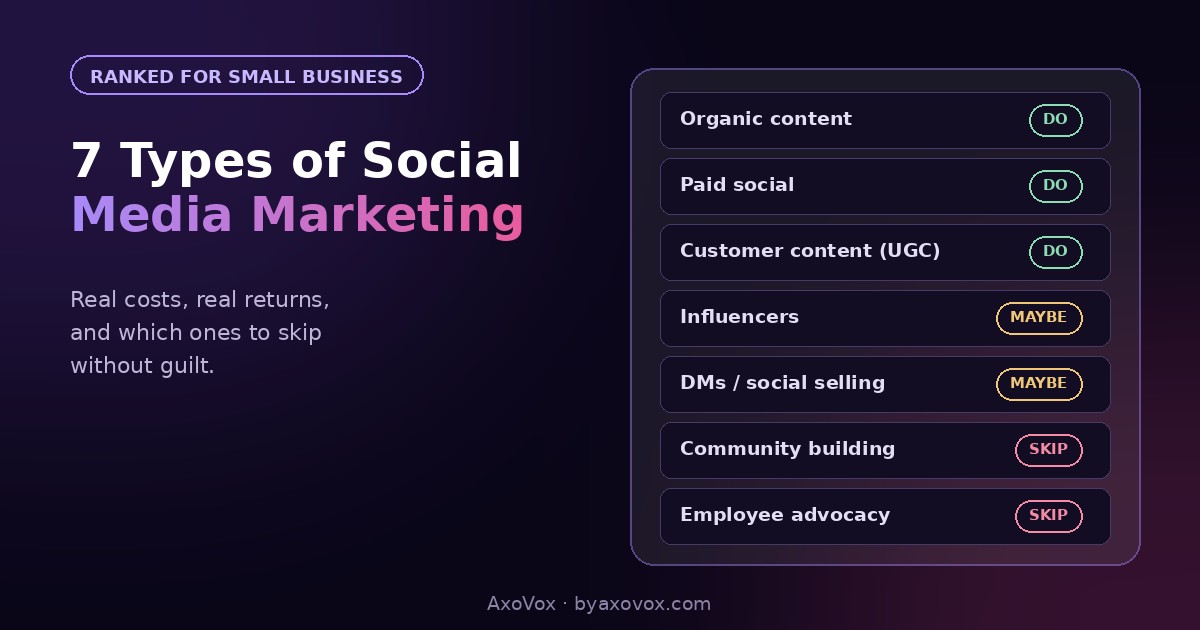
There are seven distinct types of social media marketing: organic content, paid social ads, influencer partnerships, user-generated content, community building, social selling, and employee advocacy. Every agency article lists them. Almost none answers the question a small business actually has: which ones are worth MY hours and MY budget, and which ones can I skip without falling behind?
So this is the ranked version. Each type with its real cost in time and money, what it realistically returns at small-business scale, and a straight verdict. Spoiler for the busy: two of the seven earn their keep for most small businesses, two are situational, and three are big-brand games wearing small-business costumes.
The seven at a glance
| Type | Real cost | Small-biz verdict |
|---|---|---|
| 1. Organic content | 2-5 hrs/week | Do it, as presence, not growth |
| 2. Paid social ads | $300+/mo + setup | Do it, when the offer fits |
| 3. User-generated content | Nearly free | Do it, most underused type |
| 4. Influencer marketing | $100-1,000+ per post | Situational: local micro only |
| 5. Social selling / DMs | Hours, ongoing | Situational: B2B and high-ticket |
| 6. Community building | Heavy, ongoing | Skip until you have an audience |
| 7. Employee advocacy | Coordination time | Skip under ~10 employees |
1. Organic content: the presence layer
Posting to your own profiles: tips, finished work, offers, the occasional face behind the business. The honest 2026 numbers first: organic reach for business pages is minimal, a small single-digit percentage of your own followers on most platforms. As a growth engine, organic social is mostly a treadmill.
So why do it at all? Because the profile has a second job that has nothing to do with reach: it’s a trust checkpoint. Customers who found you elsewhere, search, referral, an AI answer, check whether you look alive before calling. A page last updated in 2024 whispers “maybe closed.” Two posts a week, recycled from real work and real customer questions, keeps the lights visibly on for a couple of hours of effort. That’s the job. Expecting more than that job is where the disappointment comes from, and it’s why organic social ranks below reviews, search and email in our ranked customer sources.
2. Paid social: renting precision
Meta’s targeting machine is genuinely powerful, and it solves organic’s reach problem with money. The fit question decides everything: paid social shines for visual, impulse-friendly, broad-appeal offers (food, fitness, beauty, home improvement with good photos) and struggles for emergency services nobody thinks about until the pipe bursts; that intent lives on search, the trade-off our SEO vs PPC comparison maps.
Entry math: $300-500/month minimum to learn anything, same logic as search ads, and the same leak-control rules apply. Treat the first month as tuition, run one offer to one audience, and judge on cost per lead, never on reach.
3. User-generated content: the free one everyone ignores
Customer photos, tagged posts, video testimonials, unboxings. UGC converts better than brand-made content for the oldest reason in commerce: people believe customers over companies. It’s the same psychology that makes Google reviews your strongest asset, extended to content.
The small-business play is embarrassingly simple: ask, at the happy moment (“mind if we share this on our page? tag you of course”), then repost with thanks. A service business that reposts one customer result a week has a content calendar that builds itself and sells better than anything the owner could write. Cost: the asking. Verdict: the highest ROI-per-hour item on this page.
4. Influencer marketing: buy small or don’t
Paying people with audiences to feature you. At celebrity scale it’s a brand-awareness game with brand-sized budgets. The version that works for small businesses is local micro-influencers: the neighborhood foodie with 8,000 engaged local followers moves more plates than a national account with a million scattered ones, and often works for a free meal or $100-300.
Two rules keep it honest: engagement over follower count (500 real comments beat 100K ghost followers), and trackable offers (a code or dedicated link) so you know what a post produced. If you can’t name how you’d measure it, you’re buying a feeling.
5. Social selling: DMs as a channel
Direct relationship-building in comments and messages: answering questions, joining local groups, being helpfully present where your customers ask for recommendations. For B2B, consultants and high-ticket local services, this quietly closes real deals; a helpful answer in a neighborhood Facebook group outranks any ad in that thread.
The cost is that it’s manual, personal, and doesn’t scale, which is also why it works. Budget real weekly hours or skip it; a half-abandoned effort here is invisible.
6. Community building: the endgame, not the start
Running your own group, Discord, or engaged following that talks back. Genuinely powerful, and genuinely a heavy ongoing commitment that pays off on top of an existing audience. Starting a community with 40 followers is hosting a party in an empty room, weekly, forever. Earn the audience first through the types above; open the room later. For most local businesses, the honest version of “community” is their review page and their repeat customers, which cost far less to cultivate.
7. Employee advocacy: a big-company sport
Coordinating employees to share company content from personal accounts. Works at 200 employees; at 4, it’s asking your two technicians to post awkwardly. The tiny-business version that does work: the owner’s personal account being genuinely visible locally. People buy from faces. That costs nothing and needs no program.
The mix that makes sense
For a typical local service business: organic presence (2 posts/week, UGC doing half the work), reviews feeding both the profile and the content, paid social only when the offer photographs well, and DMs where the neighborhood already talks. Total: a few hours weekly plus an optional test budget, fitting inside the normal 7-12% marketing allocation with room left for the channels that convert harder. One practical trick while you’re at it: on Facebook, put links in the first comment rather than the post body; the algorithm treats outbound links in posts unkindly, and the reach difference is real.
Frequently asked questions
What are the main types of social media marketing?
Seven: organic content, paid social advertising, user-generated content, influencer marketing, social selling through comments and DMs, community building, and employee advocacy. Most small businesses only need two or three of them.
Which type of social media marketing is best for small businesses?
User-generated content for return on effort (customer posts convert better than brand posts and cost only the asking), organic content for presence, and paid social when the offer is visual and broad-appeal. Community building and employee advocacy generally don’t pay off at small scale.
Is organic social media marketing dead?
As a growth engine, mostly: business-page reach is a small single-digit percentage of followers. As a trust layer it’s alive and mandatory, since customers who find you elsewhere check whether your page looks active before contacting you.
How much does social media marketing cost?
Organic and UGC cost hours: budget 2-5 weekly. Paid social needs $300-500/month minimum to generate learnable data. Local micro-influencers run roughly $100-300 per collaboration. The expensive version is doing all seven types at 15% intensity each.
Do I need to be on every social media platform?
No, and trying is the most common way small businesses turn social into pure overhead. One platform where your customers actually are, maintained consistently, beats five maintained sporadically. For most local businesses that’s Facebook or Instagram, chosen by where the local groups and customers already live.
Want an honest look at whether social deserves more of your week, or less? Ask us, and bring your numbers; sometimes the right answer is two posts a week and reinvesting the rest of the hours where they convert.