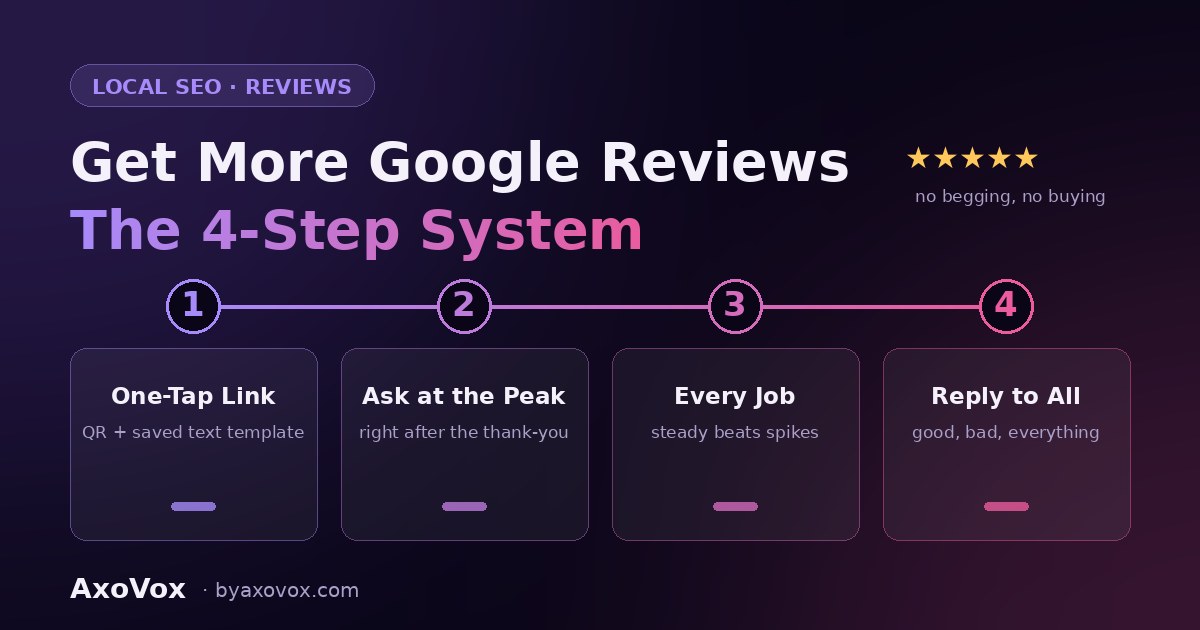
The businesses with the most Google reviews aren’t luckier, they ask more people, at the right moment, with a link that takes one tap. That’s the whole system: ask everyone, ask at peak happiness, remove every step between “sure” and “posted.” Below is the exact ask, the timing, what’s illegal (more than you’d think), and what to do when a bad one lands.
Why reviews decide more than your star rating
Three systems read your reviews, and only one of them is human:
- Customers, the obvious one. Most people read reviews before choosing a local business, and a profile with 12 reviews loses to a profile with 200 before anyone reads a word of either.
- Google’s local ranking, review quantity, recency, and your replies are established local-pack ranking factors. The map results for “plumber near me” are partly a reviews contest.
- AI assistants, the new one. When someone asks ChatGPT or Google’s AI for a recommendation, the models lean heavily on third-party signals, and review platforms are among the loudest. Reviews are earned media at scale, the exact ingredient we covered in getting your business mentioned in ChatGPT and AI search. Every review is a tiny endorsement AI can read.
First: what’s not allowed (and now actually enforced)
Worth stating before the tactics, because half the “growth hacks” floating around are policy violations:
- No buying reviews. Fake review sellers exist; so do regulators. The FTC’s rule against fake reviews carries penalties that can run into tens of thousands of dollars per violation, and Google removes both the reviews and, in bad cases, the profile’s visibility.
- No incentives. Discounts, gifts, or raffle entries in exchange for reviews violate Google’s policy, even for honest reviews, even if you don’t require 5 stars.
- No review gating. Surveying customers first and only sending happy ones to Google is explicitly prohibited. Ask everyone or ask no one.
- No employee or family reviews. Google’s detection for this is better than people assume, same devices, same networks, sudden bursts.
The good news: the legal playbook works better anyway, because steady, authentic, replied-to reviews are exactly the pattern every system rewards.
The system that fills a review profile
1. Make the link one tap (10 minutes, once)
In your Google Business Profile dashboard, hit “Ask for reviews” to get your direct review link, it opens straight into the write-a-review box, no searching required. Then deploy it everywhere the ask happens: a saved text/WhatsApp template, your email signature, invoices and receipts, and a QR code at the counter, on the van, or on the leave-behind card. Every step you remove roughly doubles follow-through; a customer who has to search for your profile mostly won’t.
2. Ask at peak happiness, not at checkout
Timing beats phrasing. The moment to ask is when satisfaction peaks: the job just passed inspection, the problem just got fixed, the customer just said “this looks amazing.” A compliment is an open door, the natural response to “you saved us” is “would you mind putting that in a Google review? Here’s the link.” Send the link within the hour while the feeling is warm; a request three days later competes with everything else in their life.
3. Ask like a person, not a kiosk
The script that works is short, personal, and explains why it matters:
“So glad it worked out. Reviews genuinely decide whether people find a small business like ours, would you mind sharing your experience on Google? Takes a minute, here’s the direct link.”
Two upgrades: make it specific (“if you mention the emergency call-out, that helps people with the same problem find us”), specific reviews are more useful to readers, and their detail is exactly what AI systems quote. And have the person who did the work ask, customers say yes to the technician they just thanked far more often than to an anonymous email blast.
4. Make it a habit, not a campaign
One blast to your old customer list produces a spike then silence, and a burst of 30 reviews followed by nothing looks manufactured to both humans and algorithms. Steady beats spiky: build the ask into the end of every job. The mechanism matters less than the consistency, a checklist item, a CRM automation, whatever survives a busy week. Two to three new reviews a week, forever, beats fifty in March and none since.
5. Reply to every review — all of them
Replies are the multiplier most businesses skip. They signal an active business to Google, show future customers someone’s home, and encourage the next reviewer. Keep positive replies short, specific, and varied, thank them for the detail they mentioned, not a copy-paste “Thanks for the 5 stars!” And write for the audience: every reply is read by hundreds of future customers and exactly one past one.
6. Handle bad reviews like a professional in public
One calm rule: the reply is for the readers, not the reviewer. Acknowledge, own what’s yours, state what you did about it, take the rest offline, never argue, never reveal customer details. A 4.7 with a few well-handled complaints converts better than a suspicious wall of perfect fives; readers look for how you behave when something goes wrong. If a review is genuinely fake or violates policy (spam, wrong business, harassment), report it through your profile dashboard, removal takes days to weeks and only works for actual violations, not for “customer was unfair.”
Frequently asked questions
Can I offer a discount for a Google review?
No, incentivized reviews violate Google’s policy regardless of whether the review is honest, and paid or faked reviews can trigger regulatory penalties. You can (and should) make asking effortless; you can’t make it a transaction.
How many Google reviews do I need?
Enough to beat your local competitors, plus recency. Look up the top three businesses in your category and area, their counts are your target. A profile whose latest review is eight months old reads as closed; recency often matters more than raw total.
Do replies to reviews affect ranking?
Engagement on your profile, including consistent replies, is part of a healthy local-SEO signal set, and Google itself encourages responding. The bigger effect is human: profiles with thoughtful replies convert more of the people already looking.
How do I remove a fake bad review?
Report it via your Business Profile dashboard (or the flag on the review) under the policy it violates, spam, off-topic, conflict of interest. Expect days to weeks, and only actual policy violations get removed. While it stands, a calm factual reply limits the damage more than the review itself causes.
Should I use a review management tool?
Once volume justifies it, automation for the ask-and-remind flow helps. But tools amplify a working habit; they don’t create one. Nail the manual system first, link, timing, personal ask, then automate what’s already producing.
The bottom line
Reviews compound like nothing else in local marketing: each one improves your map ranking, your conversion rate, and your odds of being the business AI assistants recommend, and they never expire. The system is almost embarrassingly simple: one-tap link, ask at the high point, ask every time, reply to everything. The hard part isn’t knowing it; it’s doing it every week.
Want reviews wired into a full local visibility system, profile, rankings, and AI mentions together? That’s the work we do. Tell us about your business and we’ll show you where you stand against the competitors on your map.