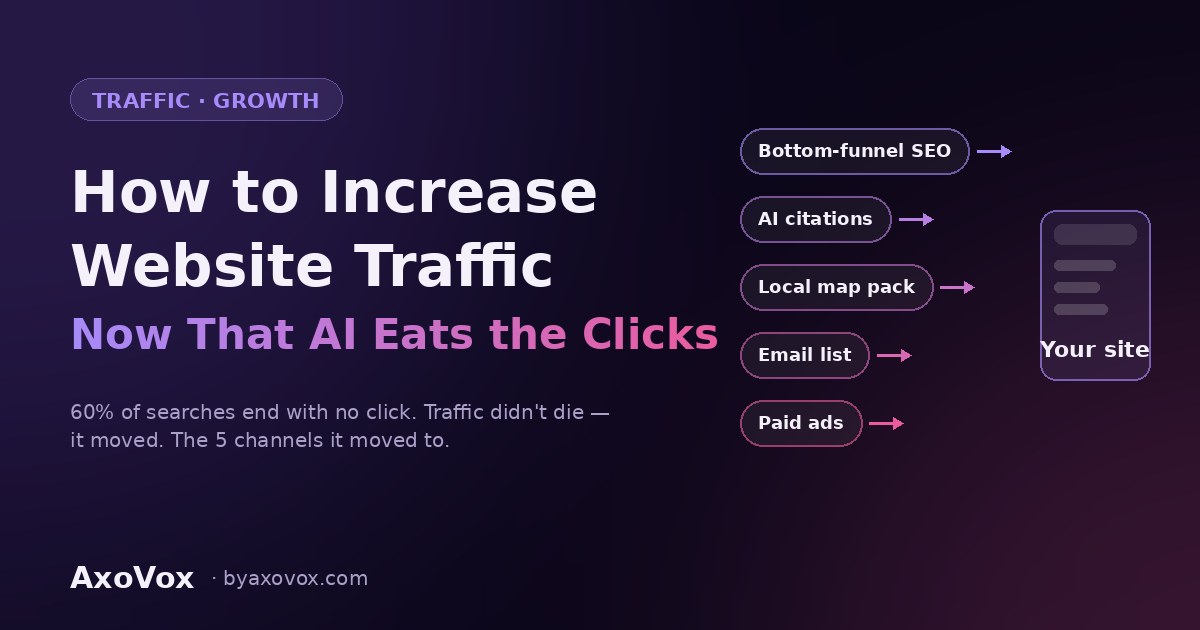
Here’s what every “increase website traffic” guide won’t open with: about 60% of Google searches now end without a click going to anyone. The 2019 playbook, publish more blog posts, wait for Google, is quietly dying while its still being sold. But traffic didn’t disappear; it moved. In 2026 it comes from five places: the clicks AI can’t take, the AI answers themselves, local search, email you own, and paid you control. Here’s the honest version of each.
First, an uncomfortable question: which traffic do you actually want?
We audit sites every week that “lost traffic” and lost nothing that mattered, the vanished visits were people reading a definition and leaving forever. Before optimizing anything, split your traffic goal in two: visits that can become customers (service pages, pricing, comparisons, local searches) and visits that build audience (email signups, followers, subscribers). Raw sessions that do neither are a vanity metric with hosting costs. Every tactic below feeds one of the two real buckets.
1. Build the pages AI can’t answer for you
AI Overviews now appear on nearly half of queries and devour generic “what is X” content. What they can’t replace: someone wanting you specifically. Pricing pages with real numbers. Comparisons against alternatives. Case studies. Calculators and tools. “Near me” intent. If your content plan is 80% explainers, this is the rebalance, and if your traffic already fell while rankings held, that’s the AI-click story, which we broke down (with the 5-minute diagnosis) in why your Google traffic dropped.
2. Get cited by the AI — the new referral channel
The counterintuitive 2026 play: the thing eating your clicks is also a traffic source. Brands cited inside AI Overviews earn dramatically more clicks than uncited brands on the same queries, 2026 measurements put it around 120% more per impression, and referrals arriving from chatgpt.com and perplexity.ai convert unusually well, because the AI already recommended you before the click. Two guides cover the playbook: winning Google’s AI Overviews and getting mentioned in ChatGPT. This is where early movers are collecting outsized share right now.
3. SEO still works — for content shaped like 2026
Organic search still delivers roughly half of web traffic; what died is lazy content, not the channel. The shape that wins now: real questions as headings, direct 40-60 word answers underneath, facts instead of adjectives, a visible author, and freshness, the large majority of AI-cited pages were published or updated within two years. Set expectations honestly too: 3-6 months to first results, compounding after (the full timeline is here). And one tactic thats pure leverage: updating your ten best existing pages beats writing ten new ones, every time we test it.
4. Local search: the most winnable traffic there is
If you serve a geographic area, this is your best pound-for-pound channel: 46% of Google searches have local intent, 76% of local mobile searchers visit a business within a day, and businesses in the map pack get 126% more traffic than those ranked just below it. Your competition is your city’s half-finished profiles, not the internet. The complete sequence, profile, reviews, citations, local content, is in our local SEO checklist.
5. Email: the only traffic nobody can take away
Every channel above rents attention from someone’s algorithm. An email list is the exception, and it still returns roughly $35-40 per dollar spent, the best in marketing. The move: turn every visitor spike from the other channels into signups (a genuinely useful lead magnet beats “subscribe to our newsletter” by miles), then email consistently. When an algorithm change hits, and one always does, the list is what keeps your traffic curve from starting over at zero.
6. Paid ads: the throttle, not the engine
Paid is the only channel where traffic responds to a dial. Used right, it’s the bridge while organic compounds and the amplifier on proven pages. Used wrong, it’s a silent budget fire, check the seven waste signs before scaling spend, and the SEO vs PPC breakdown for how the two should split your budget by timeline.
7. Distribution: one asset, five channels
The highest-ROI habit we’ve adopted internally: nothing gets published once. An article becomes a LinkedIn post, an infographic, a short video, an email, and a community answer. Social rarely drives huge direct traffic for small businesses, but it drives the brand searches and third-party mentions that both Google and AI systems read as authority. Which loops back to tactic #2: mentions everywhere are citations tomorrow.
What to stop doing (this part saves you months)
- Publishing thin informational posts, you’re manufacturing content for the AI to answer without you.
- Buying traffic packages, bot visits that tank your engagement metrics and teach the algorithms your site disappoints people. Yes, they still sell these. No, it’s never worked.
- Chasing every platform, a small business doing two channels well beats one doing six badly, and it’s not close.
- Measuring sessions instead of outcomes, the goal was never traffic. It was customers who arrived via traffic.
Frequently asked questions
What’s the fastest way to increase website traffic?
Paid ads, live within days. Fastest free: complete your Google Business Profile and push it (local businesses see movement in weeks), refresh your best existing pages, and distribute what you already published. New SEO content is the slowest lane: months, then compounding.
How can I increase traffic without spending money?
Four free levers, in order of impact: finish your Business Profile, restructure existing pages answer-first (for snippets and AI citations), build the review habit, and repurpose every asset across channels. All cost hours, not dollars, which is the real price of free.
Does social media actually increase website traffic?
Directly, modestly, platforms are built to keep people on-platform. Indirectly, meaningfully: social drives brand searches, mentions, and the third-party signals AI systems weigh. Treat it as an authority channel with a traffic side effect, not the reverse.
Why is my website traffic decreasing?
In 2026 the most common cause for stable-ranking sites is AI Overviews absorbing informational clicks, the signature is steady impressions with falling clicks in Search Console. Rule out broken tracking, technical issues, and seasonality first; our traffic-drop guide has the 5-minute diagnosis.
How much traffic does a small business website need?
Less than you think. A local service site converting 5% of 500 targeted monthly visits gets 25 leads, a full pipeline for most. A thousand random visitors converting nobody gets zero. Aim for the smallest amount of the most targeted traffic that fills your capacity, then scale.
The bottom line
Traffic in 2026 isn’t dead, its redistributed: away from generic informational clicks, toward bottom-funnel intent, AI citations, local packs, owned lists, and paid throttles. The sites growing right now aren’t publishing more, they’re publishing sharper, showing up inside the AI answers, and converting harder on fewer, better visits. That’s the whole playbook, and most of your competitors are still running the old one.
Want to know which of these five channels is your fastest win? Send us your domain, we’ll look at where your traffic comes from now, where it’s leaking, and which lever moves first for your specific situation.