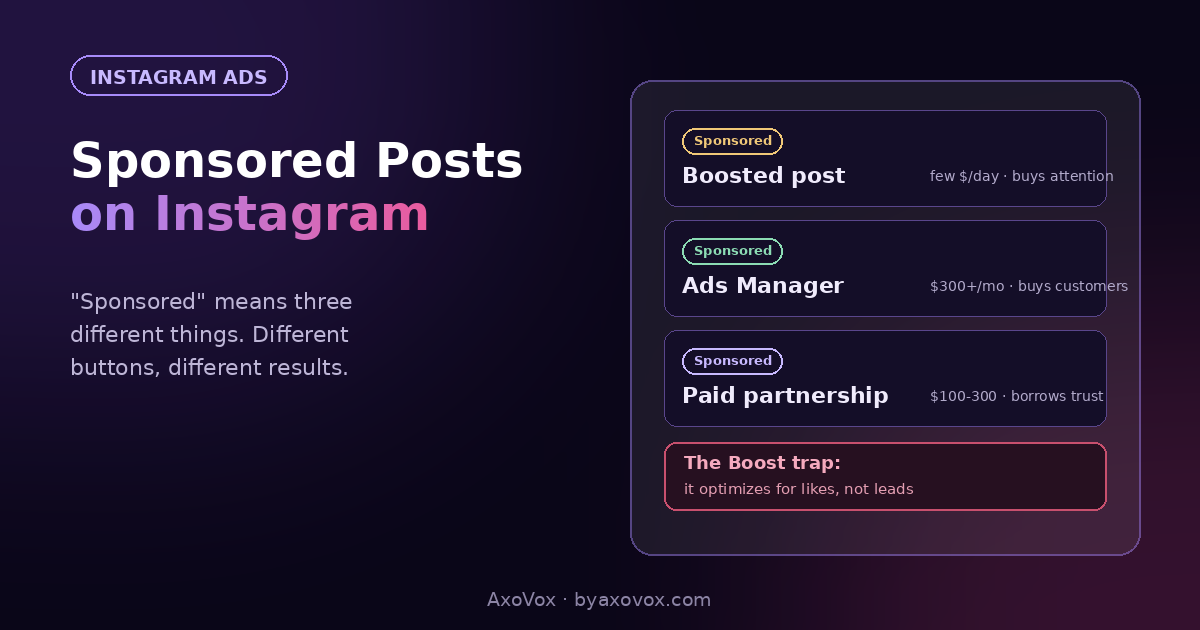
A sponsored post on Instagram is content someone paid to put in front of people who don’t follow them. That’s the label you see in the feed. Behind it, though, “sponsored post” is actually three different things, with different buttons, different price tags and wildly different results, and most explanations blur them together, which is how small businesses end up pressing the wrong one.
Here are all three, what each really costs, the trap built into the easiest option, and an honest test for whether any of them fits your business.
The three things “sponsored post” means
| Type | What it is | Cost | Best for |
|---|---|---|---|
| 1. Boosted post | Paying to push an existing post to more people, via the Boost button | From a few $/day | Visibility on a proven post; not leads |
| 2. Ads Manager ad | A real ad campaign with objectives, targeting and placements | $300-500/mo minimum to learn | Leads, sales, traffic; the serious tool |
| 3. Influencer paid partnership | Paying a creator to post about you, labeled “Paid partnership” | ~$100-300 per post for local micros | Borrowed trust with an engaged audience |
All three show up in feeds with a paid label, and that’s where the similarity ends. The rest of this guide takes them one at a time.
1. The boosted post, and the trap inside the button
Instagram makes boosting frictionless on purpose: a blue button under every post, a few taps, money spent. And here’s what the button doesn’t say: boosts optimize for engagement by default. Meta’s system goes hunting for people likely to like, comment and watch, which is a genuinely different crowd from people likely to call a plumber or book a table. You get impressive-looking numbers, hearts, views, new followers, and a phone that rings exactly as much as before.
That’s the boost trap, and it funds a lot of Meta’s revenue from small businesses. Boosting isn’t useless: pushing a post that already proved itself organically, to build local visibility around an event or an offer, is a legitimate $20 move. Just know what you bought: attention, not intent. When someone tells you “Instagram ads don’t work,” ask if they ever used anything but the blue button. Usually not.
2. Ads Manager: the version that produces customers
The real machine lives in Meta Ads Manager, where you choose an objective (leads, sales, website traffic, calls), target by location, age, interests and lookalikes, and run creative across feed, Stories, Reels and Explore. Same platform, completely different outcomes, because the system optimizes toward what you asked for instead of toward applause.
The honest requirements: a business account, an offer that photographs or films well, and enough budget to learn, $300-500/month minimum, same logic as search ads: below that, the algorithm gets too little conversion data to optimize and results come in streaky. The fit question matters more than the setup: Instagram ads shine for visual, broad-appeal, plan-able purchases (food, fitness, beauty, renovation with good before-and-afters) and struggle for emergency and research-heavy services, where the customer’s intent lives on search. That split, interruption versus intent, is the core of our paid channels comparison, and it decides more Instagram budgets than any targeting trick.
3. Influencer paid partnerships: renting trust
The third meaning: a brand pays a creator to feature it, and the post carries the “Paid partnership with…” label (which isn’t optional; disclosure is required by advertising rules, and hidden sponsorships risk both platform penalties and regulator attention).
At small-business scale the version that pays is local and micro: the neighborhood food account, the city’s home-design page, creators with 5-20K genuinely engaged local followers, often for $100-300 or product. Two rules keep it from becoming an expensive compliment: judge accounts by comments-per-post rather than follower counts, and attach something trackable, a code or a dedicated link, so you can name what the post produced. The wider ranking of where influencer spend sits among your options is in our social media types breakdown.
The fit test before any of the three
One question filters most of the waste: would a stranger, interrupted mid-scroll, plausibly want this? Instagram is an interruption channel; nobody is searching there for an accountant. A bakery’s croissant video, a gym’s transformation, a renovation before-and-after: yes, interruption works, sponsor away. Emergency plumbing, tax filing, B2B services: the buyer’s moment happens on search, and the Instagram budget converts better as a Google budget. Neither answer is wrong; they’re different businesses, and the honest ranking of every channel by cost and speed is our customer sources guide.
And whichever route fits, the same discipline applies as everywhere in paid: one offer, one audience, judged on cost per lead, never on reach, with the spend inside a real marketing budget rather than on top of it.
Frequently asked questions
What does “sponsored” mean on an Instagram post?
Someone paid for you to see it. It’s either a business boosting its own post, a full ad run through Meta’s Ads Manager, or a creator paid by a brand (labeled “Paid partnership”). All three are ads; they differ in who paid, how it’s targeted, and what it’s optimized for.
How much do sponsored posts on Instagram cost?
Boosting starts at a few dollars a day. Real Ads Manager campaigns need $300-500 monthly minimum to generate learnable results. Local micro-influencer partnerships typically run $100-300 per post; big-name creators charge thousands to far more.
What’s the difference between boosting a post and running an ad?
Boosting pushes an existing post and optimizes for engagement, likes, views, follows, by default. Ads Manager campaigns optimize for the objective you choose: leads, sales, calls or traffic. Businesses that “tried Instagram ads” via the Boost button and got nothing usually bought engagement without noticing.
Are sponsored posts worth it for a small business?
When the offer is visual and broad-appeal, yes: food, fitness, beauty, home improvement with strong photos all convert from interruption. Emergency and research-heavy services usually do better putting the same budget into search, where their customer’s intent actually lives.
Do influencers have to disclose sponsored posts?
Yes. Paid promotions must be disclosed, on Instagram via the “Paid partnership” label, and hidden sponsorships risk platform penalties and advertising-regulator action for both the creator and the brand.
How do I create a sponsored post on Instagram?
For a boost: business account, tap Boost under the post, set audience and budget. For a proper campaign: Meta Ads Manager, choose an objective, build the audience and creative, and start at a daily budget you can sustain for a month. For a partnership: agree terms with the creator, who tags your brand via the paid-partnership tool.
Not sure whether your budget belongs on Instagram or on Google? Send us your offer, we’ll give you the honest split, including “neither yet” if that’s the truth.