Google will happily take $300 a month from you. It will also happily take $30,000. Neither number tells you whether the account can work, because the budget question in Google Ads isn’t “what can I afford.” It’s “can I afford enough clicks to learn anything.”
That’s the math this article does. The real minimum, worked through with actual numbers, plus the spending order and the leaks that decide whether the budget buys customers or lessons.
Start from the click, not from the wallet
Search ads are bought per click, and in most service categories a click costs somewhere in the $2-5 range, with competitive verticals (legal, insurance, home services in big metros) running far higher. Industry benchmarks move around, but the shape holds: you’re buying visits one at a time.
Now the chain:
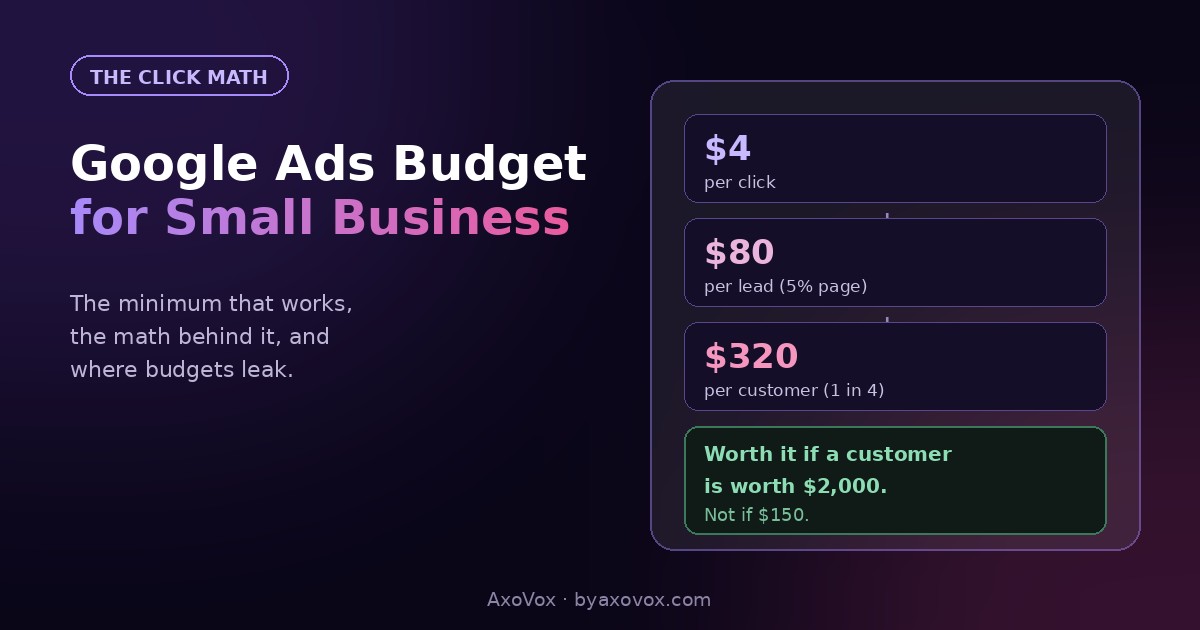
Say a click costs $4.
Say 1 in 20 visitors contacts you (a 5% landing page is respectable).
That’s $80 per lead.
Say you close 1 in 4 leads.
That’s $320 per customer.
$500/month = about 6 leads and 1-2 customers. Fine if a customer is worth $2,000. Pointless if a customer is worth $150.
Run your own numbers through that chain before setting any budget. If the output says a customer costs more than a customer is worth, the answer isn’t a smaller budget. It’s a different channel, or fixing the conversion steps first. Our SEO vs PPC comparison covers when search ads are the wrong tool entirely.
The working minimum
For most local service businesses: $500-1,500/month in ad spend, on one campaign, in one tight geography.
Below roughly $500 the account collects too few clicks to learn from. Google’s bidding systems optimize on conversion data, and an account producing two conversions a month gives the algorithm almost nothing to work with; it stays dumb, and dumb spend is expensive spend. This is also why spreading $800 across Search, Display, and YouTube at once fails predictably: three starved campaigns instead of one that learns.
One campaign, one service, one area. Boring wins again.
Where the budget actually goes
| Slice | Healthy account | Leaky account |
|---|---|---|
| Clicks from real prospects | 75-85% | 40-60% |
| Wrong searches (bad match types, no negatives) | 5-10% | 25-40% |
| Wrong locations / times | <5% | 10-20% |
| Clicks to a page that can’t convert | the rest converts | everything, effectively |
Those leak categories aren’t hypothetical; they’re the standard findings when we audit small accounts, and the fixes are usually settings, not spend. The full leak-by-leak breakdown is in our guide to where Google Ads budgets get wasted, which is the companion piece to this one: this article sizes the budget, that one keeps it.
The spending order as the account grows
- First dollars: one Search campaign on your highest-intent service, exact and phrase match, in your service area. Nothing else.
- Next: retargeting. Roughly 97% of first-time visitors don’t convert. A small remarketing budget ($100-200/month) buys second chances at the cheapest CPCs in the account.
- Then: expand keywords and area, funded by pausing what the data says loses. Expansion comes from evidence, not ambition.
- Last: other networks. Display and YouTube are awareness tools. They belong in the budget after capture works, not before, for the same demand-system reasons we covered in why campaigns break at scale.
How Google Ads fits the total marketing budget
Ads are one line inside the overall number, and the overall number for most small businesses runs 7-12% of revenue. A $400K business budgeting 10% has ~$3,300/month for everything; putting $1,000-1,500 of that into a working ads campaign is a sane allocation, putting all of it in is not. The split logic lives in our marketing budget benchmarks, and the free calculator gives you the total in 30 seconds.
One caution on the sales pitch you’ll hear: Google likes to cite an estimate that businesses make $8 for every $1 spent on its ads. That’s Google’s own economic-impact claim, averaged across everyone including giant advertisers, and it is not a promise about your plumbing company. Plan on the click math above instead.
Frequently asked questions
What’s the minimum budget for Google Ads to work?
Around $500/month in most local service categories, concentrated in one campaign. Below that the account gathers too little conversion data to optimize, and results stay random.
How much do small businesses typically spend on Google Ads?
Common ranges run from a few hundred to a few thousand dollars monthly, but the useful number is yours: cost per click × clicks needed per lead × leads needed per customer, checked against what a customer is worth.
Should I hire someone to manage it or do it myself?
Under ~$1,000/month spend, management fees eat the media budget; run it yourself with tight match types and weekly negative-keyword checks. Past $1,500-2,000, a good manager typically recovers more waste than they cost.
Why is my Google Ads budget spending so fast?
Usually broad match keywords without negatives, too wide a location setting, or Display network accidentally enabled. All three are settings problems, checkable in an afternoon, and all three are in our budget-leak guide.
Is Google Ads worth it for a small business at all?
When the click math closes, yes: it’s the fastest way to appear in front of people searching for what you sell today. When the math doesn’t close, SEO and reviews compound cheaper over time. Run the numbers before the card.
Want your click math checked against your real account? Send it over. If the honest answer is “your budget is fine, your settings are the problem,” that’s what you’ll hear, and it’s cheaper to fix.