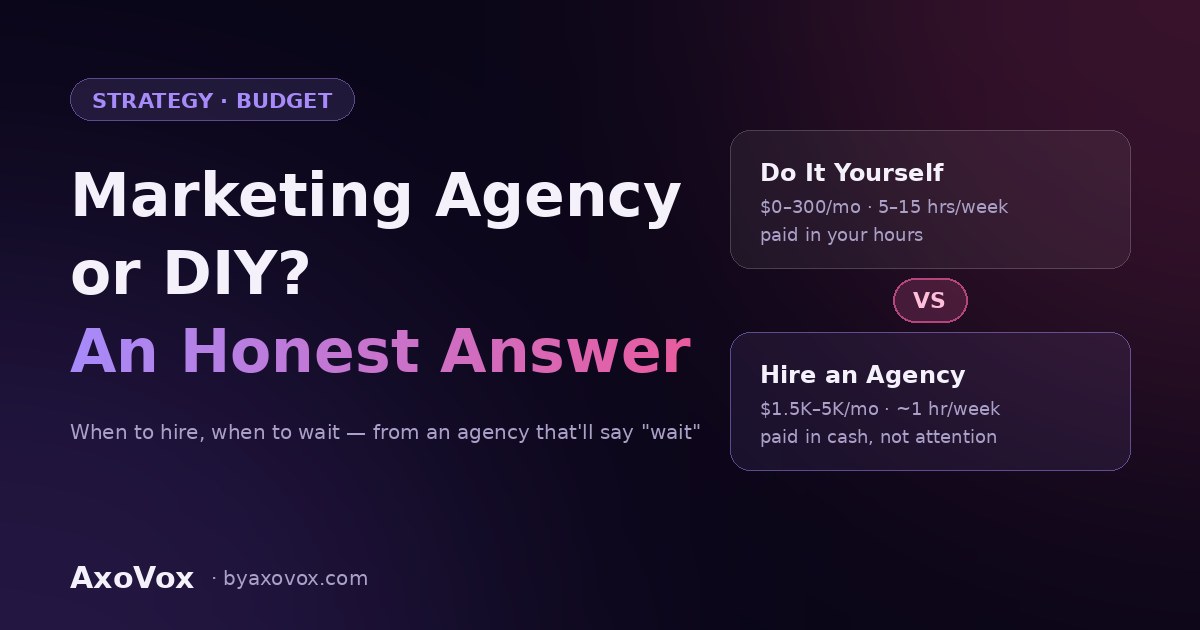
Every agency that writes about this question reaches the same conclusion by a suspicious route: it depends, but probably hire us. We’d rather give you the answer we give friends who ask over dinner. Hire an agency when marketing is costing you more in lost time and missed leads than the retainer would cost, and not one month before. If you’re pre-revenue, can’t sustain at least $1,500 a month, or haven’t yet figured out what you’re selling to whom, keep the money. Yes, an agency is telling you that. The rest of this article is the reasoning, with real numbers, so you can locate yourself honestly.
The cases where you shouldn’t hire anyone, including us
Four situations where a retainer is the wrong purchase, whatever the salesperson says:
The budget is fragile. Marketing compounds, which means an agency fired after sixty days because cash got tight is money burned on both sides of the table. If six months of consistent spend isn’t realistic, a smaller program you can actually sustain will outperform a bigger one you’ll cut.
The offer isn’t validated. When customers aren’t buying even in direct conversations, marketing isn’t the missing piece, and an agency will mostly help you fail with better graphics. Fix the offer first. Marketing amplifies what exists; it doesn’t create product-market fit.
You want to outsource the thinking entirely. Agencies bring expertise and execution, but nobody knows your customers the way you do, and the clients who vanish after signing reliably get worse results than the ones who stay in the loop half an hour a week. If total hands-off is the goal, the results will reflect it.
You’re shopping for guarantees. Anyone promising specific rankings or a fixed number of leads is lying to win the deal, because no honest practitioner controls those outcomes. Wanting to hear the guarantee is how businesses end up hiring exactly the wrong firm.
If none of those describe you, it’s a genuine three-way decision, and each option has an honest price.
Doing it yourself
Cash cost, close to nothing: $0-300 a month in tools covers the fundamentals. A well-run Google Business Profile, consistent posting, a starter email list, basic content. The real currency is 5-15 hours of your week, and that’s where the calculation most owners skip lives.
If your time is worth $75 an hour and marketing takes ten hours weekly, the true cost of “free” marketing is around $3,000 a month of your attention, spent on work a specialist does faster and better, while the selling and serving only you can do waits. Early on, that trade is right anyway, because the hours teach you things about your customers that pay off for years. Once real revenue exists, DIY quietly becomes the most expensive option on this page.
Three areas punish amateurs with actual money rather than just mediocre results: technical SEO, paid ads management, and conversion tracking. A misconfigured ads campaign burns budget silently, and the defining feature of the mistake is that you can’t see yourself making it.
Hiring a freelancer
The middle path, at $50-150 an hour or roughly $500-2,000 a month per channel, and often the correct one. A strong freelancer beats an agency whenever the need is one specific thing done well: a Google Ads specialist, an email marketer, a writer who understands your industry. You’re paying for skilled hands without agency overhead.
The limits arrive with growth. Freelancers execute inside their lane, so nobody owns the overall strategy, the channels don’t talk to each other, and coordinating three contractors turns you into a project manager, which is a part-time job you didn’t budget for. Availability is also single-threaded. One person on vacation is your entire channel on vacation.
Hiring an agency
Small-business programs run $1,500-5,000 a month (the full pricing landscape, including what separates the tiers, is in our marketing cost breakdown). What the retainer buys from a good firm: strategy and execution under one roof, several specialists for less than one full-time hire would cost, channels that coordinate so the ads data informs the SEO and the content feeds the email, and accountability to numbers in a monthly report you can challenge.
The math works when a few conditions hold. Product-market fit exists, revenue is consistent, the budget sits somewhere near the standard 7-12%-of-revenue guideline, and the owner has become the bottleneck. From there the break-even question is plain: will professional management generate more margin than the fee costs? For a business where a customer is worth $1,000 or more, a single extra deal each month covers most of a retainer.
And the math fails in two familiar ways: hiring while any of the four disqualifiers above still apply, or reaching for the $300-500 “full service” tier, which is automated junk that can leave a site worse than untouched. We covered that trap in the cost guide, and it keeps a steady supply of businesses convinced that marketing doesn’t work.
The three options side by side
| DIY | Freelancer | Agency | |
|---|---|---|---|
| Cash cost / month | $0-300 | $500-2,000 per channel | $1,500-5,000 |
| Your time / week | 5-15 hrs | 2-5 hrs managing | About 1 hr |
| Strategy | Yours to figure out | Per-channel only | Cross-channel, included |
| Best when | Pre-revenue, tight budget | One skill gap | Growth stage, several channels |
| Main risk | Your hours, amateur mistakes | No coordination, key person | Picking a bad one |
Five questions before signing with anyone
- Who exactly will work on my account? The pitch team and the delivery team are frequently different people. Ask to meet whoever will actually touch the campaigns.
- Tell me about a client where it didn’t work. The answer to this reveals more than three case studies, and how comfortably it’s answered reveals even more.
- What will you need from me each month? “Nothing” is the wrong answer. Good marketing requires your knowledge of customers and offers, and a firm that doesn’t want it is planning to run templates.
- Which metric will you report against? Leads and revenue. Not impressions, not engagement, not a summary of activities performed.
- What are the exit terms? Firms confident in their work earn retention monthly. A twelve-month lock-in demanded before any result exists tells you how they expect the relationship to go.
Frequently asked questions
Is hiring a marketing agency worth it for a small business?
Worth it once the offer is validated, $1,500 or more per month is sustainable for at least six months, and the owner’s time has become the constraint. Before that point, DIY or a single freelancer produces better returns, and an honest agency will say so.
How much does a marketing agency cost per month?
Small-business programs typically run $1,500-5,000 monthly depending on channels and market competitiveness, with ad spend always separate from management fees. Offers below $500 for “full service” are a warning sign rather than a bargain.
Is an agency cheaper than hiring in-house?
Usually, until real scale. A single marketing hire costs $60,000-90,000 a year before benefits and tools, and one person can’t be expert in SEO, ads, content, and email simultaneously. An agency delivers that specialist mix for $18,000-60,000 a year. In-house starts winning when the business can justify a team of three or more.
When should I switch from DIY to hiring help?
Three triggers, in the order they usually appear: marketing tasks keep losing to daily operations, the owner is spending ten or more hours weekly on work a specialist would do better, or real money is about to go into paid ads. Paid media is the firm line, because mistakes there burn cash invisibly.
Can I start with a freelancer and move to an agency later?
That’s often the right sequence: a freelancer to close a specific gap, an agency once several channels need coordinating. Keep ownership of your own ad accounts, analytics, and domain at every stage, so that switching providers never means losing your data or history.
Matching the option to the stage
DIY buys learning with your hours. A freelancer buys one skill. An agency buys coordinated execution and returns your week. The mistake isn’t choosing any particular option; it’s choosing by sales pitch instead of by stage, and the simplest filter for any marketer you talk to is whether they’ll tell you when not to hire them. One who won’t has answered a different question than the one you asked.
If you think you’re at the agency stage, our pricing shows the real numbers, and you can tell us your situation from there. If you’re not ready yet, we’ll say so and tell you what to do in the meantime, because a client who succeeds later is worth more to us than one who churns now.