“How long does SEO take” has a real answer, but it isn’t one number: it depends on where your site starts, who you’re competing against, and how much work actually happens. This estimator does that arithmetic. Answer three questions, and it returns the honest month-by-month expectation for your situation, using the same timelines from our SEO timeline guide. Runs in your browser, nothing stored, no email gate.
Where does your site start?
How competitive is your market?
How much SEO work will actually happen?
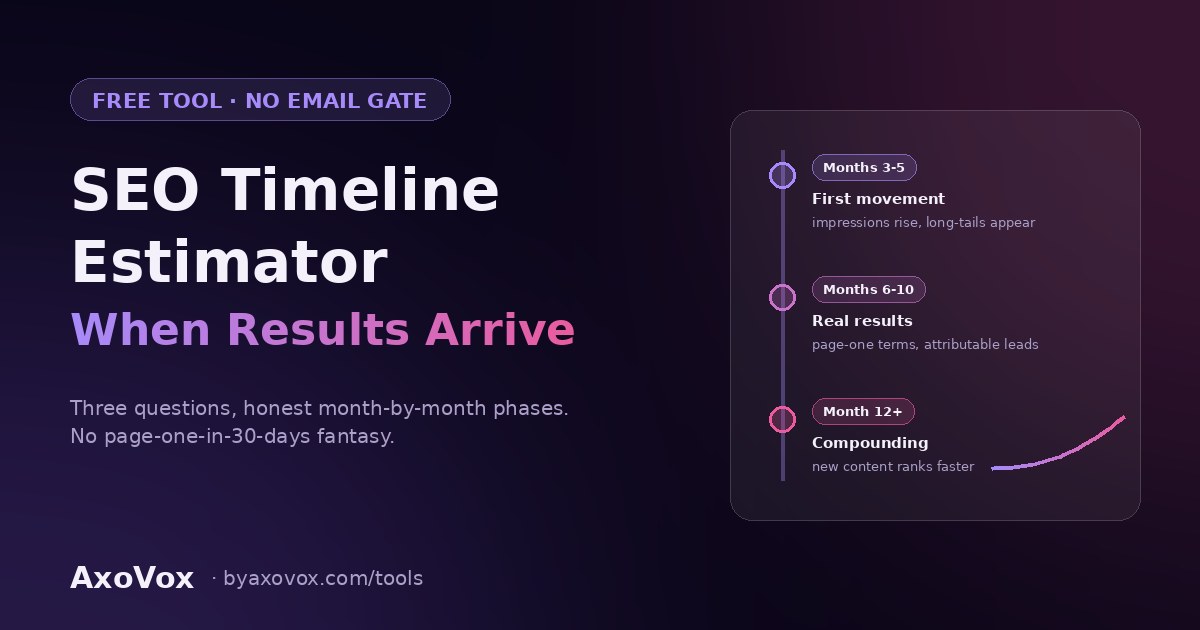
First measurable movement
Impressions rising in Search Console, long-tail keywords appearing, the first positions 20-50. Invisible to the naked eye, visible in the data.
Real results
Meaningful traffic, page-one rankings on realistic terms, leads you can attribute to search. The phase where it starts paying for itself.
Compounding
Authority accumulated, new content ranking faster, results growing without proportional new effort. The reason the wait was worth it.
How the estimate works
The baseline is the industry’s honest consensus: first movement inside 3-6 months, real results in 6-12, compounding beyond that, with roughly 95% of brand-new pages missing Google’s top ten in their first year. The estimator adjusts that baseline for the three factors that actually move it. An established site carries trust that shortens everything; a crowded national market lengthens the middle phase, because page one is occupied by sites with years of head start; and the work level matters most of all, since the calendar only advances when work happens. What no factor can do is make the answer “weeks,” which is why the tool will never show you one. Anyone promising page one in 30 days is describing either a keyword nobody searches or a technique you’ll pay for twice, and we’d rather you hear the real number from a calculator than the fantasy from a salesperson.
What to do with your timeline
Mostly one thing: budget for it, in money and in patience, before you start. The most expensive SEO is the program cancelled at month five, right before the curve bends, and the businesses that win at this are rarely the ones that worked hardest in any single month. They’re the ones that didn’t stop. If the timeline looks long, remember what it’s buying: unlike ads, which stop the day the budget stops, the rankings you build keep producing after the work that built them, and the compounding phase is where the economics turn almost unfair. The full breakdown of what happens in each phase, and how to tell progress from stalling, is in the timeline guide; where SEO fits against everything else you could do first is in the ranking pillar.
Frequently asked questions
Can SEO really not work faster than this?
Individual pages sometimes rank quickly, especially on low-competition long-tail terms, and improving existing pages moves faster than publishing new ones. But the trustworthy version of “fast SEO” is measured in months, not weeks, because trust signals accumulate on a calendar nobody controls. Speed claims beyond that are the most reliable red flag in the industry.
Why does an established site rank faster?
Accumulated trust: existing links, topical history, and pages that already rank give new content a running start. It’s also why the estimator’s biggest lever is time already invested, and why starting now beats starting later regardless of everything else.
Does more budget shorten the timeline?
Partly: budget buys more content, faster technical fixes, and more outreach, which compresses the work side. It cannot compress the trust side, where Google’s evaluation of new signals simply takes time. Double the budget doesn’t halve the timeline; it mostly deepens the results at each phase.
What should I see at month three to know it’s working?
Rising impressions in Search Console even without clicks, more queries triggering your pages, and long-tail terms entering positions 20-50. Flat impressions at month three with steady work happening is a signal to audit; falling ones are a signal something’s actually wrong.
Does this estimator send my answers anywhere?
No. It runs entirely in your browser, stores nothing, and asks for no email, like every tool we publish.
The honest close
SEO’s timeline is its price, and the businesses that pay it get an asset the impatient ones never build. If your estimate above fits your patience and your runway, tell us your market and we’ll tell you what the work itself looks like month by month, with the boring parts included.