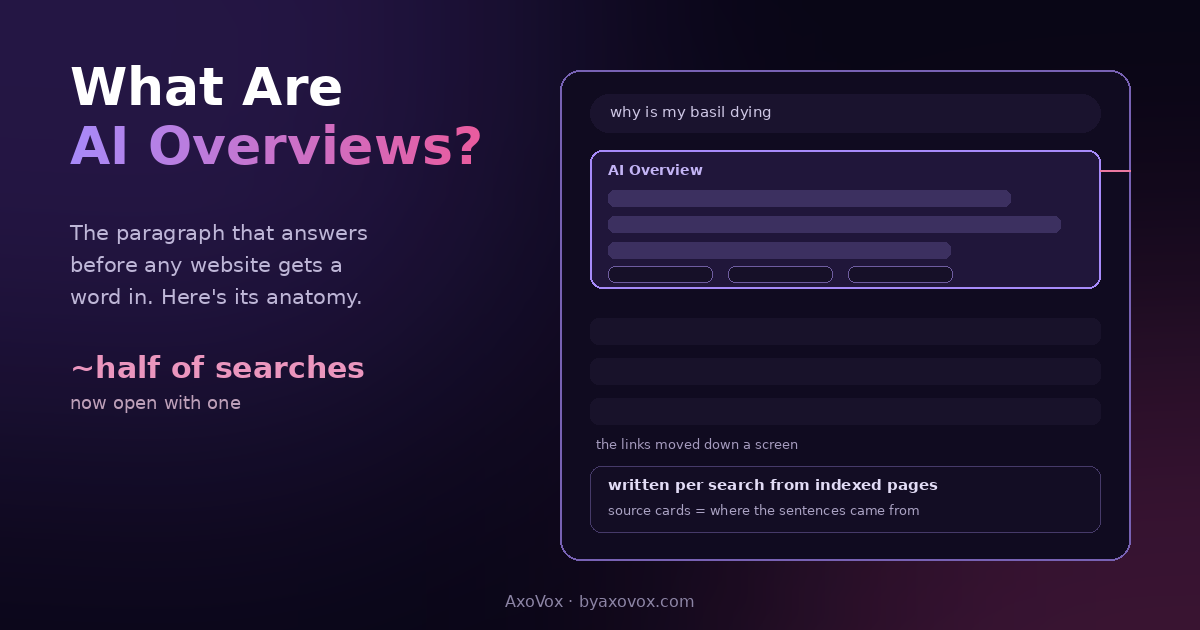
You search something, and before any website gets a word in, Google itself answers: a generated paragraph at the top, a few source cards tucked beside it, the famous ten blue links demoted below the fold. That paragraph is an AI Overview, it now opens roughly half of all Google searches, and it quietly rewrote the deal between you, Google, and every website on earth.
Plain definition first: an AI Overview is an answer Google’s AI writes on the spot, per search, by reading pages from its index and compressing what they say into a few sentences, with links to the pages it leaned on. Nothing is pre-written; ask the same thing tomorrow and the paragraph may rebuild differently. It launched in the US in May 2024, expanded worldwide, and went from novelty to default faster than any search change in memory.
Where the answer actually comes from
Three-step machinery, simplified honestly:
- Google decides the query suits an Overview. Questions, how-tos, comparisons and “why” searches trigger it most; precise lookups (a store’s hours, a person’s name) and sensitive areas trigger it least.
- Its systems pull candidate passages from indexed pages, often fanning the question into several hidden sub-searches, the same retrieval idea behind query fan-out.
- A Gemini model writes the paragraph from those passages and attaches the sources as cards. The links aren’t decoration; they’re where the sentences came from.
That last point is the one worth keeping: the Overview is a remix of websites, not knowledge from nowhere. Which explains both its strength (it reads faster than you) and its failure mode (garbage in, confident garbage out).
Why some searches get one and others don’t
Google shows an Overview when its systems predict the AI genuinely helps, which in practice maps to: informational intent, multi-part questions, and topics with enough decent pages to synthesize. You’ll rarely meet one on navigational searches, and on your-money-your-life topics the bar is higher and the box more cautious. The result is lumpy coverage that confuses everyone: your recipe search gets a mini-essay, your plumber search gets the map pack, and nobody at Google will hand you the exact rulebook because the rulebook is a model’s prediction.
Can you trust it?
Mostly, with a seatbelt. Overviews compress real pages, and on well-documented topics they’re usually fine; the famous early faceplants (glue on pizza stays undefeated) came from the machinery treating jokes and junk as sources, and the system has tightened since. The working rule we give clients and family alike: treat the Overview as a briefing, click a source before acting on anything involving money, health or law, and when it’s wrong about something you know, report it properly, specific corrections genuinely get reviewed.
What AI Overviews did to clicking (the honest numbers)
Around 60% of searches now end without a click to any website, and Overviews lean into that curve: when the answer sits on top, many people read it and leave satisfied. For searchers that’s convenience. For websites it’s the earthquake: impressions without visits, rankings that no longer equal traffic, and a new scoreboard where being cited inside the box beats ranking under it. Google now even reports those citations separately, in Search Console’s Generative AI report, which is as official as a scoreboard change gets.
If you own a website or business, read this box twice
The Overview doesn’t kill your visibility; it relocates it. The box cites pages that answer sub-questions cleanly: direct answers under question headings, concrete numbers, sentences that survive being lifted out of context. Sites built that way, small ones very much included, get quoted over bigger sites that ramble, we watch it happen monthly on our own pages. The full method is the AI Overviews playbook; the five-minute version: answer first, evidence everywhere, one deep page per real question.
Can you turn it off? And what’s that other AI tab?
Short answers to the two follow-ups everyone asks. Off switch: no official one exists; Google’s Web filter (the udm=14 view) shows plain links, full walkthrough in the off-switch guide. The other tab: that’s AI Mode, a separate conversational search you enter deliberately, a different animal entirely, and the two get confused so often we wrote the side-by-side.
Common questions
What are AI Overviews on Google?
AI-generated summaries that appear above regular search results: Google’s AI reads pages from its index, writes a few-sentence answer per search, and links the sources it used. They appear on roughly half of searches, mainly questions and how-tos.
Where does the AI Overview get its information?
From indexed web pages: the systems retrieve relevant passages, often via multiple hidden sub-searches, and a Gemini model synthesizes them into the paragraph. The source cards show which pages supplied it.
Why do some searches show an AI Overview and others don’t?
Google predicts where the AI helps: informational and multi-part questions trigger it most, navigational lookups least, and sensitive health or finance topics get a more cautious box or none.
Are AI Overviews accurate?
Usually on well-documented topics, since they compress real pages, but errors happen when sources are thin, stale or satirical. Verify through a cited source before acting on money, health or legal answers, and report specific errors.
How are AI Overviews different from AI Mode?
Overviews appear automatically on top of normal results, one-shot; AI Mode is a separate conversational tab you open on purpose, with follow-ups and memory. One happens to your search, the other is a destination.
Can I turn AI Overviews off?
No official switch exists. Google’s Web filter, reachable via the Web tab or the udm=14 URL parameter, shows plain link results without the box, and can be set as a custom default search.
Do AI Overviews hurt websites?
They reduce clicks on answered queries, with most searches already ending clickless, and shift the prize to being cited inside the box. Pages structured as direct, liftable answers earn those citations, now measurable in Search Console’s Generative AI report.
How do I get my website cited in AI Overviews?
Answer real questions directly under question-phrased headings, lead each section with the answer, include concrete numbers, and keep business facts consistent across the web. Structure and extractability beat raw site size for citations.