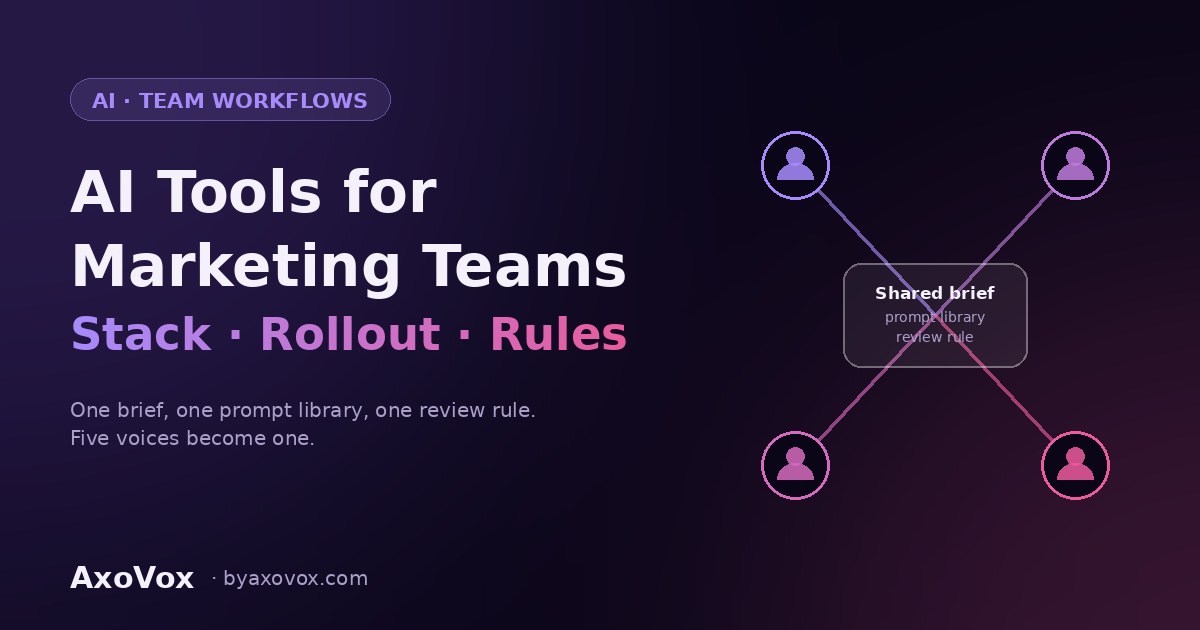
One marketer using AI is a productivity boost. A whole team using AI without a system is five subscriptions, five prompt styles, five slightly different brand voices, and one very confused audience. We run a marketing team on AI daily, and the honest finding is that the tools were the easy part. What makes team AI work is the shared layer on top: one brief, one prompt library, one review rule, one policy. That’s what this guide covers.
Why team AI fails differently than solo AI
The adoption numbers look great from a distance: 58% of small businesses now use generative AI, and growing companies adopt it at far higher rates than declining ones (83% vs 55%, per 2026 adoption data). Up close, the team version has failure modes solo users never hit:
- Voice drift. Five people prompting five ways produce content that reads like five different companies. Customers notice before you do.
- Shadow tooling. Everyone quietly expenses their favorite tool, nobody shares learnings, and you’re paying four times for the same capability. Nearly three quarters of AI-using businesses rely on a single AI service, which sounds limiting until you’ve seen the alternative.
- The quality lottery. Without a review rule, output quality depends on who was busiest that day. One unedited AI post can undo months of brand credibility.
- Data leaks by enthusiasm. The intern pasting a client’s customer list into a consumer chatbot isn’t malicious; they’re helpful. Policy exists because helpfulness scales faster than judgment.
The shared stack (small on purpose)
We keep tool opinions in our tested AI tools list, so here’s just the team-shaped version: one chatbot on a team plan (shared Projects or workspaces mean the brief and context live once, not in five personal accounts, and business tiers add the data controls the free tiers lack), one design tool with the brand kit locked in (colors, fonts, and templates enforced beats “please use the right purple” in Slack), and one automation layer owned by one person, because five people’s untracked automations is how a business ends up emailing a customer four times about the same review. Add channel tools only where you genuinely compete. Total for a small team: usually $30-60 per person per month, which the time savings repay in the first week if the rollout below actually happens.
The team layer: four things that matter more than any tool
1. One brief, used by everyone
The single highest-leverage asset: a one-page business brief (audience, offers, tone with real writing samples, banned phrases) saved where every AI session starts from it. This is the same brief habit from our ChatGPT workflows, promoted from personal habit to team infrastructure. When the brief lives in a shared workspace, voice drift mostly solves itself, because everyone’s AI is briefed by the same document.
2. A prompt library, not prompt folklore
When someone’s prompt produces a great ad set or a clean brief, that prompt goes into a shared doc with a note on what it’s for. Ten working prompts, maintained, outperform a hundred saved bookmarks nobody opens. Assign an owner; unowned libraries rot in a month. This is also how new hires get productive in days instead of relearning everything from zero.
3. The review rule (one sentence, non-negotiable)
Nothing AI-drafted publishes without a named human editing it. Not skimming: editing, with the authority to kill it. This one sentence is the difference between AI as leverage and AI as a sludge pipeline, and it’s the rule Google’s spam systems effectively enforce anyway. Put a name on every piece; accountability is the quality system.
4. The one-page policy
Skip the 20-page document nobody reads. One page: what never goes into consumer AI tools (client personal data, unreleased plans, credentials), which tools are approved, the review rule above, and who to ask when unsure. Written down, it protects the enthusiastic junior as much as the business.
The 30-day rollout that actually sticks
Week 1: pick one pilot use case with visible pain, usually first drafts of a recurring content type, and two volunteer users. Write the brief together. Week 2: pilot runs, working prompts go into the library, time saved gets logged honestly. Week 3: pilot pair demos to the team, warts included; the failed prompts teach more than the wins. Policy page ships. Week 4: everyone’s on the shared workspace, second use case starts, and a monthly 30-minute “what’s working” slot goes on the calendar forever. That last meeting is where the compounding happens: teams average around 5.6 saved hours per person per week once workflows settle, but only the teams that keep trading discoveries get there.
What to measure (so the subscription survives budget season)
Three numbers, tracked monthly: hours saved on the piloted workflows (self-reported is fine, honesty beats precision), output shipped per person on those workflows versus before, and quality incidents, meaning anything published that shouldn’t have been. Rising first two, flat third: the system works. If quality incidents rise, the review rule is being skipped, and that’s a management conversation, not a tooling one.
Frequently asked questions
Do marketing teams need enterprise AI plans?
Small teams need business tiers more than enterprise ones: shared workspaces, admin controls, and the data-handling terms consumer tiers lack. Enterprise plans earn their price at bigger headcounts or in regulated industries. The upgrade trigger is usually the first time client data needs to touch the tool.
How do we keep brand voice consistent when everyone uses AI?
One shared brief with real writing samples, loaded into a shared workspace, plus the named-editor rule. Voice drift comes from unbriefed prompting, not from AI itself. Teams that centralize the brief sound more consistent after adopting AI than before, because the brief forced them to define the voice at all.
Should every person on the team use AI, or just some roles?
Everyone should have access and training; adoption will be uneven anyway, and that’s fine. The pattern we see: writers and paid-media folks adopt fastest, designers second, strategists use it least for output and most for thinking. Mandating usage quotas backfires; showing time saved in the monthly slot spreads it naturally.
How do we stop AI tool sprawl?
An approved-tools list on the policy page, a quarterly subscription review, and one question for every new request: what does this do that the current stack plus a good prompt doesn’t? Most requests fail that question, which is the point. New tools enter through a two-week pilot with a named owner, or not at all.
Can we put client data into AI tools?
Only into tools whose tier contractually covers it (business and enterprise plans with data controls, ideally with training opt-outs), and even then, minimize: anonymize where the task allows, and never paste credentials or payment data anywhere. When in doubt, the one-page policy’s answer is “ask first,” and that answer has never once been wrong.
The bottom line
The team that wins with AI isn’t the one with the most tools; it’s the one with one brief, one library, one review rule, and a monthly habit of trading what works. Build the shared layer in 30 days and the stack almost doesn’t matter. Skip it, and the best stack money can buy will produce five voices and a cleanup project.
Want the team layer built with you: brief written, library seeded, policy drafted, pilot chosen? Tell us about your team. We’ve run this rollout on ourselves first, which is where all the warnings above come from.