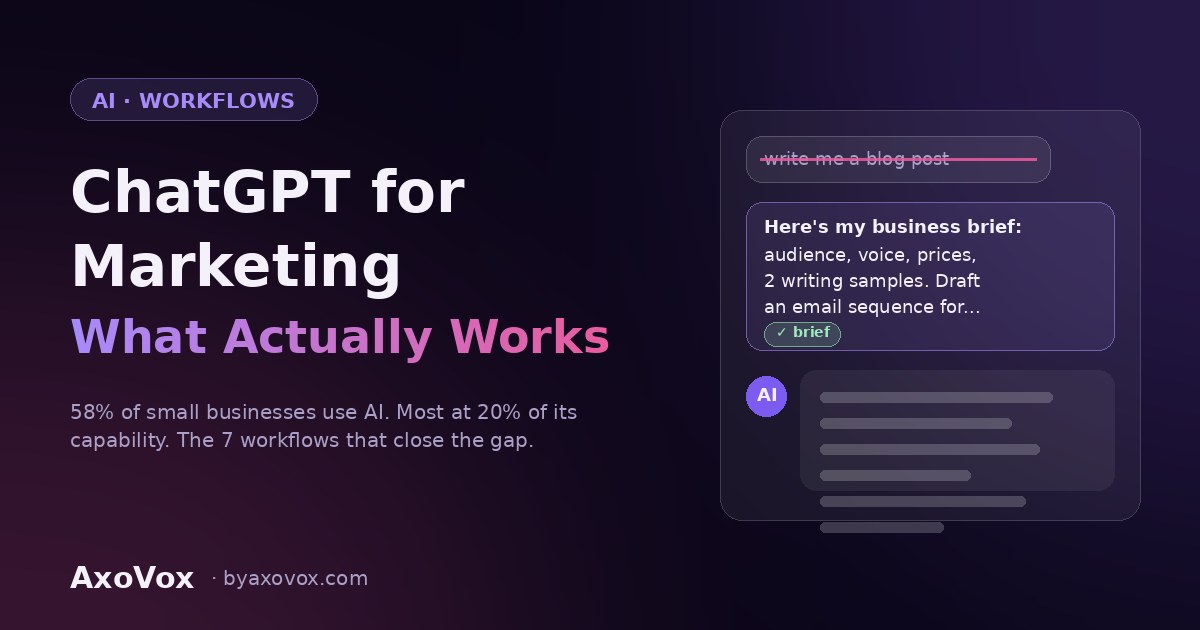
Here’s the strange thing about ChatGPT and small business marketing: 58% of small businesses now use generative AI, content and marketing is the #1 use case — and almost everyone is using it at maybe 20% of its capability. We know because we see the inputs: one-line prompts, zero business context, first draft published. Then “AI content doesn’t work.” It works fine; the workflow is broken. Here’s how we actually use it at our agency, job by job.
Do this first, or skip the rest: the brief
The number-one reason ChatGPT output sounds generic is that it knows nothing about your business, so it writes for an average one. Fix it once: write a one-page brief — what you sell, to whom, your prices, your tone (with two real examples of writing you like), what makes you different, phrases you’d never use. Save it in ChatGPT’s custom instructions or a Project, or just paste it at the start of every session. This single habit improves everything below more then any prompt trick you’ll ever read. It takes 30 minutes. Most people skip it for two years.
Job 1: customer research (the most underrated use)
Before ChatGPT writes anything, make it think. Paste in your reviews, customer emails, and sales-call notes, then ask: What words do customers use to describe their problem? What objections repeat? What outcome do they actually want? The answers become your ad copy, your headlines, your FAQ — in the customer’s own language, which converts better than yours. This costs nothing and it’s the step nearly everyone skips on the way to “write me a blog post.”
Job 2: writing that doesn’t smell like AI
The workflow that works: you provide the substance, it provides the structure. Give it your outline, your real opinions, your examples and numbers — then ask for a draft in your voice (that brief again). Then the pass most people skip: Remove clichés, vary sentence length, cut anything that sounds like a LinkedIn influencer. Then you edit, adding the things only you know. First-draft publishing is how the internet filled with sludge; Google’s spam systems and your readers both smell it instantly.
Job 3: ad copy and landing page critique
Two moves here. Volume: 15 Google Ads headlines for [service], under 30 characters, using these customer phrases: [paste from Job 1] — then you pick the five worth testing. And critique, which is weirdly its best skill: paste your landing page text and ask You're a skeptical customer comparing three options. What's unclear, unconvincing, or missing? It finds the gaps politely that your customers find silently.
Job 4: email marketing, sequenced
Email still returns $35–40 per dollar, and this is where ChatGPT shines because email is structured: welcome sequences, abandoned-cart flows, re-engagement, the monthly newsletter nobody has time to write. Feed it the brief plus one real customer story a month and it’ll draft the sequence; you spend 20 minutes editing instead of three hours staring. Small businesses report saving about 5.6 hours a week with AI overall — in our experience, email is where the biggest chunk hides.
Job 5: review replies and customer comms
Every review deserves a reply and no owner has time. Paste the review, ask for a warm, specific reply mentioning the service — then personalize one detail before posting, and vary the wording between replies (ten identical AI thank-yous read as spam to customers and to Google). Same trick for the awkward messages: payment reminders, “we’re running late” notes, complaint responses where you’re too annoyed to write calmly. It’s very good at calm.
Job 6: SEO briefs and question mining
Ask What are 20 questions someone would ask before hiring a [your business] in [city]? and you have a content plan — those questions become headings, FAQs, and Business Profile Q&A. One caution that matters in 2026: ChatGPT will confidently invent statistics and sources, so every fact gets verified before publishing. Use it to structure and question; use search to verify. (And if you want those FAQs to earn AI citations too, structure them the way we describe in our AI mentions guide — same technique, double payoff.)
Job 7: quick-and-dirty data analysis
Export your sales, ad, or booking data as a CSV, paste it, and ask plain questions: Which service has the best margin? Which month do leads drop? What changed after March? It’s not a replacement for real analytics, but for a small business whose “dashboard” is a spreadsheet nobody opens, it turns data into answers in minutes. We’ve caught real budget leaks this way that the fancy dashboards missed.
What we never use it for
- Facts without verification — it hallucinates confidently. Every statistic, legal claim, and price gets checked.
- Customer personal data on consumer tiers — names, health info, payment details stay out of the chat. Use business tiers with data controls if you need to work with sensitive material.
- Publishing unedited — covered above, worth repeating: the tool drafts, a human decides.
- Strategy by proxy — it will happily generate a “marketing strategy” that’s a horoscope. Strategy needs your numbers, your market, your judgment; it’s an assistant in that meeting, not the chair.
The gap is the opportunity
One more stat worth sitting with: 67% of AI-using small businesses use ChatGPT or a similar model, and nearly three-quarters rely on a single AI tool — mostly at the “write me an email” level. Meanwhile 83% of growing small businesses have adopted AI versus 55% of declining ones. The tools are identical and twenty dollars. The workflows are the whole difference — which is genuinely good news, because workflows are learnable and this article just handed you ours. (For the tools beyond ChatGPT worth adding once the habit sticks, our tested AI tools list is the sequel.)
Frequently asked questions
Is the free version of ChatGPT enough for marketing?
To start, yes — the free tier plus the brief habit beats the paid tier with lazy prompts. Upgrade (~$20/month) when you hit usage limits or want Projects, file uploads, and stronger models for longer work. The habit matters more than the subscription.
Will Google penalize my site for ChatGPT-written content?
Google targets low-quality content regardless of origin. AI-assisted content with your expertise, real editing, and verified facts ranks fine; unedited mass-produced output is what spam updates hunt. The risk isn’t the tool — it’s publishing without a human filter.
ChatGPT vs Claude vs Gemini — which is best for marketing?
They’re closer than the arguments suggest, and each leads somewhere: many writers prefer Claude’s prose, ChatGPT has the biggest ecosystem, Gemini ties into Google’s tools. Honest answer: pick one, build the brief-and-edit workflow, and switch only if you hit a real wall. The workflow transfers; the subscription is a detail.
How much time does ChatGPT actually save?
Surveys put average small-business AI savings around 5.6 hours a week, and business users report 40–60 minutes a day. Our observed pattern: near zero in week one (you’re learning), then it compounds as the repeatable jobs — email, replies, briefs, variations — move onto it.
Can ChatGPT do my whole marketing?
No — and businesses that try become invisible sludge factories. It executes; it doesn’t decide what’s worth saying, whether it’s working, or what your market actually needs. That judgment is either yours or someone you hire. The winning setup is human strategy with AI-speed execution.
The bottom line
ChatGPT for marketing isn’t a magic button, its a very fast junior employee who’s read everything and knows nothing about your business until you brief it. Write the brief, feed it real substance, edit everything, verify every fact — and it genuinely runs like an extra hire for $20 a month. Skip the brief and publish the drafts, and you’re just adding to the pile the internet is learning to ignore.
Want your whole marketing stack — AI included — set up to actually convert instead of just produce? Tell us where you are. We’ll show you what to run yourself with these workflows, and what’s worth handing off.