Every AI marketing tool list is written for a company with a marketing team. You don’t have a marketing team. You have yourself, maybe one other person, a budget that has to justify itself monthly, and a business to actually run. That changes which tools make sense, and more importantly, it changes the order you should buy them in.
We run an agency, we’ve tested the field (the full teardown is in our best AI marketing tools guide), and this article is the small-business cut of that testing: what to use at $0, what the first paid subscription should be, and where the spending stops making sense.
The rule that saves you money: buy for a bottleneck, not a category
Tool lists organize by category: one for content, one for email, one for design, one for SEO. That framing quietly assumes you need one of each. You don’t. A small business needs a tool when a specific task is eating hours or not happening at all. If writing is your bottleneck, an AI writing layer pays for itself in a week. If nobody visits your website, that same subscription does nothing, because the bottleneck was never writing.
So before any purchase, name the bottleneck out loud. “I don’t post because writing takes me two hours” is a bottleneck. “Everyone says AI is the future” is not.
Stage one: $0, and further than you’d think
The free tier of this stack is genuinely capable now, which wasn’t true two years ago.
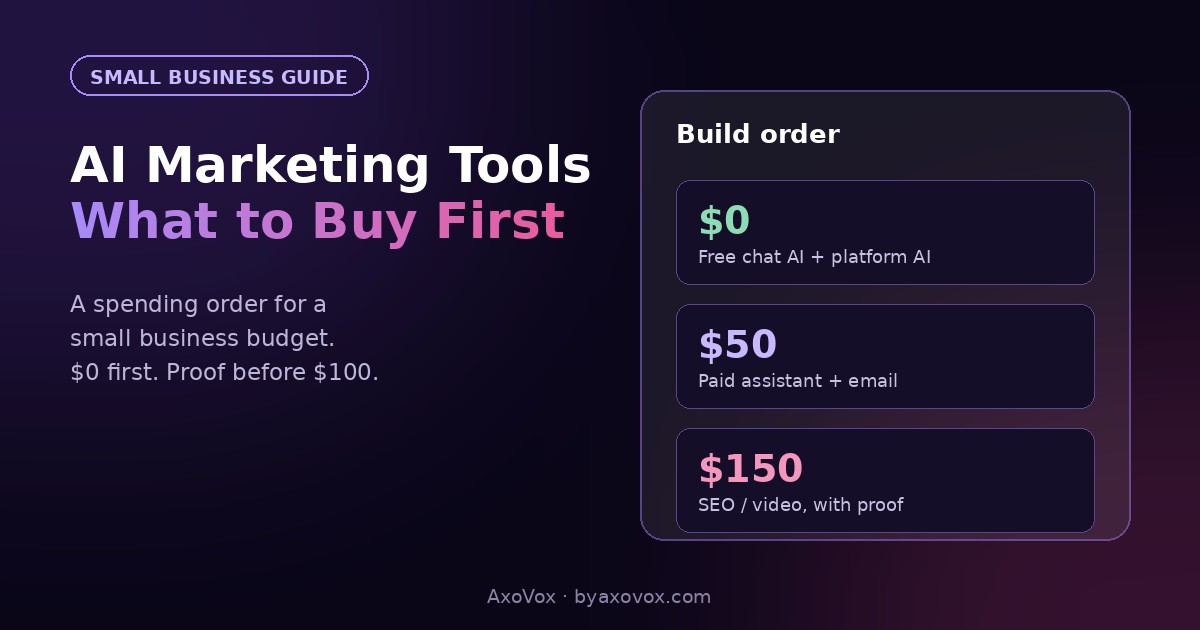
Free ChatGPT or Claude handles drafts, replies to reviews, ad copy variations, and turning one blog post into five social posts. NotebookLM, which is free and weirdly underused, lets you load your own documents and question them. Canva’s free tier covers most social graphics. And the AI already built into Google Ads and Meta’s ad platform costs nothing extra; it’s in your account whether you use it or not.
A one-person business can run its entire content operation at this stage. The catch is your time: free tools don’t connect to each other, so you’re the integration layer, copying and pasting between tabs. That’s fine at low volume. It stops being fine when marketing becomes a daily task instead of a weekly one.
Stage two: the first $50/month
When a bottleneck earns its subscription, this is the order we’d spend in for a typical service business:
First purchase: the paid tier of ChatGPT or Claude, $20-25/month. Longer context, better output, fewer usage limits. This is the highest-leverage single subscription in marketing right now becuase it upgrades every writing task at once instead of one channel.
Second: email, if you have any list at all. Email keeps returning roughly $36-42 for every dollar spent, the best ratio in marketing, and modern platforms write and time the sends for you. If your list is under a few hundred contacts, free tiers cover it; past that, $20-45/month.
Not yet: SEO content tools. The $99+/month optimization platforms are built for sites publishing constantly. If you’re writing one or two posts a month, the paid chat assistant plus your own judgment gets you 90% of the value. We explain which tools clear this bar, and which don’t, in the full tool roundup.
Stage three: $100-200/month, and only with proof
This tier is where small businesses waste the most money, so the entry condition matters: you add tools here only after the cheaper stack produced results you can point to. More traffic, more calls, more booked jobs. Something measurable.
What earns a place at this stage: an SEO platform if content has become your main channel, a video repurposing tool if video is genuinely part of your strategy, automation software once you have repetitive multi-step workflows worth gluing together. What doesn’t: buying tools to feel like a bigger operation. A $150/month stack pointed at a business with no working acquisition channel is decoration.
For context on what marketing budgets normally look like at this size, typical small businesses put somewhere between 7 and 12 percent of revenue toward marketing overall. Tools should be a small slice of that, not the whole thing. Our digital marketing cost breakdown covers the full picture.
The tool nobody sells you: a visibility check
One more thing belongs in a small-business stack, and it’s free: knowing whether AI systems can actually see your business. More of your customers are asking ChatGPT and Google’s AI for recommendations, and those answers either include you or they don’t. We built a free AI visibility checker that scores this in two minutes, no email required. If the score is low, fixing it beats any subscription on this page.
Frequently asked questions
What’s the best AI marketing tool for a small business starting from zero?
The free tier of ChatGPT or Claude. It covers writing, brainstorming, ad copy and customer replies, which is most of what early-stage marketing actually is. Buy nothing else until a specific bottleneck shows up.
How much should a small business spend on AI marketing tools?
Most small businesses do well between $0 and $50/month, and almost none need more than $200/month. The bigger constraint is time to use the tools properly, not the subscription cost.
Do I need different AI tools than a bigger company?
Mostly you need fewer of them. Big-company stacks solve coordination problems you don’t have. The core layer, a good AI assistant plus your ad platform’s built-in AI, is identical at every size.
Can AI tools replace hiring a marketer or agency?
They replace tasks, not judgment. AI compresses the hours that writing, design and reporting take, but deciding what to say, to whom, and where to spend is still the part that determines results. That’s the honest boundary.
Which AI tool actually gets me more customers?
None of them directly. Tools speed up the work; visibility brings customers. If forced to pick one thing from this page, run the free visibility check and fix what it finds before subscribing to anything.
Want a second opinion on your specific stack and budget? Ask us. If the honest answer is “you don’t need to buy anything yet,” that’s the answer you’ll get.