Disclosure: information and opinion, not sponsored. Benchmarks and prices come from Anthropic’s and OpenAI’s own launch pages and docs, checked on November 7, 2026. Vendor benchmarks are run by the vendor, so read them as claims, not referee results.
A lot of people still search for “Claude 4 vs GPT-5” when they mean “which AI should write my code next year”. Small problem: Claude 4 shipped in May 2025 and GPT-5 in August 2025. Both are already two generations behind. The models you’d actually be comparing going into 2027 are Claude Opus 5.5 and GPT-6, and the gap between them is smaller, stranger and more interesting than any spec table suggests.
We use both every week for client sites and internal tools. Here’s where they stand right now, what the benchmark numbers really mean, and what we expect to change for developers in 2027.
- Claude 4 and GPT-5 are 2025 models. The current flagships are Claude Opus 5.5 (Sept 22, 2026) and GPT-6 Astra (Sept 3, 2026).
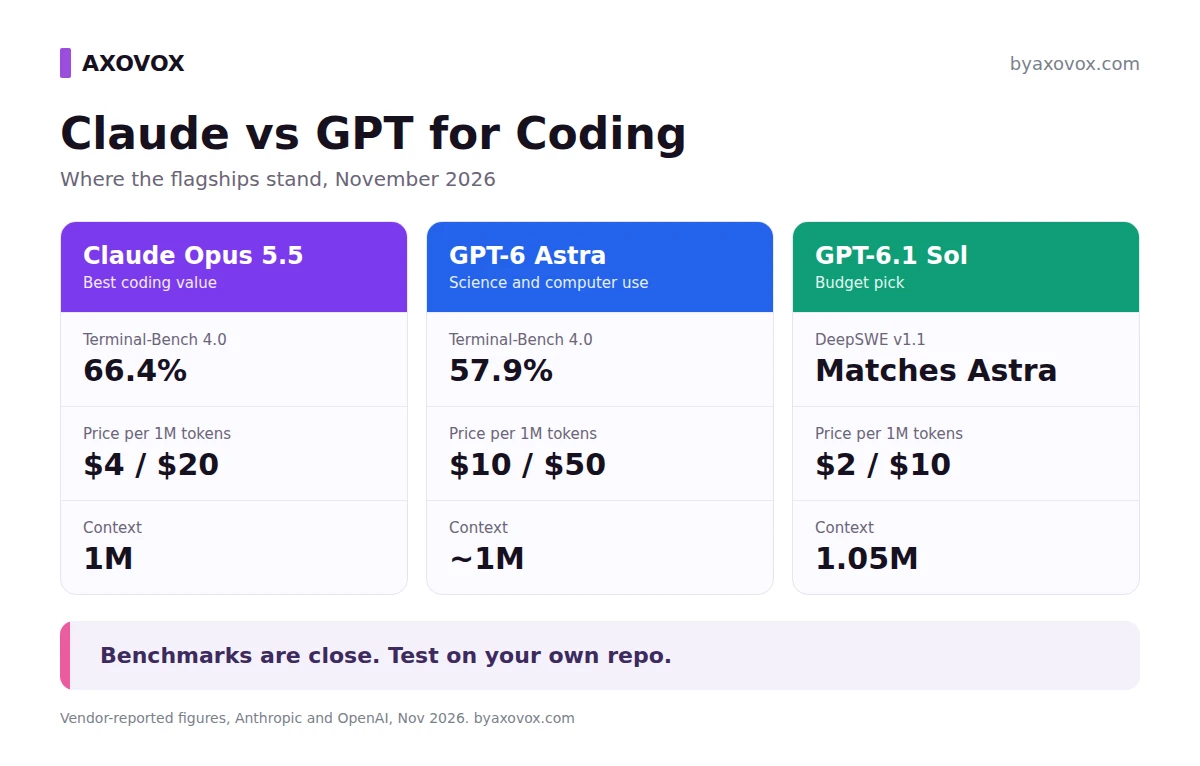
- On the coding benchmarks both labs still publish, they’re close. Anthropic reports Opus 5.5 at 66.4% on Terminal-Bench 4.0 against 57.9% for GPT-6 Astra. On FrontierCode the gap is about one point.
- Ignore the 98% SWE-bench claims. OpenAI says SWE-bench Verified no longer gives meaningful signal, and it estimates about 30% of SWE-bench Pro tasks are broken.
- Price per task is falling fast. Opus 5.5 costs $4 in and $20 out per million tokens. GPT-6.1 Sol costs $2 and $10 and nearly matches Astra.
- Multi-agent coding is real but experimental, and it burns tokens. The bottleneck in 2027 is human review, not code generation.
First, the naming mess
Both companies now ship families, not single models. That’s why comparisons go stale so fast.
- Anthropic: Claude Fable 5.1 is the top tier. Opus 5.5 is the one Anthropic tells most people to start with. Then come Sonnet 5.5 and Haiku 5.5. All four have a 1M token context window.
- OpenAI: GPT-6 Astra is the flagship. GPT-6.1 Sol is the cheaper workhorse for coding and computer use. Terra and Luna sit below those. Inside ChatGPT, “GPT-6” is a label that routes to Sol or Luna depending on your plan.
So when someone says “GPT-6 is better at coding than Claude”, ask which GPT-6 and which Claude. The honest matchup for serious coding work is Opus 5.5 against Astra, with GPT-6.1 Sol as the budget pick.
Claude Opus 5.5 vs GPT-6 Astra: the numbers
Everything below comes from the two launch pages: Anthropic’s Opus 5.5 announcement and OpenAI’s GPT-6 Astra post. Where they test the same benchmark, they mostly agree on the other side’s number. That’s a good sign.
| Metric | Claude Opus 5.5 | GPT-6 Astra |
|---|---|---|
| Released | Sept 22, 2026 | Sept 3, 2026 |
| Terminal-Bench 4.0 | 66.4% (xhigh effort) | 57.9% (high effort) |
| FrontierCode 1.1 Main | 54.4% | 53.3% |
| AutomationBench | 40.0% | 41.4% |
| Terminal-Bench Science 0.1 | 58.7% | 64.6% |
| Context window | 1M tokens | Not stated (tested to 1M) |
| API price per 1M tokens | $4 in / $20 out | $10 in / $50 out |
| Coding agent | Claude Code | Codex |
Claude takes pure terminal coding. Astra wins on science work, and it’s level on business automation. On price, Opus 5.5 is less than half of Astra per token. Anthropic also claims that at default effort it matches Astra’s Terminal-Bench score for about 40% of the cost.
One honest caveat. Each lab picks the effort setting that flatters its own model and quotes the rival’s self-reported score. Treat a gap of two or three points as a tie.
Why the 98% SWE-bench numbers don’t matter anymore
You’ll still see posts claiming one model hits 98.5% on SWE-bench Verified and the other 97.8%. Those numbers are invented. Neither lab’s latest flagship launch reports SWE-bench Verified at all, and there’s a reason for that.
In July 2026, OpenAI published an analysis titled Separating signal from noise in coding evaluations. It says SWE-bench Verified had design and contamination problems and no longer gives meaningful signal. It then audited SWE-bench Pro, the supposed replacement. Pass rates on Pro had jumped from 23.3% to 80.3% in eight months, and OpenAI estimates about 30% of its tasks are broken. Tests that demand one specific implementation. Prompts that don’t say enough. OpenAI withdrew its own recommendation to use it.
So what does that mean for you? Benchmarks now tell you which models are in the top group. They don’t tell you which one will handle your messy WordPress plugin or your five-year-old Laravel app. Your own repo is the only test that counts.
What these models actually do in a codebase
Long, unattended runs
“Self-healing codebase” sounds like a slide deck. The real version is more modest, and more useful. Anthropic quotes early testers who say Opus 5.5 audited and fixed a 200,000-line codebase in under three hours. Another tester did a 680,000-line migration in less than a day. One company, Clio, ran it unattended for over 18 hours across six repositories. These are vendor-picked stories, sure. Still, two years ago the same tools struggled with a single file.
Memory that survives the context window
Both labs now offer roughly 1M tokens of context, so a mid-sized repo plus docs fits. OpenAI is going after the bigger problem: what happens when a long session fills up anyway. In Codex, Astra can keep notes across context windows and search earlier ones. That’s better than squashing everything into one lossy summary. It’s experimental and switched on in config.toml for now.
Agent teams
This is the part that will shape 2027. Claude Code agent teams let one lead session start teammates. They share a task list and message each other directly. Separate sessions can also pass findings to each other mid-task. Anthropic’s own docs are blunt about the downside, though. The feature is experimental and off by default. It also uses significantly more tokens than a single session, and for sequential work or edits to the same file, one agent does better.
Codex works differently. Astra can ask you clarifying questions in the background and keep working on the parts that don’t depend on your answer. Less swarm, more patient senior dev.
The budget option most people miss
If you run agents all day through the API, Astra’s $50 per million output tokens adds up fast. GPT-6.1 Sol costs $2 in and $10 out. OpenAI says it matches Astra on DeepSWE v1.1 at about a fifth of the cost. Watch the fine print, though: prompts over 272K input tokens are billed at double the input rate for the whole request.
On Anthropic’s side, Sonnet 5.5 has the same $2 and $10 pricing. For routine refactors, tests and boilerplate, either cheaper model is usually enough. Save Opus or Astra for the hard bugs.
What changes for developers in 2027
Nobody knows exact 2027 scores, and anyone quoting them is guessing. The trends are clear enough to plan around, though.
- Cost per finished task keeps dropping. Opus 5.5 is about 40% cheaper to run than Opus 5 on typical work, and Sol undercuts Astra five to one. Expect another big cut by the middle of 2027.
- Review becomes the job. In the 2026 Stack Overflow Developer Survey, nearly half of developers trust AI output only when they can easily verify it. Only 6.6% trust it for important decisions. The ones who do well will write better specs and better tests.
- Security gets stricter. Astra is the first OpenAI model rated Critical for cybersecurity capability, and it refuses some exploit work by default. Expect more guardrails, approval prompts and paused tasks in both tools.
- Model loyalty fades. The top spot changes hands every couple of months. More teams will route jobs by task and cost through tools like Copilot, Cursor or OpenRouter, rather than pick one vendor.
What gets better
- Big migrations and audits in hours, not weeks
- Tests and docs written as part of the task
- Small teams can maintain much larger codebases
- Falling price per task, especially on mid-tier models
What gets harder
- Reviewing a lot of code that looks right
- Token bills from long agent loops and teams
- Security review, since AI code still ships vulnerabilities
- Juniors learning fundamentals they never had to type
Which one should you use?
- Terminal-heavy coding, long refactors, best value at the top: Claude Opus 5.5 in Claude Code.
- Science, data and computer-use work: GPT-6 Astra in Codex.
- High-volume agent work on a budget: GPT-6.1 Sol or Claude Sonnet 5.5.
- Not sure: run both on one real ticket from your own backlog. An afternoon tells you more than any table.
If you’re also choosing a model for research or writing rather than code, our Gemini 4 Argon review covers Google’s side of the race.
FAQ
Is Claude 4 or GPT-5 better for coding?
Both are 2025 models and have been replaced. Claude Opus 4 and Sonnet 4 came out in May 2025, GPT-5 in August 2025. For current work, compare Claude Opus 5.5 with GPT-6 Astra or GPT-6.1 Sol.
Which is better for coding right now, Claude Opus 5.5 or GPT-6 Astra?
On Anthropic’s figures, Opus 5.5 leads Terminal-Bench 4.0 with 66.4% against 57.9%, and it costs less than half as much per token. Astra leads on science benchmarks and is level on business automation. For most web and app development, Opus 5.5 is the better value. Test both on your own code before you commit.
What is SWE-bench and can I trust it?
SWE-bench measures whether a model can fix real GitHub issues. OpenAI has said SWE-bench Verified no longer gives meaningful signal, and that about 30% of SWE-bench Pro tasks are broken. Use it as a rough tier marker, not a ranking.
How big is the context window of Claude Opus 5.5 and GPT-6?
Claude Opus 5.5 has a 1M token window. GPT-6.1 Sol lists 1.05M tokens in the API and a 500K default in Codex. OpenAI doesn’t state Astra’s limit but tests it on up to 1M tokens.
Will AI replace software engineers by 2027?
Unlikely. The work is shifting toward writing specs, reviewing code and catching security problems. Most developers still trust AI output only when they can check it, and that’s not going away soon.