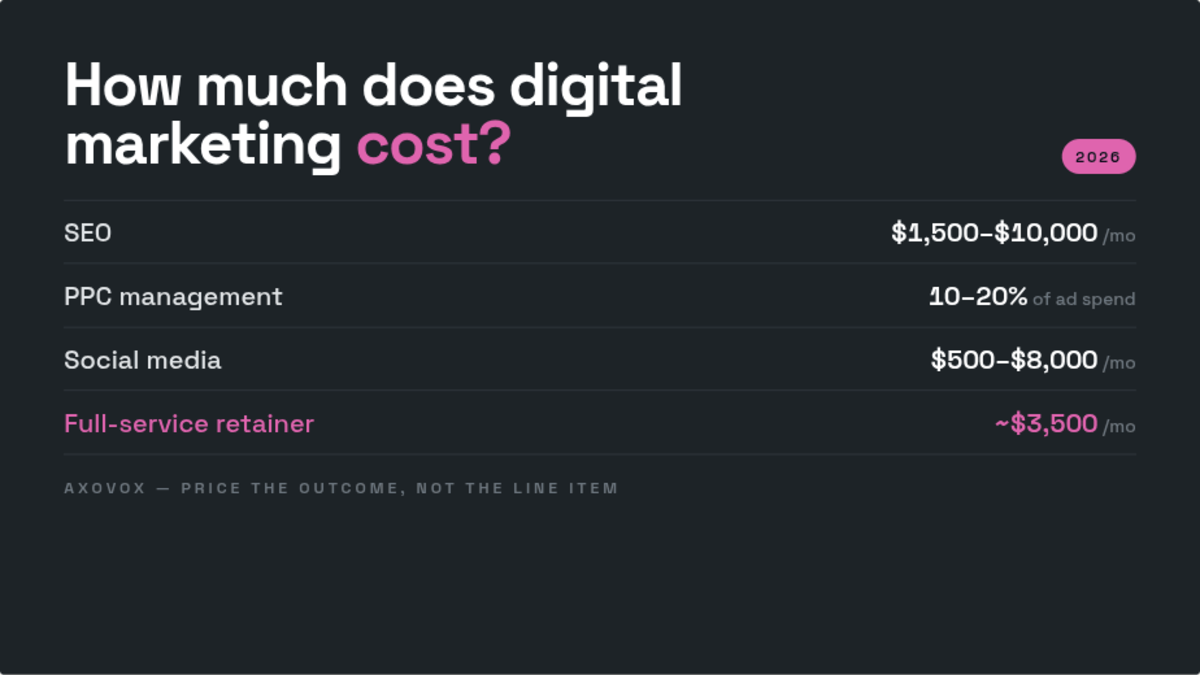
Digital marketing usually costs somewhere between $1,500 and $10,000 per month for a small-to-mid-sized business working with an agency, though real invoices run from a few hundred dollars for a single service up to $25,000+ for enterprise programs. The reason the range is so wide isn’t vagueness — it’s that “digital marketing” covers a dozen different services, priced by scope, competition, and who’s doing the work. This guide breaks down what each piece actually costs, what moves the number, and how much you should budget.
What actually drives the cost
Before any price makes sense, you need to know what you’re paying for. Five factors explain almost all the variation between a $1,000 quote and a $15,000 one:
- Scope — one channel or an integrated program across SEO, ads, social, and content. More surface area, higher cost.
- Your market’s competitiveness — ranking or bidding in finance, legal, or e-commerce costs far more than a local service niche, because the work is harder and the auctions are pricier.
- Who does the work — a freelancer, a boutique agency, and an enterprise firm can quote 5–10x apart for similar scope. The gap reflects overhead and client size more than raw quality.
- Pricing model — retainer, project, percentage of ad spend, or performance-based (more on these below).
- Deliverable volume — how many posts, pages, campaigns, or reports per month. Output, not follower count, drives most retainers.
The pricing models you’ll be quoted
Almost every agency uses one of these structures. Knowing them helps you compare quotes that look different on the surface:
- Monthly retainer — a fixed fee for ongoing work. The most common model for SEO, social, content, and PPC management. Predictable and easy to budget.
- Project-based — a fixed price for a defined deliverable (a website, an audit, a campaign launch). Clear scope, clear KPIs.
- Percentage of ad spend — common for paid media; the agency charges 10–20% of what you spend on ads, often with a minimum.
- Hourly — typically $75–$250+ per hour, best for audits, consulting, or supporting an in-house team rather than full management.
- Performance-based — fees tied to results (leads, revenue, rankings). Growing, but still a minority of agreements — and worth scrutinizing for how “results” are defined.
Digital marketing cost by service (2026 ranges)
Here’s where the money actually goes. These are typical market ranges reported across industry pricing surveys — treat them as a map, not a quote.
| Service | Typical monthly cost | Common model |
|---|---|---|
| SEO | $1,500–$10,000 (low end ~$500; enterprise $25,000+) | Retainer |
| PPC management | $500–$2,000 flat, or 10–20% of ad spend (+ ad spend itself) | Retainer or % of spend |
| Social media management | $500–$1,500 basic; $3,000–$8,000+ full-service | Retainer |
| Content marketing | $2,000–$30,000 depending on volume and format | Retainer |
| Full-service retainer | ~$3,500 average; minimums ~$1,000–$1,500 | Retainer |
A note on paid ads specifically: the management fee and the ad spend are two separate things. If an agency charges 15% to manage $20,000 in monthly media, that’s roughly a $3,000 management fee on top of the $20,000 that goes to Google or Meta. Setup fees of about $1,000–$2,500 are also standard for building campaigns and tracking. Be wary of any bundled quote where you can’t see the split between fee and media — that’s where hidden margins hide.
How much should you actually spend?
A useful benchmark: across companies surveyed in Gartner’s 2025 CMO Spend Survey, marketing budgets averaged 7.7% of total company revenue — though half of the marketing leaders surveyed reported 6% or less. That figure is for large enterprises; small businesses and those chasing aggressive growth often go higher as a percentage, because they’re building awareness from a smaller base.
The practical rule most owners can use: decide what a customer is worth, work backward to what you can afford to spend acquiring one profitably, and size your budget from there — not from a round number that “feels” right. A budget anchored to revenue targets beats an arbitrary spend level every time.
- Marketing budgets average 7.7% of company revenue — flat for two years and down from 9.5% three years earlier (Gartner, 2025).
- Paid media is now ~30.6% of the average marketing budget — the largest single share and the only one that’s grown over five years (Gartner, 2025).
- Google Ads returns an average of about $8 for every $1 spent, though individual results vary widely (Google Economic Impact Report).
- Agencies that adopted AI tooling have cut content and reporting costs 20–35%, while strategy and technical work held steady or rose (industry pricing analysis, 2026).
Agency vs. in-house vs. freelancer
Cost isn’t just the invoice — it’s the invoice divided by the result. Here’s the honest trade-off:
- Freelancer — cheapest, best for a single well-defined channel. The risk is bandwidth and no bench when they’re sick, busy, or gone.
- In-house a marketing hire costs a salary plus tools plus management, and one person rarely covers SEO, ads, creative, and analytics well. Makes sense once volume justifies dedicated headcount.
- Agency — more per month than a freelancer, but you get a team of specialists, tools, and process for less than the loaded cost of several hires. Best when you need multiple channels working together.
There’s no universally right answer — it depends on how many channels you need and how mature your program is. What you’re really buying with an agency is breadth and coordination you’d otherwise have to hire three or four people to match.
How to tell if a price is fair
A quote is fair when you can see exactly what you’re paying for and how success is measured. Watch for the warning signs: a mystery split between fee and ad spend, “standard” reporting that costs extra, long lock-ins, or a guarantee of specific results before anyone has looked at your account. Cheap that delivers nothing is the most expensive option there is. (We wrote a full guide on vetting agencies without getting burned — worth a read before you sign anything.)
Frequently asked questions
How much does digital marketing cost per month?
For most small-to-mid-sized businesses working with an agency, digital marketing costs $1,500–$10,000 per month. Single services cost less (SEO from ~$1,500, social from ~$500), while full-service retainers average around $3,500/month.
How much should a small business spend on digital marketing?
A common benchmark is a single-digit percentage of revenue — enterprises average about 7.7% (Gartner, 2025), and smaller or growth-focused businesses often spend more as a share. The better method is to base your budget on what a customer is worth and what you can profitably pay to acquire one.
How much does SEO cost per month?
Legitimate SEO retainers typically run $1,500–$10,000 per month, with a low end near $500 and enterprise programs above $25,000. Price tracks the competitiveness of your market and the depth of work, not a fixed rate card.
How much do agencies charge to manage Google Ads?
PPC management is usually 10–20% of your ad spend, or a flat $500–$2,000/month for smaller accounts, plus a one-time setup fee of roughly $1,000–$2,500. Remember: the management fee is separate from the ad spend paid to Google.
Is it cheaper to hire an agency or do it in-house?
For multiple channels, an agency is usually cheaper than the loaded cost of several specialist hires plus tools and management. A single in-house hire only wins once your volume justifies dedicated, full-time headcount in one channel.
Why do digital marketing prices vary so much?
Because “digital marketing” isn’t one service. Prices swing on scope, your market’s competitiveness, who does the work (freelancer vs. enterprise agency can differ 5–10x), the pricing model, and how much output you need each month.
The bottom line
Digital marketing pricing looks chaotic until you break it into services and understand what moves each number. For most businesses, a realistic starting budget is $1,500–$10,000 per month depending on how many channels you’re running and how competitive your space is. The figure that matters isn’t the invoice — it’s the return it produces. Price the outcome, not the line item.
Want a straight answer for your specific situation? Book a free 30-minute strategy call and we’ll map a realistic budget to your goals — whether you work with us or not.