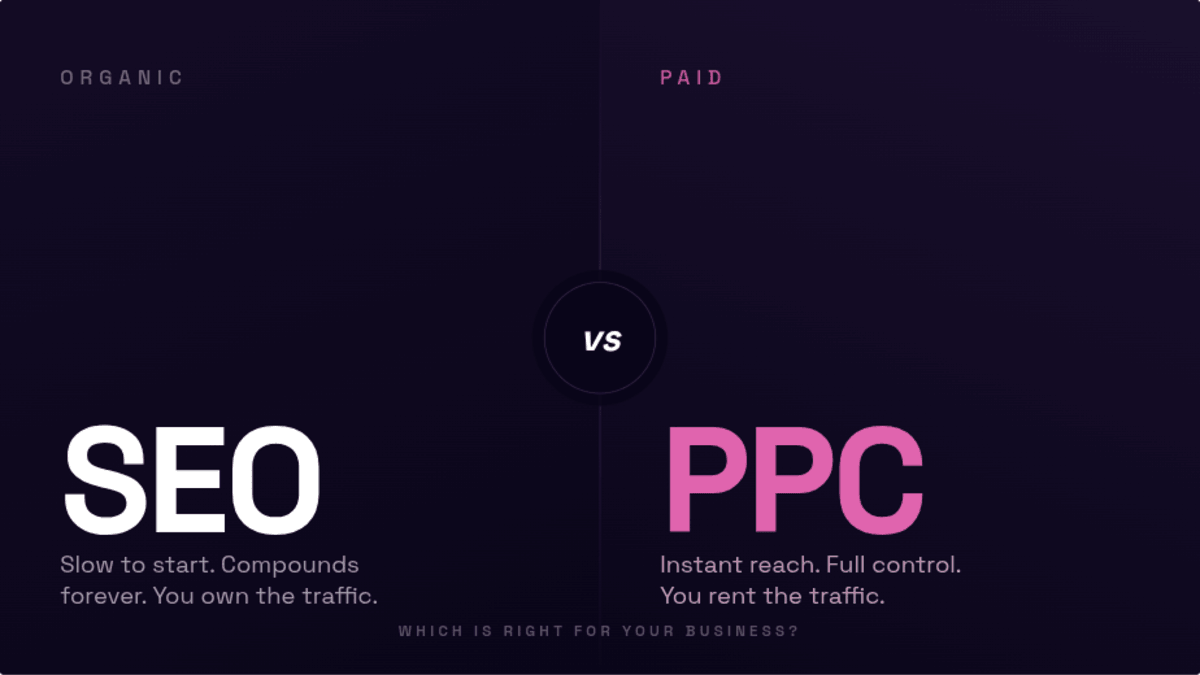
EO vs PPC: Which Is Right for Your Business? (2026)
SEO vs PPC isn’t really a either/or question — but if you’re forced to choose, the short version is this: PPC buys you traffic today; SEO builds traffic that keeps coming for free tomorrow. Choose PPC when you need results now, are testing an offer, or sell something with clear buying intent. Choose SEO when you can invest for the long term and want an asset that compounds. Most businesses that can afford to should run both. Here’s the full breakdown.
What SEO and PPC actually are
SEO (search engine optimization) is the work of earning unpaid (organic) rankings in search results — through content, technical health, and authority — so people find you without you paying per click. PPC (pay-per-click) is paid search and social advertising, where you bid to appear and pay each time someone clicks. Same goal — getting in front of people who are searching — bought two very different ways.
SEO vs PPC: head to head
| Factor | SEO | PPC |
|---|---|---|
| Speed to results | Slow (months) | Immediate (days) |
| Cost over time | Drops per visit as it compounds | Constant — you pay for every click |
| Longevity | Keeps working after you stop | Stops the moment you stop paying |
| Trust | Higher — organic results earn more clicks | Lower — users know it’s an ad |
| Control & targeting | Limited, indirect | Precise — audience, budget, timing |
| Best for | Long-term growth, authority, lower cost per lead | Fast wins, launches, testing, high-intent terms |
The case for SEO
SEO’s superpower is compounding. A page that ranks keeps delivering visitors month after month without paying per click, so your cost per lead falls over time. It also earns more trust — the top three organic results capture over half of all clicks (Backlinko), and organic search has one of the highest conversion rates of any channel at around 2.4% (WordStream), because people who find you actively went looking.
Where SEO wins:
- Lower cost per visit the longer it runs — you’re building an asset, not renting one.
- Credibility: people trust earned rankings more than ads, and SEO leads close at far higher rates than outbound (HubSpot puts it at 14.6% vs 1.7%).
- Durability: rankings keep sending traffic after the work is done.
The catch: it’s slow. SEO typically takes months to gain traction, offers less direct control, and depends on algorithms you don’t own.
The case for PPC
PPC’s superpower is speed and control. Turn it on and you can be at the top of the results today, targeting exactly who you want, with a budget you set to the dollar. That makes it unbeatable for launches, promotions, and testing whether an offer or message even works before you commit to a long SEO play.
Where PPC wins:
- Immediate visibility and traffic — no waiting.
- Precise targeting and full budget control.
- Fast, clean data for testing offers, landing pages, and keywords.
- Strong ROI on high-intent terms — Google reports an average of about $8 back per $1 spent.
The catch: the traffic is rented. Stop paying and it vanishes the same day. Costs also climb in competitive auctions, and users trust ads a little less than organic listings.
When to choose which
Lean PPC-first if you:
- Need leads or sales now, not in six months.
- Are launching a product or running a time-boxed promotion.
- Want to test an offer, message, or market quickly.
- Sell something with clear, high commercial intent.
Lean SEO-first if you:
- Can invest for the long term and want compounding returns.
- Want to lower your cost per lead over time.
- Are building authority and trust in your category.
- Have informational topics your buyers research before purchasing.
Why the real answer is usually “both”
Framing SEO and PPC as rivals is the mistake. They cover each other’s weaknesses. PPC delivers traffic immediately while SEO takes months to mature — so ads carry you in the early days, then organic takes over the workload as it grows, lowering your blended cost. Run together, they also feed each other: PPC gives you fast keyword and conversion data you can pour into your SEO strategy, and owning both the ad and the top organic spot on a valuable term means a competitor can’t slip in between you and the customer.
- On queries where Google shows an AI Overview, organic click-through rates fell about 61% and paid about 68% (Seer Interactive, 2025) — the “zero-click” search is now the norm, with roughly 60% of searches ending without a click.
- But brands cited inside AI Overviews earned 35% more organic and 91% more paid clicks than those left out (Seer Interactive) — visibility in the AI answer is the new front line.
- The takeaway: SEO’s job now includes being cited by AI, not just ranked — and PPC is one way to stay visible on queries where organic clicks are shrinking. Neither channel is “dead”; both are shifting.
What about the cost?
Budget often decides the mix. SEO retainers typically run $1,500–$10,000/month, while PPC management is usually 10–20% of ad spend (plus the spend itself). If you only have budget for one to start, PPC proves demand fastest; SEO builds the cheaper long-term engine. For a full breakdown, see our guide on how much digital marketing costs.
Frequently asked questions
Is SEO or PPC better?
Neither is universally better — they solve different problems. PPC is better for speed and control; SEO is better for long-term, lower-cost, compounding traffic. Most businesses that can afford both should run them together.
Is SEO cheaper than PPC?
Over time, usually yes. PPC charges for every click, forever. SEO costs more upfront relative to results but drives traffic without per-click costs once pages rank, so the cost per visit falls the longer it runs.
Which is faster, SEO or PPC?
PPC is far faster. It can drive traffic within days of launching. SEO typically takes several months to build meaningful rankings and traffic.
Should I do SEO and PPC at the same time?
If budget allows, yes. PPC delivers immediate traffic while SEO matures, and PPC’s keyword and conversion data sharpens your SEO. Running both also lets you dominate a valuable term with the ad and the top organic result at once.
Does PPC help SEO directly?
Not directly — paying for ads doesn’t raise your organic rankings. But it helps indirectly: PPC data reveals which keywords and messages convert, which you can feed into your SEO and content strategy.
How long does SEO take to work?
Generally several months to see meaningful movement, and longer in competitive markets. That lag is exactly why pairing early PPC with a long-term SEO investment works so well.
Is PPC worth it for a small business?
Often yes, especially for high-intent searches and local services — Google reports an average return of about $8 per $1 spent, though results vary. Start with a small, tightly targeted budget and scale what proves profitable.
The bottom line
SEO and PPC aren’t competitors — they’re two halves of a complete search strategy. PPC buys you speed, control, and fast data; SEO builds a durable, compounding asset that lowers your cost per lead over time. If you must start with one, let your timeline decide: need results now, start with PPC; playing the long game, invest in SEO. When you can run both, you stop choosing between fast and durable and get both at once.
Not sure where your budget belongs? Book a free 30-minute strategy call and we’ll tell you straight — SEO, PPC, or both — based on your goals, not a sales script.