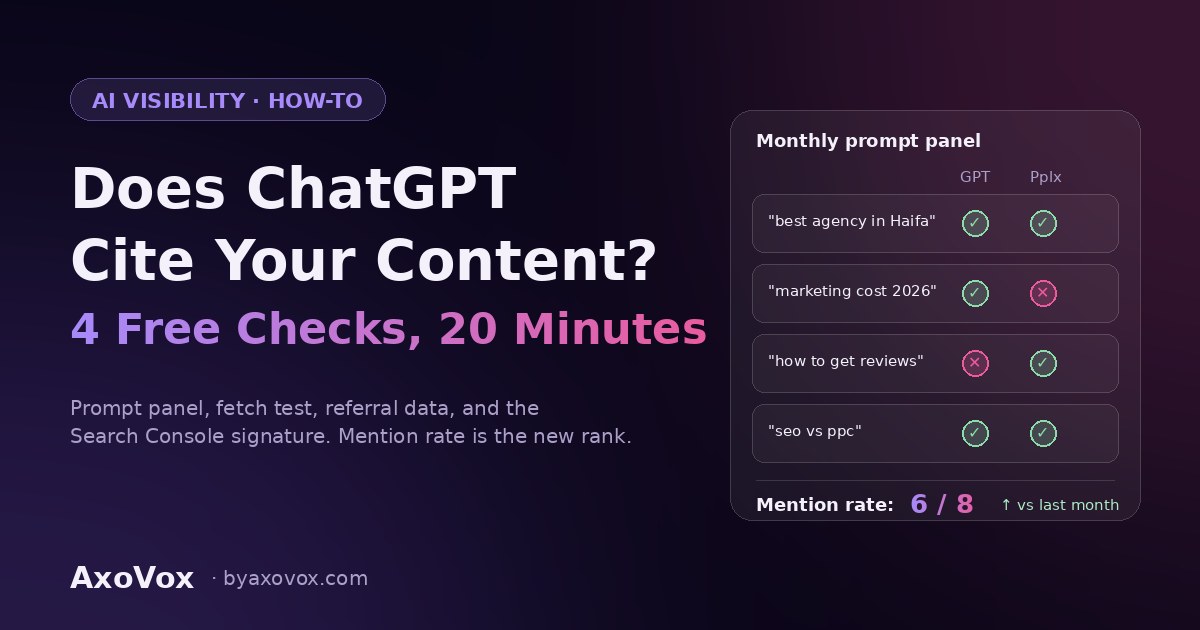
To check if ChatGPT and AI search cite your content, run four free checks: a monthly panel of customer-style prompts across the AI tools, a fetch test that asks the AI to read your page directly, a referral report in GA4 for chatgpt.com and perplexity.ai, and the impressions-versus-clicks signature in Search Console. Together they take about twenty minutes a month, and they answer the question most businesses are only guessing at. Here’s each check, step by step.
Check 1: the monthly prompt panel (the core method)
AI answers change between sessions, so a single “is my business mentioned?” test proves nothing. What works is a fixed panel, repeated monthly:
- Write 10 prompts your buyers would use. Mix four types: recommendations (“best [service] in [city]”), costs (“how much does [service] cost”), how-tos in your specialty, and comparisons (“[you] vs [competitor]” once you’re established enough to appear).
- Run them in three places: ChatGPT with web search enabled, Perplexity, and Google’s AI Mode or AI Overviews. Use fresh sessions or incognito so your history doesn’t tilt results.
- Log three things per prompt: which brands get named, which sources get cited, and whether you’re either. A simple spreadsheet beats memory; the trend across months is the actual metric.
Expect variance: appearing in most runs is a win, appearing in every run is rare for anyone. If the same competitor keeps getting named where you don’t, open the sources the AI cites for them. That list is your gap analysis, written by the machine itself, and closing those gaps is exactly what our guide to getting cited by AI covers.
Check 2: the fetch test (can AI even read your site?)
Before worrying about being chosen, confirm you’re readable. Paste your most important URL into Perplexity or ChatGPT with search and ask: Summarize this page: [URL]. A clean summary means access is fine. A refusal, an error, or a summary of your navigation menu means a technical problem: blocked crawlers in robots.txt or your CDN settings, or content that only renders with JavaScript. This two-minute test catches the silent killer, because a site AI can’t read will never be cited no matter how good the content is. The fixes live in phase one of our AI search checklist.
Check 3: referral data in GA4 (the receipts)
When AI answers send actual visitors, they show up as referrals. In GA4: Reports → Acquisition → Traffic acquisition, then search the source dimension for chatgpt.com, perplexity.ai, and copilot. Two things to know about what you’ll see: the numbers are usually small, and they’re unusually valuable, because these visitors arrive pre-recommended: the AI already told them you’re the answer before they clicked. Rising AI referrals month over month is the cleanest proof your citation work is compounding. Consider marking these sources in a saved report so the check takes thirty seconds next month.
Check 4: the Search Console signature (for Google’s AI specifically)
Search Console still doesn’t separate AI Overview citations from regular results, so you read it by signature instead: for a query you target, impressions rising while position holds steady often means your page is being surfaced inside AI-flavored results, and if clicks hold up while competitors’ informational clicks sink, you’re likely the one being cited. Pair it with a manual spot check: search your top queries in an incognito window and see whether an AI Overview appears and whether you’re in its citation cards. The full playbook for winning that box is in our guide to appearing in Google AI Overviews.
When to graduate to tracking tools
The manual system above is genuinely enough for most small businesses, and it costs nothing but the twenty minutes. Paid AI-visibility trackers (Semrush’s AI toolkit, Profound, Peec and a fast-growing crowd) earn their subscription when you’re mentioned sometimes and want to grow the rate systematically: they run hundreds of prompts, track competitors, and chart your share over time. Our take on when each is worth it is in the AI marketing tools list. Start manual; the spreadsheet teaches you what to buy.
Reading your results honestly
Never mentioned anywhere: start with the fetch test result. If access is fine, the problem is substance and reputation, and the fix is a program, not a tweak. Mentioned occasionally: you’re in the pool; freshness updates and more third-party mentions raise the rate. Mentioned for some topics, invisible for your money topic: the most common pattern we see, and the most fixable, since you already know the machine can choose you. And one warning for competitive spirits: don’t prompt-test obsessively day to day. Answers vary run to run, and daily checking produces anxiety, not data. Monthly, logged, trended: that’s the discipline that shows the real line.
Frequently asked questions
Does ChatGPT cite sources in normal chats, or only with search?
Reliably only when web search is active: that’s when it fetches live pages and shows source links. In plain mode it answers from training data, may mention brands without links, and can’t be audited. For citation checking, always test with search enabled, and treat plain-mode brand mentions as a bonus signal, not the measurement.
How often should I check if AI cites my content?
Monthly for the prompt panel and referral report, quarterly for a deeper look at which sources your competitors’ citations come from. More frequent checking mostly measures the AI’s natural variance, not your progress. Set a recurring 20-minute slot and let the spreadsheet accumulate the story.
Why does AI cite my competitor instead of me?
Open the sources it cites for them and you’ll usually find the answer: fresher pages, more third-party mentions (reviews, directories, press, forums), and content structured so a direct answer is easy to lift. AI systems reflect the web’s evidence about who’s trustworthy; the competitor typically has more of it, not better luck.
Can I just ask ChatGPT “do you know my business”?
You can, but the answer is nearly meaningless: it tests training-data trivia, not the live retrieval that actually powers recommendations. The prompt panel with customer-style questions and search enabled is the honest test, because it recreates what a real buyer’s session does.
Is there a free tool that tracks AI citations automatically?
Free tiers of some visibility trackers exist and change monthly, but honestly, the spreadsheet method above is the dependable free option, and it doubles as competitor research. Automation is worth paying for once your manual log shows mentions worth growing.
The bottom line
Whether AI cites you stops being a mystery the moment you measure it: ten prompts, one fetch test, two saved reports, twenty minutes a month. Most businesses will never check, which means the ones that do get to find and close their gaps while competitors are still guessing. Run the panel this week; whatever it shows, at least you’ll be the one who knows.
Want us to run the full audit for you: prompt panel, access check, competitor citation sources, and the gap list? Send us your domain and we’ll show you exactly where you stand in the AI answers your buyers read.