Perplexity Deep Research reads hundreds of pages before it writes a single report. But it only cites a fraction of what it reads. The rest gets skimmed, used for background, and dropped. If your page is in that second group, you did the work and someone else got the footnote.
The good news is that getting into the first group isn’t mysterious. You won’t find a secret ranking formula here (Perplexity doesn’t publish one, and anyone claiming to know it is guessing). What you will find is what Perplexity has actually documented about how Deep Research and its search index work, what the citation data shows, and the changes that follow from both.
- Deep Research runs many searches, reads hundreds of sources and writes a cited report in a few minutes. Since October 2026 it also runs as a skill inside Perplexity Computer.
- Perplexity’s index treats sections and passages of a page as separate units, so every section of your page needs to make sense on its own.
- Step zero is access. If PerplexityBot is blocked by robots.txt or a firewall rule, nothing else in this guide matters.
- Original numbers with a date and a source in the same sentence are the easiest thing for a research agent to quote.
- Most citations go to the long tail. In one study of 10.37 million Perplexity citations, 91% went to sites outside the top 50 domains.
- Run Deep Research on your own buyers’ questions first. The source list shows you exactly which sites you need to be on.
What Perplexity Deep Research actually is in 2026
Deep Research is Perplexity’s long-form research mode. When it launched in February 2025, Perplexity described it as performing “dozens of searches,” reading “hundreds of sources” and spending 2 to 4 minutes on work that would take a person hours. The output is a structured report with numbered citations that can be exported as a PDF or shared as a page.
It has changed a lot since then. An update called Advanced Deep Research added a code sandbox for calculations, work with uploaded documents, clarifying questions for broad prompts, and the ability to reach “harder-to-reach sources.” Then in October 2026, Deep Research started rolling out as a built-in skill inside Perplexity Computer. On its Deep Research page, Perplexity now says it runs “thousands of retrieval steps” in parallel, routes subtasks across more than 20 models, and pulls premium data from sources like Statista, PitchBook and CB Insights.
That last part matters more than it looks. If your page is about market sizes or funding numbers, you’re now competing with paid databases for the same footnote. A page that only repeats Statista’s number has no reason to be cited when the agent can cite Statista directly.
How Deep Research finds and picks pages
Perplexity doesn’t publish how Deep Research chooses which sources to cite. It has published quite a bit about the search system underneath it, though, and that’s where the useful clues are.
It searches by passage, not by page
In its technical write-up of the Perplexity Search API, the company says its index tracks over 200 billion unique URLs and handles 200 million queries a day. More importantly, it says the system treats “the individual sections and spans of documents as first-class units.” A later update describes labeling which spans of a page are “vital” to a query and which are irrelevant.
In plain English: the agent often pulls a passage from your page, not the whole page. A section that starts with “As mentioned above…” loses its meaning the moment it’s cut out. A section that opens with a direct answer and a number doesn’t.
Two bots, two jobs
Perplexity’s crawler documentation lists two user agents. PerplexityBot builds the search index and is the one you need to allow. Perplexity-User fetches a page when a user’s question needs it, and Perplexity says it “generally ignores robots.txt rules” because a person asked for the page.
There’s history here worth knowing. In August 2025 Cloudflare accused Perplexity of stealth crawling on sites that had blocked it, and removed it from its verified bot list. Whatever you think of that dispute, the practical effect is that some Cloudflare and firewall setups block Perplexity’s declared bots by default. Plenty of site owners don’t know they’re blocking it.
| What you often read | What’s actually documented |
|---|---|
| Deep Research gives pages a “methodology score” | No such score is documented. Clear methods help because they make claims quotable and checkable. |
| You need a 2,000+ word article | The index works on passages. A strong 900-word page beats a padded 3,000-word one. |
| PDF whitepapers get priority | Nothing says so. Deep Research can read documents, but HTML is the safer default. |
| Blocking all AI bots keeps you safe | Blocking PerplexityBot removes you from the index Deep Research searches. |
What Perplexity cites in practice
The best public look at real citation patterns right now comes from Surfer. It pulled every Perplexity citation its users tracked between September 1 and 28, 2026: 57,327 prompts, 978,402 answers and about 10.37 million citations, per its study of the most-cited domains.
- Reddit was the single most cited domain, with 1.70% of all citations, almost three times LinkedIn in second place.
- Review and directory sites like Clutch, G2, Capterra and Yelp took 21.6% of the top 50’s citations.
- Statistics aggregators took 6.9%. Surfer’s explanation: pages that list dated numbers are easy to quote.
- The long tail wins overall. The top 50 domains got only 9% of all citations. The other 91% went to everyone else.
That last number is the one to remember. Perplexity isn’t just citing a handful of giant sites. Most footnotes go to specialist pages, which is exactly where a business site can compete.
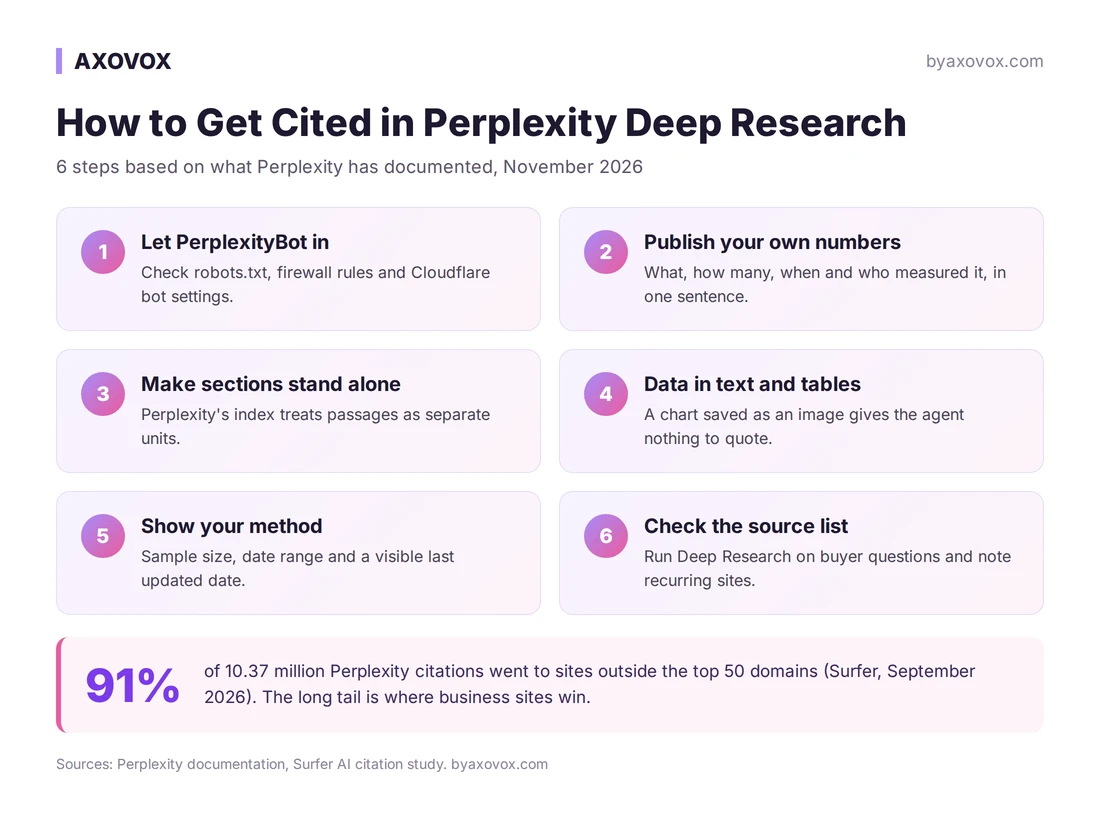
6 steps to get your pages cited in Deep Research
1. Make sure PerplexityBot can reach you
Check three places: your robots.txt, your firewall or WAF rules, and your Cloudflare bot settings. Allow PerplexityBot and, if your firewall works by IP, Perplexity’s published ranges. Our guide on checking which AI crawlers visit your site shows how to confirm it in your server logs. This takes ten minutes and it’s the step most sites skip.
2. Publish numbers nobody else has
Research agents look for evidence. If your page repeats a figure from someone else’s study, the agent will usually cite the original. Your own data is different: prices from your last 200 jobs, response times from your support desk, survey answers from your customers. The Princeton research paper that coined the term GEO found that adding statistics, quotations and sources lifted visibility in AI answers by up to about 40%.
Write each number so it can stand alone: what, how many, when, and who measured it. “Our median install time across 214 jobs in 2026 was 3.5 hours” can be quoted. “Installs are quick” can’t.
3. Write sections that survive being cut out
Because the index works at the passage level, give every section a heading that says what it covers and a first paragraph that answers it directly. Avoid “this,” “the above” and “as we said” at the start of a section. Read any section alone. If it still makes sense, it’s ready to be quoted.
4. Put the data in text and tables, not images
A chart exported as a picture gives an agent nothing to quote unless the numbers are also written out. Keep key comparisons in real HTML tables with clear column headers, and repeat the headline numbers in a sentence. If you also publish a PDF report, make sure it’s text-based rather than scanned, and link to it from the HTML page. Treat it as an extra, not a replacement.
5. Say how you got your numbers
One or two sentences is enough: sample size, date range, how you measured. It’s not a magic signal. It’s simply what makes a claim safe to repeat in a research report, for the agent and for the human reading the report afterwards. Add a visible “last updated” date and keep dateModified in your schema honest.
6. Run Deep Research on your buyers’ questions
This is the most useful hour you’ll spend. Run Deep Research on five or ten questions your customers actually ask before buying. Open the source list of each report and write down which domains keep coming back. Usually it’s a mix of review sites, directories, Reddit threads, trade publications and a few competitors’ guides. Those are the places you need to be, either with a better page of your own or with a listing, a review or a useful forum answer.
Do it again every month or two. If you want to track this at scale instead of by hand, we compared the options in our guide to AI search tracking tools.
Worth your time
- Allowing PerplexityBot and checking your firewall
- Original numbers with dates and sample sizes
- Sections that answer their heading in the first lines
- Getting listed on the sites Deep Research already cites
Not worth the effort
- Padding pages to hit a word count
- Rewriting other people’s statistics
- Charts with no numbers in the text
- Chasing a secret “trust score” nobody has documented
If your buyers research before they buy, B2B services, software, finance, health, anything with a comparison stage, Deep Research reports are where your category gets summarized for them. It’s worth an afternoon. For a local business that mostly gets calls from Google Maps, steps 1 and 6 are enough for now. For a broader view of how Perplexity compares with other tools, see our Perplexity Pro review.
Common questions
What is Perplexity Deep Research?
Deep Research is Perplexity’s long-form research mode. It runs many searches, reads hundreds of sources and writes a structured report with numbered citations, usually in a few minutes. Since October 2026 it is also available as a skill inside Perplexity Computer.
How does Perplexity Deep Research choose which sources to cite?
Perplexity hasn’t published its citation rules. What it has published is that its search index treats sections and passages of pages as separate units. In practice, pages with clear, self-contained answers, original data and dated facts are the easiest to quote.
Do I need to allow PerplexityBot?
Yes, if you want to appear in Perplexity. PerplexityBot builds the search index that Perplexity uses. Perplexity-User only fetches pages on demand for a user’s question. Check robots.txt, your firewall and any Cloudflare bot rules.
Do PDFs help you get cited in Deep Research?
Not on their own. Deep Research can read documents, but there’s no evidence PDFs are preferred. Publish the research as an HTML page first, and add a text-based PDF only as an extra.
How long should a page be to get cited?
There’s no required length. Perplexity’s search works at the passage level, so one strong section with a clear answer and a number can be cited from a short page. Long pages only help if every section adds something.
Which sites does Perplexity cite most?
In Surfer’s September 2026 study of about 10.37 million Perplexity citations, Reddit was the most cited domain, and review and directory sites took 21.6% of the top 50’s citations. But 91% of all citations went to sites outside the top 50.
Disclosure: information and opinion, not sponsored. No affiliate links. Facts about Perplexity were checked against Perplexity’s own documentation on November 14, 2026. Perplexity changes this product often, so some details may move.