We normally review things launched in the last eight weeks; this one’s the exception, because Perplexity Pro is the tool running under half our client workflow and readers kept asking whether it’s worth it. So here’s the review of the thing we actually pay for: a year of daily use across citation tracking, competitive research, and the fortnightly answer-logging we do for clients, with the annoyances left in.
The pitch, in case you’ve escaped it: Perplexity is an answer engine, not a chatbot. Ask a question, it searches the live web, reads the sources, and returns a composed answer with footnotes you can click. For researchers tired of ten blue links and the ad-and-affiliate sludge above them, that’s the whole product, and it’s a good one.
The 2026 question is sharper though: ChatGPT, Gemini and Claude all search the web now, free. Is a dedicated $20 answer engine still worth it? Short version: for research-heavy work, yes, with caveats this review doesn’t hide.
- Perplexity Pro costs $20 a month or $200 a year, and pays for itself if you research more than about 30 minutes a day.
- Deep Research is the main reason to pay: a several-minute, multi-source report with footnotes that replaces an afternoon of tabs.
- Citations are its strength, but some footnotes don’t fully support the sentence. Click before you quote.
- Usage limits changed during 2026 with little notice, so treat any exact daily number as a snapshot.
- It’s the wrong tool for long-form writing or serious coding. Max at $200 a month is only for heavy agent users.
Perplexity Pro ($20/month, $200/year) remains the best pure research tool we use: fast multi-source answers with clickable citations, a genuinely strong Deep Research mode, a model picker that routes to current OpenAI, Anthropic and Google flagships under one subscription, and Spaces for organized project work. It pays for itself if you research more than 30 minutes a day. The caveats: citations occasionally don’t support the sentence they’re attached to (verify before you quote), usage limits have shifted during 2026 without much announcement, and it’s the wrong tool for long-form writing or serious coding.
What $20 actually buys in late 2026
| Price | $20/month or $200/year (Education Pro: $10/month with academic verification) |
| Search tiers | Quick Search (fast, lighter model) and Pro Search (multi-step, source-heavy); free accounts get a small daily Pro allowance, Pro gets high limits, recent trackers put it around 300 Pro Searches a day, but Perplexity has adjusted limits during 2026, so treat any exact number as a snapshot |
| Models | Perplexity’s Sonar family (Sonar Pro, Sonar Reasoning, the deep-research model) plus a picker routing to current OpenAI, Anthropic and Google flagships; Auto is the default and honestly what we leave it on |
| Deep Research | Autonomous multi-step investigation, several minutes, structured report with footnotes |
| Files | PDF, CSV, DOCX, image uploads, read and cross-referenced with live web data |
| Organization | Spaces: project folders with their own custom instructions and files |
| Creation tools | Image generation plus document, spreadsheet and simple-app generation; genuinely handy for quick deliverables, not the reason to buy |
| Comet browser | Perplexity’s AI browser with a side-panel assistant that reads and synthesizes the page you’re on, free for everyone since late 2025; our full Comet review covers it; Pro mainly upgrades the intelligence behind it |
| Above Pro | Perplexity Max ($200/month): frontier-model access, Model Council multi-model answers, much higher credit ceilings, early features and media tools (Sora 2 Pro video generation currently sits there). Built for heavy agent use, not for most readers of this review |
Pro Search vs Quick Search: the actual difference
Quick Search runs one query and summarizes a handful of links, fine for settling a lunch argument. Pro Search changes behavior: it decomposes your question into several sub-queries, pulls from a wider source set, and asks a clarifying question when your prompt is ambiguous. Ask it to compare two tools on pricing and limits and you can watch it research each half separately before composing.
In our daily use the practical difference is trust: Pro Search answers arrive with enough sourcing to verify in one click, which is the entire reason it lives in our client workflow. Every fortnightly citation log we run starts life as a stack of Pro Searches.
Deep Research: the feature that justifies the fee
Point Deep Research at a genuinely complex question and it goes away for several minutes, reads dozens of pages, follows cross-references, and returns a structured report with footnotes. We use it for competitive landscape sweeps before client engagements; what used to be an afternoon of tabs is now a coffee’s worth of waiting plus an hour of verification.
That last word is load-bearing. The reports are strong starting documents and occasionally confidently wrong in a detail, which brings us to the honest part.
Perplexity’s superpower is citations; its known weakness is that sometimes the footnote doesn’t actually support the sentence wearing it, the source is real, the claim drifted. In our spot-checks it’s a minority of citations, concentrated in synthesis-heavy answers, and it’s exactly why our house rule is “click before you quote.” A research tool that’s right most of the time and checkable all of the time is still a great tool; just don’t skip the checking, and don’t let juniors treat the footnotes as proof.
The model picker: one subscription, several flagships
Pro’s picker routes queries through Perplexity’s own Sonar models or current flagships from OpenAI, Anthropic and Google, the specific versions rotate as the labs ship, which in 2026 means monthly. The honest usage note: Auto is the default, Auto is good, and after a year we manually switch models maybe once a week, usually to a reasoning model for something gnarly. The picker’s real value is insurance against any one lab’s bad month, more than a daily ritual.
Free vs Pro vs Max
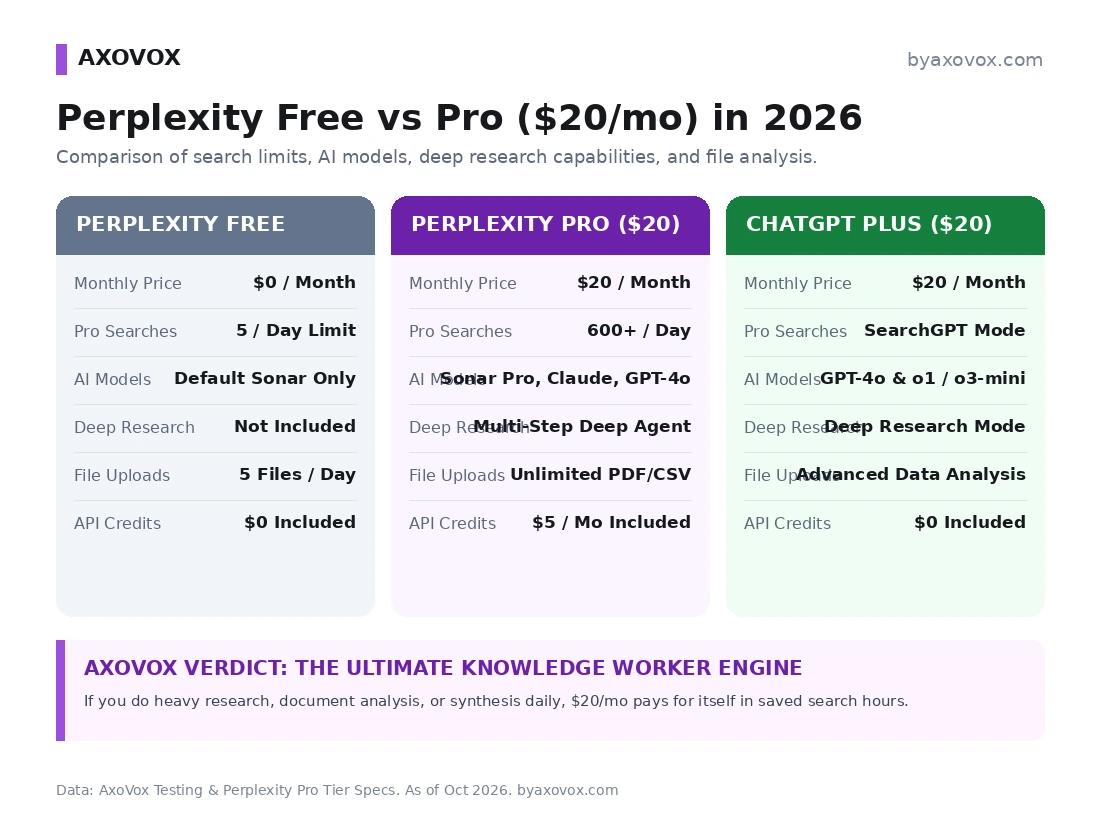
| Feature | Free | Pro ($20/mo) | Max ($200/mo) |
|---|---|---|---|
| Pro Searches | Small daily allowance | High limits (adjusted during 2026) | Highest ceilings |
| Models | Default Sonar | Sonar family + flagship picker | Adds frontier tier + Model Council |
| Deep Research | Taste of it | Included | Highest depth and credits |
| File uploads | Limited daily | Effectively unrestricted in our use | Same, bigger ceilings |
| Spaces | No | Yes | Yes |
| Who it’s for | Trying it | Research-heavy humans | Heavy agent/automation users |
The honest scorecard
Hours of manual research replaced weekly, genuinely clickable sourcing, Deep Research as a junior-analyst stand-in, one fee covering several frontier models, a clean ad-free interface, and Spaces keeping client projects separated with their own instructions. It’s the px in our address-bar shortcut stack for a reason: it’s the one we hit most.
Citations need spot-checking (above); limits have moved during 2026 with little announcement, so the exact daily numbers in older reviews, including “600+”, are snapshots, not promises; long-form writing, serious coding and heavy math or multi-step reasoning are better served elsewhere, it’s a research tool wearing a chat interface; paywalled and subscription-gated sources (news sites, academic databases) get summarized from around the wall, sometimes clumsily, it can’t go where your library card can; and one disclosure our regulars will expect: Perplexity’s crawler has faced public accusations of ignoring robots.txt directives, a publisher-side controversy we cover in the robots guide. As users we rate the product; as publishers we watch that story with one eyebrow up.
Who it’s for, who should skip it
If your work is finding things out, research, analysis, competitive intelligence, due diligence, Perplexity Pro is the most directly useful $20 in AI; skip it if your AI time is mostly writing, coding or conversation, where the general assistants earn the same money better.
Related reading: our Comet browser review, the AI search shortcut setup, and what to do when these engines recommend your competitor.
FAQ
Is Perplexity Pro worth $20 a month in 2026?
For research-heavy work, yes: it replaces hours of manual searching weekly and bundles several frontier models under one fee. For writing, coding or casual chat, no; the general assistants spend the same $20 better, and the free tier lets you test which camp you’re in.
Which AI models does Perplexity Pro include?
Perplexity’s own Sonar family plus a picker routing to current OpenAI, Anthropic and Google flagships; the exact versions rotate as the labs release, so any review naming specific models is dated within weeks, this one included. Auto-selection is the default and what most users, us included, actually run.
How many Pro searches do you get per day?
Honest answer: a high limit that Perplexity has adjusted during 2026, sometimes quietly, so we won’t print a number that might be stale next month. In a year of heavy daily use we’ve hit throttling only during marathon Deep Research days.
What is Perplexity Max and do I need it?
The $200/month tier above Pro: frontier-model access, Model Council (multiple models answering and cross-checked), much higher credit ceilings and early features. It’s built for heavy automation and agent workloads; for human research, Pro is the right buy, and we review from Pro.
Is the Comet browser part of Pro?
Comet went free for everyone in late 2025, so the browser itself costs nothing; Pro upgrades the intelligence and agent capability behind it. Our separate Comet review covers whether the browser’s worth switching to at all.
Can Perplexity Pro analyze my PDFs and CSVs?
Yes, and cross-reference them against live web data, which is quietly one of its best tricks: drop a competitor’s pricing PDF in and ask what changed versus their site today. Limits exist but we’ve never meaningfully hit them in normal use.
Are Perplexity’s citations reliable?
Mostly, with a real asterisk: in our spot-checks a minority of footnotes don’t fully support the sentence they’re attached to, especially in heavy-synthesis answers. The sources are real and one click away, so the tool stays excellent for anyone who verifies, and risky for anyone who doesn’t.
Is Perplexity Pro better than ChatGPT Plus?
Different jobs: Perplexity wins cited web research and news synthesis; ChatGPT Plus wins writing, coding, voice and general assistance. Plenty of research-heavy people, us included, justify both; if forced to one and your work is research, Perplexity.
Disclosure: information and opinion, not sponsored; no affiliate links. We pay for our own subscription and use it daily in client work. Pricing and features recorded against Perplexity’s live plans as of October 21, 2026, and they change often. See our full disclaimer.