A prospect asked ChatGPT about a client of ours before a sales call. The AI answered confidently: wrong founding year, a service they’d dropped in 2023, and an address two moves old. The prospect mentioned it on the call as fact. Nobody at the company had ever asked an AI about themselves, so for months, possibly years, that had been the official story to everyone who did.
This failure wears a few costumes: wrong facts delivered confidently, “I couldn’t find information about this business,” your company merged with a similarly-named one in another country, or a description pulled from who you were five years ago. Different costumes, same disease: the machines assembled your story from whatever public sources they could verify, and your sources are weak, stale, or contradicting each other.
Here’s the fix path we actually run, in order of leverage, plus the honesty about timelines nobody selling “AI reputation repair” will give you.
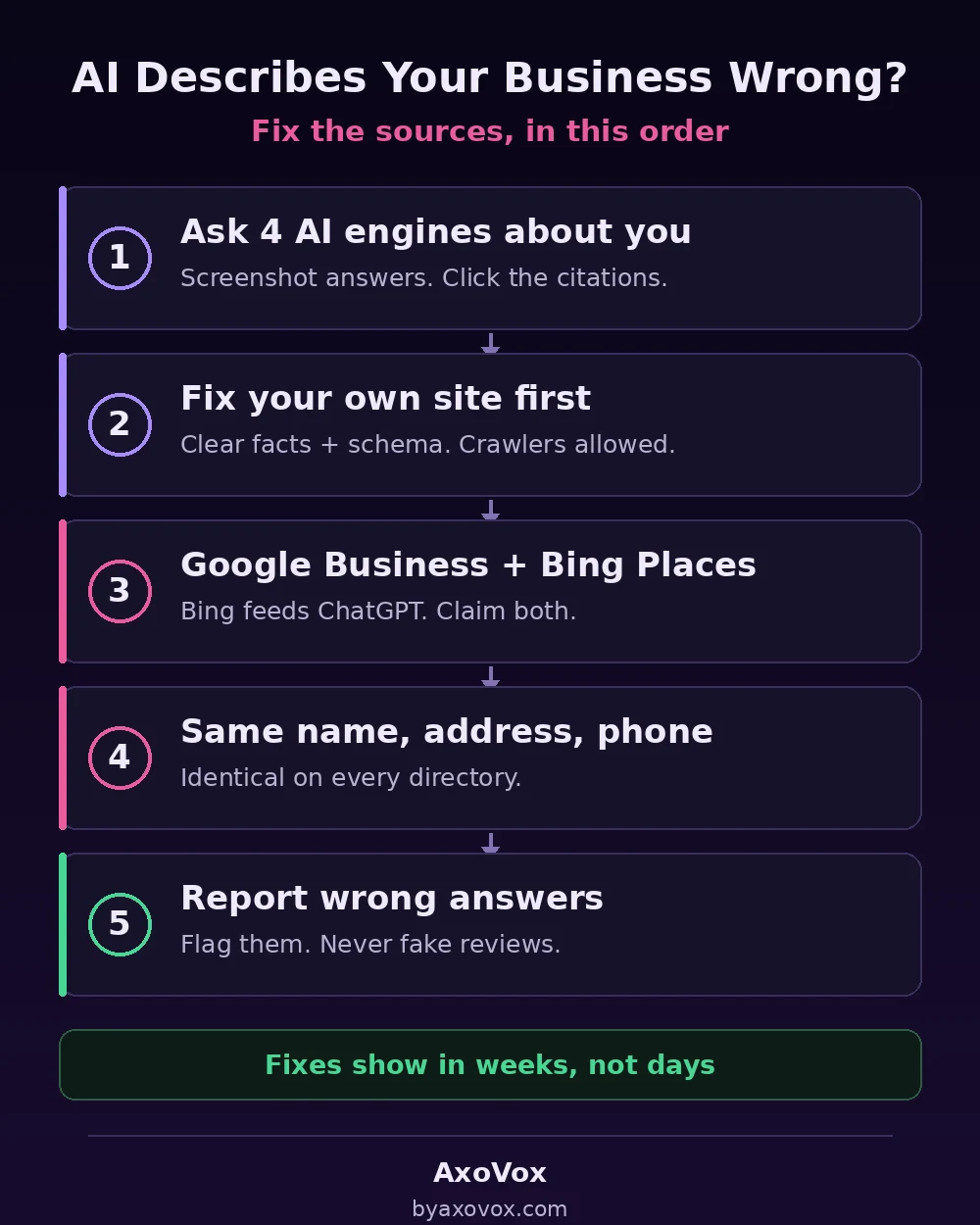
- Start by asking ChatGPT, Gemini, Perplexity and AI Mode the same five questions about your business in fresh sessions, and log every wrong answer.
- Fix your own site first: an About page with plain who, what, where and since-when sentences gives engines facts they can lift.
- Update the outside sources engines cross-check, starting with Google Business Profile and Bing Places, which feeds ChatGPT through Bing.
- Use each engine’s feedback button, but expect little. Correcting the sources works far better than reporting the answer.
First, diagnose: ask all four engines the same five questions
Before fixing anything, record the damage. In fresh sessions (logged out or temporary chat, so your history doesn’t flavor it), ask ChatGPT, Gemini, Perplexity and Google’s AI Mode:
- What is [business name]?
- What services does [business name] offer?
- Where is [business name] located and how do I contact them?
- Is [business name] legitimate and still operating?
- [Business name] vs [your closest competitor], which should I choose?
Screenshot everything, note the date, and click the citations: the sources the engines lean on are your repair map. In our audits, the wrong fact almost always traces to a real page, an old directory listing, a dead crunchbase-style profile, a forgotten About page on a subdomain, that the engine reasonably trusted because nothing stronger contradicted it.
Fix 1: your own site has to state the facts machines can lift
The engines’ first stop is you, and most business sites fail the five questions above on their own pages. The repairs:
- An About page that answers who/what/where/since-when, plus who you serve and public pricing if you have it, in liftable plain sentences. The difference, concretely: “We deliver innovative solutions for ambitious brands” gives a machine nothing; “[Name] is a [city] accounting firm that files returns and handles payroll for restaurants and cafes, since 2014” is a sentence an AI can quote whole
- Organization schema (LocalBusiness for local businesses) with name, URL, logo, contact, address, and sameAs links to every real profile you control, this is you telling machines which profiles are actually you
- One canonical description of the business, reused word-for-word on the homepage, About, and every external profile; consistency is the signal, creativity here is noise
- Kill the contradictions: old addresses in footers, abandoned service pages, a stale subdomain, every one is a source an AI can “verify” against you
- And confirm the machines can read any of it: AI crawlers blocked by a security plugin or firewall make every other fix invisible, the five-minute check is in our robots guide and the indexing walkthrough
Fix 2: the external sources engines actually check
AI answers trust you more when others agree with you. The hierarchy that moves the needle, roughly in order: your Google Business Profile (feeds Gemini and AI Overviews most directly, claim it, complete it, keep hours and address current), Bing Places (the one everyone forgets, and ChatGPT leans on Bing’s index, so an unclaimed or stale Bing listing feeds ChatGPT answers directly), the big horizontal directories and your industry’s vertical ones with identical NAP (name, address, phone) everywhere, your LinkedIn company page, and for businesses that qualify, Wikidata, machine-readable by design. Reviews platforms count double: they’re third-party, dated, and verifiable, exactly what answer engines weigh.
The identical part is the work. We’ve watched a single inconsistent listing, old phone number, slightly different name, keep a business’s AI description stale for months because the engines had two stories and split the difference. Pick the canonical facts once, then make every profile on the internet agree, character for character.
If AI merges you with a similarly-named business, differentiation is on you: the engines won’t guess. The canonical description should carry your disambiguators naturally (“the [city] [industry] firm”, founding year, founder name), your schema should be complete where the other company’s is thin, and your sameAs links should fence off exactly which profiles are yours. In stubborn cases, an FAQ entry on your own site (“Is [you] related to [them]? No, …”) gives engines a liftable sentence that settles it, we’ve used precisely this, and it got quoted.
Fix 3: use each engine’s feedback door (modest expectations)
Every engine has a report mechanism: thumbs-down and report options on ChatGPT answers, feedback links on Gemini and AI Overviews, Perplexity’s answer feedback. Use them with the correct facts attached, it costs minutes. Honesty: in our experience these are the weakest lever, feedback trains systems slowly and generically rather than hot-fixing your entry. The exception is Google surfaces fed by your Business Profile, where editing the profile IS the fix and propagates on Google’s schedule, not yours. Treat feedback buttons as planting flags, never as the repair itself. And the inverse rule: never manufacture the fix, fake reviews, planted “news” articles and farms of thin pages are exactly the low-trust pattern verification-driven engines learn to discount, and once associated with your entity they’re far harder to remove than a wrong address.
Fix 4: publish the content that answers the exact questions
The engines compose from what exists. A business with a real blog answering its niche’s questions gives them current, dated, attributable material to quote, which crowds out the stale third-party scraps. This is the slow, compounding layer: the findable, verifiable, quotable method in full, and the reason fixing what AI says about you and earning AI citations turn out to be the same project wearing different urgency.
Day 1: run the five-question audit across the engines, screenshots and cited sources. Day 2: rewrite the About facts into liftable sentences and set the canonical description. Day 3: schema with sameAs, and verify the AI crawlers get through. Day 4: Google Business Profile and Bing Places corrected. Days 5-6: directory and profile NAP sweep, one story everywhere. Day 7: re-ask the five questions, log what moved, diary the rest for a monthly re-check.
The timeline, honestly
| Fix | Effort | When AI answers typically reflect it (our observations) |
|---|---|---|
| Google Business Profile corrections | An hour | Days to weeks on Google surfaces |
| Site facts + schema + canonical description | A day | Weeks, as engines re-crawl; live-retrieval answers can pick it up fast |
| Directory/NAP cleanup | A week of tedium | Weeks to months, worst sources linger longest |
| Feedback reports | Minutes | Unreliable; plant the flag, expect nothing dated |
| Fresh quotable content | Ongoing | Compounds over months, then becomes the description |
The pattern across engagements: live-search answers (ChatGPT Search, Perplexity) correct first because they re-fetch, model-memory answers correct last because they wait for retraining cycles you don’t control. Anyone promising to fix what ChatGPT says about you in 48 hours is describing the one lever (their own site edit) and selling the rest.
Documented: Organization and sameAs schema (schema.org), each engine’s feedback mechanisms, Google Business Profile feeding Google’s AI surfaces. From our client work, labeled as such: the wrong-fact-traces-to-a-real-weak-source pattern, the inconsistent-listing stall, the name-collision FAQ fix that got quoted, and every timeline in the table. Unknowable from outside: when any given model retrains, which is why the honest unit of progress here is “the sources now agree,” not “the AI now says.”
FAQ
Why does ChatGPT say my business doesn’t exist?
Usually one of three: your site blocks the AI crawlers (check that first, it’s a five-minute fix), your business has almost no machine-verifiable footprint beyond its own site, or your name collides with something bigger. The diagnosis step’s citation-clicking tells you which within an hour.
Can I contact OpenAI or Google to correct information about my business?
No direct correction line exists for AI answers; the feedback buttons are the official door and they’re slow and generic. The real correction channel is the sources: your site, your Google Business Profile, and the profiles the engines cite. Fix those and the answers follow on their schedule.
How long until AI answers show my corrected information?
Live-retrieval answers (ChatGPT Search, Perplexity, AI Overviews) can update within days to weeks of your sources changing; answers from model memory wait for retraining you can’t schedule. Months-not-days is the honest planning number, which is exactly why starting before it hurts beats starting after.
AI merged my company with another business with a similar name. What now?
Differentiate explicitly: disambiguators in your canonical description, complete Organization schema with sameAs fencing your real profiles, and a liftable FAQ sentence on your site stating you’re unrelated. Engines resolve collisions toward whichever entity is better documented, so become that entity.
Do Google Business Profile edits affect ChatGPT too?
Indirectly at best: GBP feeds Google’s surfaces directly, while ChatGPT leans on web sources and Bing’s index. That’s why the fix is never one platform, it’s making every public source tell the identical story so no engine has a stale version to prefer.
Is there a tool to check what AI says about my business?
The five-questions audit above is the manual version and worth doing quarterly with screenshots. For the technical half, whether engines can read and verify your site at all, our free checker runs those tests; what the engines currently say still needs the asking, because no external tool sees their answers for every phrasing.
Should I just pay an AI reputation repair service?
Ask them which sources they’ll change and how they measure progress. The legitimate version of this work is source cleanup plus content, exactly what this guide describes, and takes weeks to months; the illegitimate version promises specific AI outputs on dates, which nobody controls. The question filters them fast.
Disclosure: information and opinion from our client work and own tests; AI answers change constantly, so examples describe patterns, not permanent behavior. See our full disclaimer.