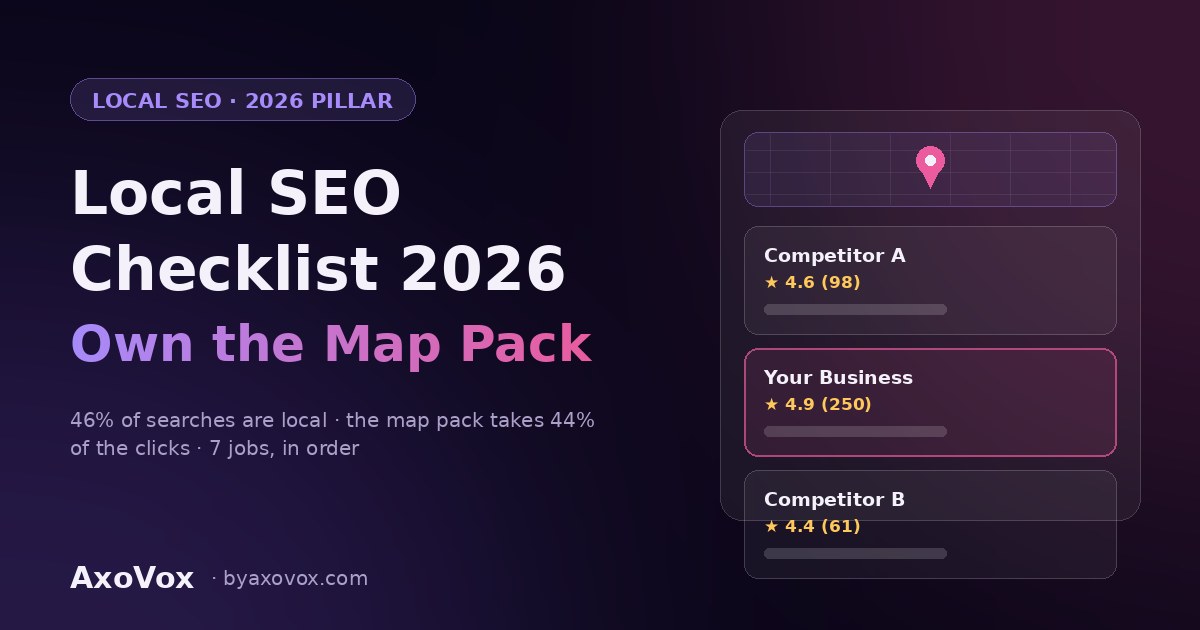
Local SEO in 2026 comes down to seven jobs, in order: a fully optimized Google Business Profile, a review engine, a website that agrees with your profile, consistent citations, genuinely local content, community links, and, new this year, showing up in the AI answers that now cover most local searches. The stakes are simple: 46% of all Google searches have local intent, and 76% of people who search locally on mobile visit a business within 24 hours. Here’s the full checklist.
Why local is the best ROI in search (still)
A local searcher isn’t browsing, they’ve done the thinking and they’re choosing. That’s why 76% of local mobile searchers visit a business within a day, and why local SEO’s cost per lead runs about 61% lower than traditional outbound marketing. You’re not creating demand; your capturing it at the exact moment of decision. Almost no other channel gets to say that.
1. Google Business Profile — the ~32% factor
The single heaviest input into map-pack ranking is your profile. Complete beats claimed: a complete profile makes customers 2.7x more likely to consider you reputable and 70% more likely to visit. Interesting detail from 2026 profile research: top-ranking profiles average around 70-word descriptions and roughly 250 reviews and images, completeness plus volume, not magic. The full section-by-section walkthrough (categories, services, Q&A seeding, the suspension traps) is in our Google Business Profile optimization checklist, do that first, everything else builds on it.
2. Reviews — the ~16% factor and the trust layer
98% of consumers read reviews before choosing a local business, and review signals drive roughly 15-17% of local pack ranking. Quantity, recency, velocity, and your replies all count, a steady flow of fresh reviews beats a stale pile of old ones. Build the system, not a one-time push: direct link, ask at the moment of peak happiness, reply to everything within a day or two. The complete engine, including whats against the rules, is in our guide to getting more Google reviews.
3. A website that agrees with your profile
The map pack and local organic results run on different signals, you need both. On the site: exact NAP match (name, address, phone, character for character with your profile), city and service in your homepage title tag, a dedicated page per core service, and if you serve multiple areas, a genuinely useful page per area, not ten copies with the city swapped, Google’s been onto that trick for a decade. One number worth knowing: businesses in the map pack average nearly a thousand backlinks per Semrush data, so your site’s overall authority feeds your local ranking too.
4. Citations: the ~7% factor, done once and done right
Citations are mentions of your NAP on other sites: the big data aggregators, Apple and Bing maps, review platforms, industry directories, the local chamber. Consistency matters more than count, fifteen perfect listings beat fifty with three different phone numbers, because mismatched data erodes Google’s confidence in who you are. This is a one-big-push-then-quarterly-check job, not a monthly grind.
5. Local content: answer your city’s questions
Skip the “10 reasons to choose us” posts. Local content that ranks and gets cited answers what people in your area actually ask: what a permit costs in your county, which neighborhoods you cover and how fast, how the local climate affects the thing you fix. One genuinely useful local answer outranks ten generic posts, and it’s exactly the kind of passage AI answers quote when someone asks about your city.
6. Community links: the moat nobody can fake
Sponsor the league, join the chamber, get quoted in the local paper, be useful in the neighborhood groups. Local links and mentions from your own city are authority signals a national competitor can’t buy, and their also the third-party evidence AI assistants weigh when recommending businesses. This looks like PR; its ranking fuel.
7. The 2026 addition: local AI answers
The genuinely new checklist item. AI Overviews barely touched local search in early 2025 (~8% of local queries); by mid-2025 that hit 40%, and 2026 data shows them appearing on up to 68% of local searches. These answers pull from business websites, review platforms, and forums, which means items 1-6 on this checklist are also your AI strategy: complete profile data, fresh reviews, quotable local content, third-party mentions. Citation share is brutally uneven right now, heavily rewarding early movers, which for once is good news for small businesses, since most of your local competitors haven’t started.
The order of operations (and the budget)
Weeks 1-2: Business Profile complete, review link deployed. Weeks 3-6: website NAP + service pages, citation push. Months 2-3: local content and community outreach begin, review engine running. Months 3-4: first map-pack movement in typical markets, local SEO moves faster than national because you’re competing with your city, not the internet (full timeline expectations in how long SEO takes). Budget-wise, a solid outsourced local program runs $500-$1,500/month, the cheapest serious entry point in marketing, as we covered in the cost guide.
Frequently asked questions
What’s the most important local SEO ranking factor?
Google Business Profile signals, roughly a third of the map-pack algorithm by industry factor studies, with your primary category as the single strongest lever inside it. Reviews are second at ~16%. If you only fix two things, fix those two, in that order.
Can I do local SEO myself?
The foundation, absolutely: profile completion, review asking, citations, and basic on-site fixes are effort, not wizardry. Where DIY typically stalls is content production, link earning, and consistency over months. Many owners do the setup themselves and outsource the ongoing engine, a reasonable split.
How long does local SEO take to work?
Profile-level fixes can move things in weeks; meaningful map-pack movement typically shows in 3-4 months. That’s dramatically faster than national SEO because the competitive pool is your city’s businesses, most of whom have half-finished profiles.
Do I need local SEO if I don’t have a storefront?
Yes, service-area businesses (plumbers, cleaners, consultants who travel to clients) rank in the map pack without showing an address. Hide the address, set service areas honestly, and everything else on this checklist applies unchanged.
Does AI search matter for a local business yet?
As of 2026, unavoidably: AI Overviews now appear on a majority of local searches by most measurements, and they recommend specific businesses. The encouraging part, the inputs are the same profile, reviews, and content work you’re already doing, and early movers are capturing wildly outsized citation share.
The bottom line
Local SEO in 2026 is seven jobs done in order, and the weightings are public: profile first, reviews second, everything else after. The map pack takes nearly half the clicks, the AI answers above it are being divided up right now, and in most cities the competition is doing maybe three of the seven. Doing all seven, consistently, is the whole edge.
Want to know which of the seven you’re losing on? Send us your business name and city, we’ll score you against the checklist and against the three businesses currently sitting in your map pack, in plain numbers.