In March a B2B client showed me his screen and asked a question I now hear weekly: “why does Perplexity recommend these three, and we don’t exist?” His SEO was fine. Page one for his money keywords. And when a buyer asked the machines for “the best [his category] for mid-size teams,” the answer named his competitors, cited their pricing, and never breathed his name.
We spent six weeks fixing exactly that, and I’ve since run the same repair on other clients, so this article is the repair manual, not theory. The core of it: AI engines don’t rank pages, they WRITE answers, and they write them from whatever sources are easiest to verify and quote. Your competitor isn’t winning because their marketing is better. They’re winning because their facts are easier to lift.
Four fixes, in the order we apply them, with the before-and-after from our own work and an honest section on what nobody outside these companies can prove.
- Pages that win AI recommendations read like reference material: concrete numbers, specifics and plain facts.
- Add Organization or LocalBusiness schema with sameAs links so engines can verify you’re real.
- Build your own “vs” and “alternatives” pages before affiliate blogs answer those questions for you.
- Engines cross-check reviews, forums and roundups. On-page work closes about half the gap, outside mentions close the rest.
- Every two weeks, ask the engines your five money questions and log who gets recommended.
Behind every “best tools for X” answer, the engine does three mundane things: it searches the live web, reads the pages it trusts, and composes a recommendation from what it could extract. That gives you the three levers, and only these three:
- Extractability: can the model pull your exact pricing, features and use-cases out of your pages, or does it drown in slogans?
- Entity clarity: does your brand have one consistent, machine-readable identity across your site, schema and profiles?
- Third-party consensus: do review platforms, forums and industry roundups confirm you exist and say what you say?
Everything below serves one of those levers. Nothing else you do, link building included, moves these answers much, which is why a site with weaker “SEO” can beat you here.
Fix 1: reshape your money pages into liftable sources
The pages that lose in AI answers all look the same: a warm-up paragraph, a slogan (“revolutionizing workflow alignment”), features described in adjectives. The pages that get quoted look like reference material. When researchers at Princeton tested what actually lifts a source’s presence in generated answers, the winners were concrete: statistics, quotations, specifics, with visibility gains of up to around 40% in their benchmark. Our client work keeps confirming the pattern: the machine quotes whoever sounds like evidence.
The reshape, page by page:
- Answer-first headers: a direct 1-2 sentence answer immediately under every H2, THEN the elaboration. The model reads top-down and quotes early
- Tables for anything comparable: pricing tiers, feature matrices, system requirements. In our testing, facts in a clean HTML table survive into answers far more reliably than the same facts buried in prose
- Numbers where adjectives were: “affordable” extracts as nothing; “$29/user/month” extracts as a recommendation ingredient. Same for platforms, integrations, limits
Before, which AI skipped: “Our platform offers incredible, enterprise-grade security features for teams of all sizes at competitive prices.”
After, which Perplexity now quotes: “Security: SOC 2 Type II, AES-256 encryption at rest, SSO/SAML, HIPAA compliance. Pricing from $29/user/month.”
Same product. The second version is simply quotable, and that was the entire edit.
Fix 2: give your entity a machine-readable identity
Engines verify before they recommend, and verification runs on structured data. A site carrying only generic page markup gives the model a shrug; explicit JSON-LD structured data gives it a confident file card. The three blocks that matter for recommendation queries:
- Organization or LocalBusiness: your exact type, your sameAs links to the profiles that prove you’re real (Crunchbase, LinkedIn, official socials), and the topics you’re known for
- Product or SoftwareApplication: offers with real price and currency, category, featureList, aggregateRating where you have one
- FAQPage on the comparison questions buyers actually ask, including the awkward ones naming competitors
A working snippet to adapt (swap in your real values, every field shown is one we populate for clients):
<script type="application/ld+json">
{
  "@context": "https://schema.org",
  "@type": "SoftwareApplication",
  "name": "Your Brand Name",
  "operatingSystem": "Web, iOS, Android",
  "applicationCategory": "BusinessApplication",
  "offers": {
    "@type": "Offer",
    "price": "29.00",
    "priceCurrency": "USD"
  },
  "featureList": "Automated reporting, API integrations, Real-time analytics, SSO",
  "sameAs": [
    "https://www.crunchbase.com/organization/yourbrand",
    "https://www.linkedin.com/company/yourbrand"
  ]
}
</script>
Honesty note, because vendors oversell this: structured data is read by the crawlers feeding these engines, and consistent entity data visibly correlates with cleaner, more confident mentions in our audits. How heavily each engine weighs it is unpublished. We implement it because it’s cheap, it’s the official machine-readable channel, and every audit where we added it alongside Fix 1 saw the brand’s details come back more accurate. Correlation plus mechanism is enough to act on; just don’t let anyone sell it to you as a guaranteed switch.
Fix 3: own the “versus” pages before a stranger writes them
“[Competitor] alternatives” and “[Competitor] vs [You]” are the highest-intent questions in AI search, and when you haven’t answered them, the engine grounds on whoever has, usually an affiliate blog with its own agenda. For our client, two of the three queries where rivals got recommended were exactly this shape, and his domain had nothing to say.
- Build dedicated pages at clean URLs: /vs/competitor-name/ and /alternatives/competitor-name/
- Lead with an honest side-by-side table: features, pricing, ideal use-case per column
- Concede something real. State plainly where the competitor is the better pick and for whom
A page claiming total superiority reads as marketing, to humans and to the systems trained on humans. A page that says “choose them if you need X, choose us if you need Y” reads as a reference, and references get quoted. This costs sales teams some pride and wins the citation; in our client’s rebuild, the versus page that conceded two features is the one Perplexity now draws from when his category comes up.
Fix 4: build the consensus layer, because engines check your story
In our audits, on-page work closes roughly half the gap; the rest lives off your domain. Before an engine recommends you, it cross-checks what the independent web says, review platforms, forums, industry roundups, and a brand that exists only on its own site reads as unverified. Meanwhile a competitor present across G2, Trustpilot, Reddit threads and a handful of “top tools” lists reads as the category’s standard, whatever the truth is.
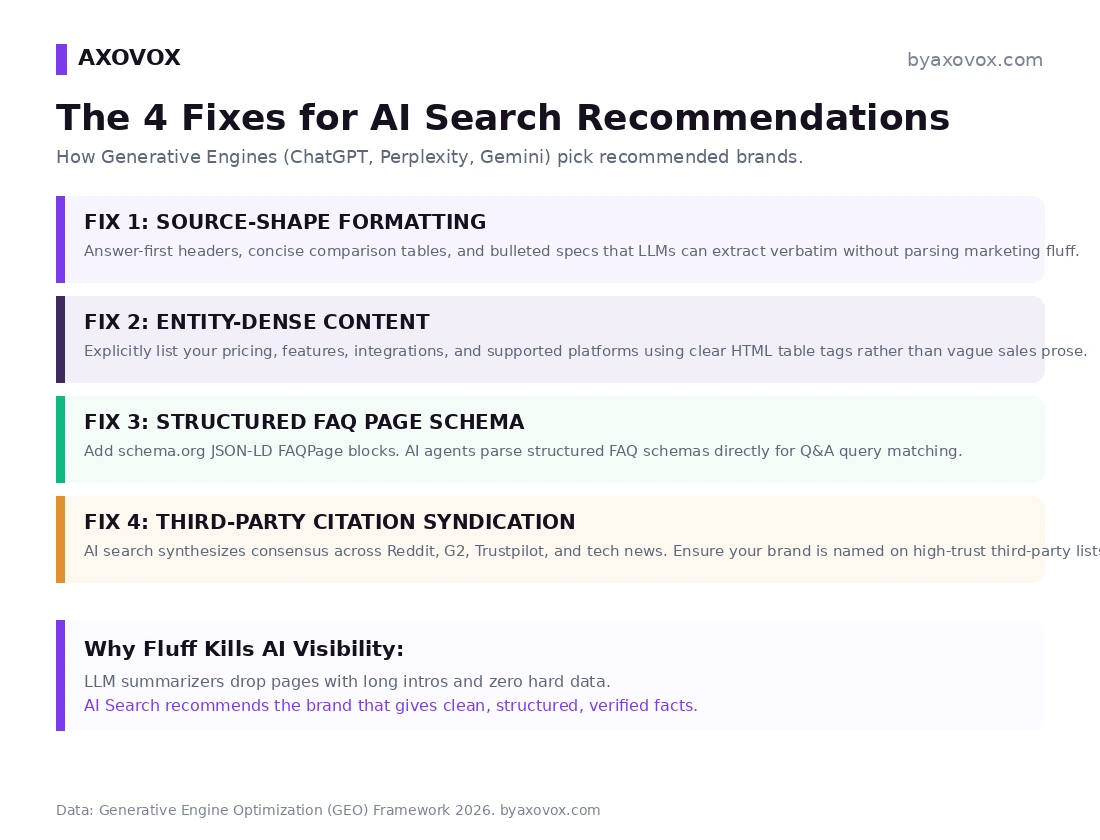
Where the consensus work actually pays:
- The open review platforms: G2, Capterra, Trustpilot, Product Hunt. Crawlable, crawled constantly, and the review SENTENCES matter more than the star math, ask customers to mention what you did, the same testimony rule we push for local reviews
- Reddit and niche forums: authentic-user discussion is visibly over-weighted in these answers; be genuinely present where your category gets argued about, and never astroturf, these communities and the engines both punish it
- Roundup outreach: pitch the “top [category] tools” lists that already get cited for your queries. In our client’s case, landing in three such roundups plus the on-page work took him from absent to named on six of his ten money queries within five weeks, our sample of one niche, offered as experience, not as a law
The follow-up audit (every two weeks, fifteen minutes)
- In private browsing, ask ChatGPT, Perplexity and Gemini your five non-branded money questions: “best [category] for [audience],” “[competitor] alternatives,” and so on
- Log three things per answer: are you named, which sources the citations point to, and whether your pricing and features came back accurate
- Diff against last time. The cited-sources column is your to-do list: those are the pages and platforms to strengthen or get into
Verified: the answer-ingredient findings (the Princeton GEO benchmark linked above), the structured-data mechanics (Google’s own documentation), and the fact that these engines search and cite the live web. From our client work, labeled as such: the half-on-page-half-off split, the table-extraction advantage, the five-week timeline, and the concession effect, consistent across the audits we’ve run, but our sample, not a study. Unknowable from outside: each engine’s exact weighting, which shifts without announcement. The audit loop above exists precisely so your decisions ride on your own fortnightly data instead of anyone’s claims, including mine.
FAQ
Why does Perplexity or ChatGPT recommend my competitor even if my SEO is better?
Rankings measure link authority and relevance; recommendations measure how easily an engine can extract, verify and quote your facts, plus what the independent web says about you. A competitor with weaker rankings wins the answer when their pricing, features and third-party presence are easier to lift and confirm.
What is Generative Engine Optimization (GEO)?
The practice of structuring your content and off-site presence so AI engines like ChatGPT, Perplexity and Gemini retrieve, cite and recommend your brand in generated answers. In practice it’s the four levers above: liftable pages, clear entity data, owned comparisons, and third-party consensus.
Does schema markup directly influence ChatGPT or Perplexity recommendations?
The crawlers feeding these engines read JSON-LD, and in our audits consistent structured data correlates with more accurate, more confident brand mentions; the exact weighting is unpublished by every engine. It’s cheap, official and mechanically sensible, implement it, but treat anyone promising a guaranteed effect as selling.
How long until AI search recommendations change after fixes?
Engines that search the live web respond on content timelines: in our client work, on-page rewrites and new comparison pages started surfacing in answers within 2-5 weeks, with roundup placements accelerating it. Anything promising days is noise; anything requiring “model retraining” talk is stalling.
Does hiding pricing behind a demo hurt AI recommendations?
Yes, measurably in the answers themselves: comparison responses favor sources with explicit numbers, and demo-gated tools get labeled “custom pricing” or skipped. If sales insists on gating, publish at least a starting price or a range; the machine can’t recommend a number you won’t say.
Can I pay to be recommended by AI search?
Not organically: ChatGPT and Perplexity recommendations come from retrieval, not a rate card. Google is a partial exception, ads now appear inside its AI surfaces, which we broke down in the AI Mode ads analysis, but the organic citation remains the slot money can’t buy, there and everywhere else.
How do I find out which sources the AI trusts for my category?
Ask it your money question and read the citations: the footnoted domains ARE the trust list for that query. Every platform and roundup appearing there twice is a place your brand needs a presence, which turns the citation list into your outreach plan.