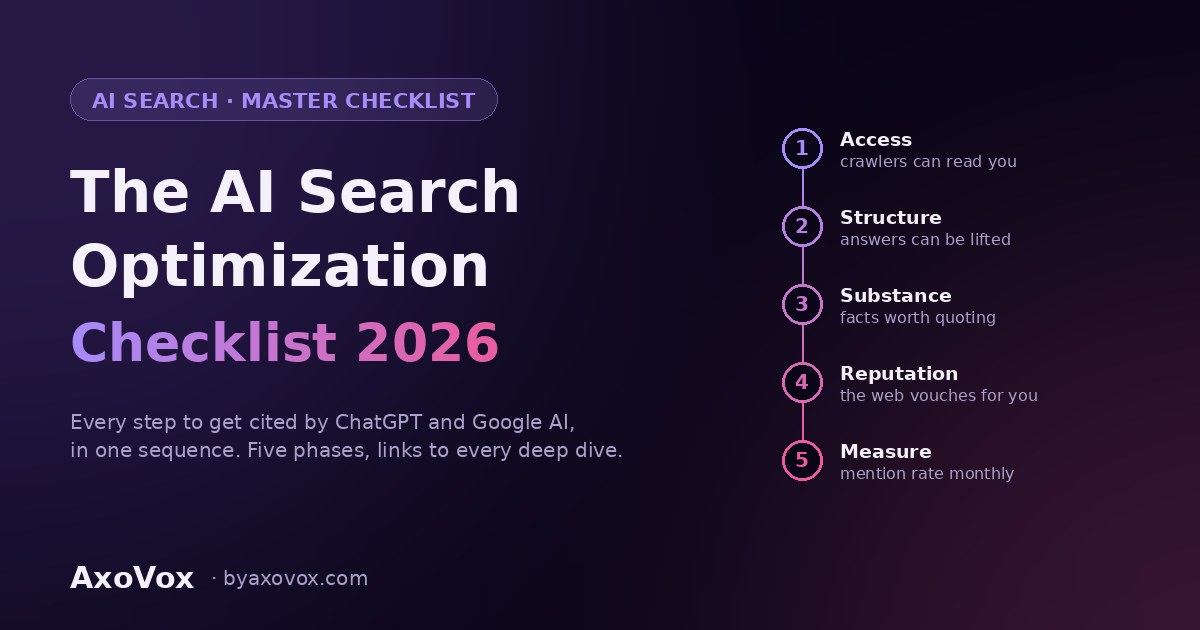
Getting your business cited by AI search comes down to five jobs, done in order: make your site readable to AI crawlers, structure pages so answers can be lifted, fill them with facts worth quoting, build the off-site reputation models trust, and measure whether it’s working. We’ve written a deep guide on each piece. This page is the master checklist that ties them together, so you can run the whole program from one tab.
Why one checklist (and why now)
AI Overviews now appear on roughly half of Google searches, ChatGPT serves 800 million people weekly, and the brands cited inside those answers earn dramatically more clicks than the ones left out (the 2026 numbers are here). The playbook for winning citations is genuinely learnable, but it’s spread across disciplines: technical SEO, content structure, reputation building, measurement. This checklist puts every step in sequence. Where a step deserves a full article, we link it; do the item, go deeper when you need to.
Phase 1: Access — can AI read you at all?
Nothing else matters if the crawlers can’t fetch your pages.
- Check robots.txt for rules blocking GPTBot, ClaudeBot, PerplexityBot, or Google-Extended. CDNs like Cloudflare block AI bots by default on many plans; check that setting too.
- Confirm your content is server-rendered. Pages that only fill in after JavaScript runs are invisible to many AI fetchers. Quick test: ask Perplexity to summarize one of your pages. If it can’t, you have a rendering problem.
- Verify indexing health in Search Console → Pages: no accidental noindex, no crawl errors on your key URLs.
The full walkthrough, including the Cloudflare specifics, is in our guide to getting your business mentioned in ChatGPT.
Phase 2: Structure — can answers be lifted?
AI systems assemble answers from passages, not pages. Your job is making every important answer liftable.
- Phrase H2s and H3s as the actual questions people ask, worded naturally.
- Put a 40-60 word direct answer immediately under each question heading. Complete enough to make sense with zero surrounding context, because that’s exactly how it gets quoted.
- Match format to answer shape: numbered lists for processes, bullets for options, simple tables for comparisons. These map onto the shapes AI Overviews render.
- Add schema: Article on posts, FAQPage on Q&A sections, Organization site-wide. Validate in Google’s Rich Results Test; broken markup is silent noise.
- Add a genuine FAQ section to key pages. Each question is another passage in the citation pool.
Google’s selection mechanics (query fan-out, passage competition, why position #5 gets cited over #1) are in our AI Overviews playbook, and the snippet-vs-Overview distinction is covered in this comparison. The conceptual backdrop, if you want the “why” behind all of it, is our GEO explainer.
Phase 3: Substance — is there anything worth quoting?
Structure gets you scanned; substance gets you cited.
- Replace adjectives with numbers. Real prices, real results, dates, named methods. The Princeton GEO research found adding statistics lifted citation visibility by roughly a third; vague marketing language gets skipped entirely.
- Show a human: named author, short bio, an about page. Citation data skews hard toward content with visible expertise and away from anonymous content mills.
- Keep pages alive. The large majority of AI-cited pages were published or updated within two years, and recently refreshed pages get cited several times more often. Book a quarterly touch on your ten most important pages: update stats, current-year examples, prune dead claims.
Phase 4: Reputation — does the wider web vouch for you?
This is the phase that separates cited brands from structured-but-ignored ones. AI systems weigh third-party evidence heavily, sometimes more than your own site.
- Reviews, steadily: one-tap link, ask at the moment of peak happiness, reply to everything. The full engine is in our reviews guide.
- Complete profiles and listings: your Google Business Profile, the major maps and review platforms, your industry directory. Consistent details everywhere.
- Communities, sincerely: Reddit alone accounts for around a fifth of AI answer citations. Pick one community where your customers actually are and be useful for a month before ever mentioning yourself.
- One earned mention beats ten owned posts: a quote in a trade publication, a local paper feature, a “best of” list. This is classic PR with a new payoff.
Phase 5: Measure — is any of it working?
- The monthly prompt test: ten questions your customers would ask (“best [service] in [city]”, “how much does [service] cost”), run through ChatGPT, Perplexity, and Google’s AI Mode. Log every brand named. Your mention rate is the new rank tracking.
- The Search Console signature: for queries you target, watch for impressions rising while position holds. If clicks fall on informational queries while that happens, AI answers are absorbing them; our traffic-drop diagnosis covers reading it correctly.
- Referral check in GA4: chatgpt.com and perplexity.ai as sources. Small numbers, unusually warm visitors.
- Graduate to paid tracking (Semrush’s AI toolkit and friends, covered in our tools list) once manual volume justifies it.
The realistic timeline
Phases 1-2 are a week of focused work and can show up in AI answers within weeks, since several of these systems pull from live results. Phase 3 is an ongoing habit. Phase 4 compounds over 3-6 months and does the heaviest lifting. Phase 5 costs twenty minutes a month, forever. The order matters: reputation built on unliftable content is wasted, and beautiful structure nobody vouches for stays uncited. Run the phases in sequence and each one multiplies the previous.
Frequently asked questions
What is an AI search optimization checklist?
A step-by-step sequence for making a business citable by AI systems like ChatGPT, Perplexity, and Google’s AI Overviews: crawler access, liftable content structure, fact-dense substance, third-party reputation, and monthly measurement. It sits on top of normal SEO rather than replacing it.
How long does AI search optimization take to work?
Technical and structural fixes can appear in AI answers within weeks, because tools like Perplexity and ChatGPT search pull live results. The reputation phase (reviews, mentions, PR) compounds over 3-6 months. Anyone promising guaranteed AI citations in days is selling something that doesn’t exist.
Do I need special tools for this?
Not to start. Robots.txt, Search Console, and a monthly prompt spreadsheet cover phases 1, 2, and 5 for free. Paid AI-visibility trackers earn their subscription later, when you’re mentioned sometimes and want to grow the rate systematically.
Does AI optimization replace regular SEO?
No. It’s the same foundation with a different scoreboard: crawlability, structure, and authority power both rankings and citations. What changes is emphasis, toward quotable passages, freshness, and earned mentions, and away from chasing one keyword position.
Which phase matters most?
Access first, because nothing works if crawlers can’t read you, but reputation (phase 4) does the most heavy lifting long-term. AI systems trust what the wider web vouches for. A business with strong reviews, mentions, and complete profiles gets cited even with average content; the reverse rarely happens.
The bottom line
Five phases, one sequence: access, structure, substance, reputation, measurement. None of it is exotic, and that’s the opportunity. Most of your competitors haven’t done phase 1, which means running this checklist completely is currently a genuine edge rather than table stakes. It won’t stay that way for long.
Want us to score your business against all five phases and show you exactly where you’re losing citations? Send us your domain. You’ll get the gap list in plain language, whether or not you hire us to close it.