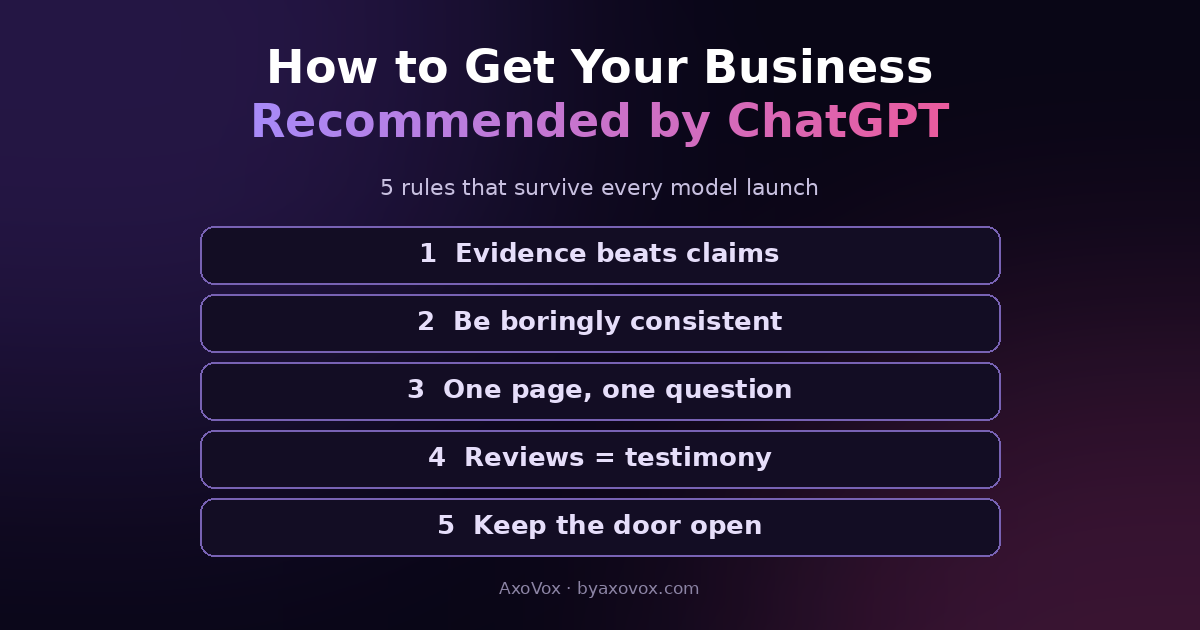
I’ve stopped keeping up with model names. Argon this week, Astra last week, something with “Sol” in it apparently. Clients ask me which one matters and my answer disappoints them: none of them, individually. What matters is that all of them, whatever launches next quarter, decide whether to recommend your business the same way.
They read public evidence and compress it into an answer. That’s the whole machine. Google’s AI opens roughly half of searches now, around 60% of searches end with no click to any website, and ChatGPT fields buying questions by the hundreds of millions weekly, and underneath all that drama sits one boring constant: how you get your business recommended by ChatGPT, by Google’s AI, by whatever ships next, never changes.
Five of them, from three years of watching which clients the machines pick and which they skip. Each comes with a test you can run today.
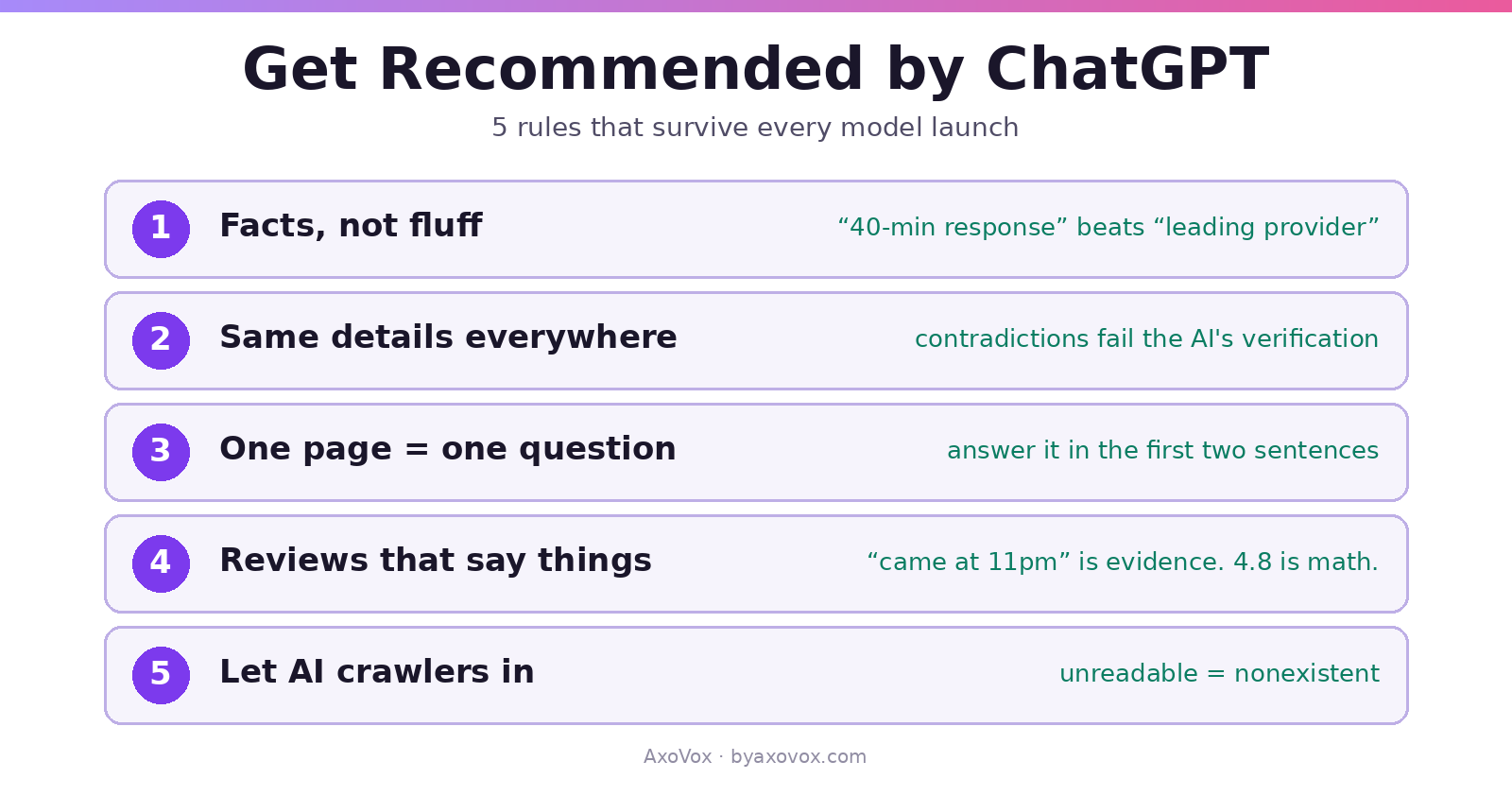
Principle 1: Evidence beats claims, every single time
Your homepage says you’re “the leading provider of innovative solutions.” An AI reads that and extracts nothing, there’s no fact in it to lift. Your competitor’s page says “we answer emergency calls within 40 minutes, 24/7, across the Sharon region.” That sentence gets quoted into answers verbatim, because it IS an answer.
The machines don’t rank vibes. They assemble responses from liftable claims: numbers, timeframes, prices, specifics. Every marketing sentence you publish either contains a fact an AI can use or it’s decoration. Audit accordingly, and be ruthless; in my experience about 70% of small-business homepage copy evaporates under this test.
Principle 2: Be boringly consistent, because machines verify before they trust
Humans forgive a stale address on some directory from 2019. Verification systems don’t; a contradiction reads as unreliability, and unreliable sources get skipped, silently. The least glamorous work in marketing, same name, address, phone, hours, claims, everywhere, is now a trust signal read by machines at scale.
A client of ours lost AI mentions for months over exactly this: two old listings carried a previous location, and every assistant hedged about them (“locations unclear”). Fixed the listings, the hedging stopped. No content was written. Trust was repaired with janitorial work.
Principle 3: One page, one question, answered in the first two sentences
People write pages about topics. Machines cite pages that answer questions. The difference sounds subtle and decides everything: “Our Services” is a topic; “What does a kitchen renovation cost in Netanya?” is a question, and a page with that H2 and a real range in sentence two is pre-formatted for citation.
This is also, not coincidentally, what your human visitors always wanted. The AI era didn’t invent a new writing standard; it built an enforcement mechanism for the old one. Warm-up paragraphs, buried answers and clever-but-vague headlines now carry a measurable cost: the citation goes to whoever answered faster.
Principle 4: Reviews are testimony now, not decoration
A 4.8 average is arithmetic. “Came at 11pm and charged exactly what he quoted” is evidence with a timestamp and a witness, and when an assistant explains WHY it recommends a business, those sentences are the explanation. We’ve watched businesses with 60 specific reviews outrank 200 generic ones inside AI answers, repeatedly, because the smaller pile contained more usable testimony.
You can’t write your reviews, but you control the prompt that produces them. One line added to your review ask, “mention what we did, it helps people with the same problem find us”, changes what the next hundred reviews contain. And mind the wall: Google’s AI reads your Google reviews natively while ChatGPT mostly can’t, so your best quotes belong on your own site as text too.
Principle 5: Keep the door open, because unreadable means nonexistent
Roughly half the sites I audit block AI crawlers without knowing it: a security plugin’s default, a firewall rule from 2023, a robots.txt line that outlived the debate that wrote it. Everything above, the evidence, the consistency, the answer-shaped pages, the testimony, is worthless behind a locked door, and the lock is silent; no error, no notice, just absence from every answer.
There’s a legitimate choice buried here (blocking training is a real position), but make it ON PURPOSE, knowing which crawler does what. The accidental version is just self-deletion with extra steps.
Why these five survive every model launch
Because they’re not features of any engine; they’re features of how machine trust works. Whatever ships next quarter will still read the public web, still verify before citing, still quote the page that answered fastest, still need third-party testimony, and still skip what it can’t access. Google’s 90% search share can erode, chatbots can trade places, and these rules transfer untouched, which is precisely what makes them worth your hours while the model names aren’t.
The order of operations (because sequencing matters)
Door first (principle 5, twenty minutes), facts second (principle 2, an afternoon), then pages (3), then the review pipeline (4), with the evidence audit (1) running through all of it. Teams that start with content on a blocked site, and I’ve watched several, publish into a void for months. Plumbing before poetry.
Common questions
How do I get my business recommended by ChatGPT?
Make yourself the easiest business to verify: publish pages with liftable facts, keep your details identical everywhere, answer one real question per page, feed the review pipeline with specifics, and make sure AI crawlers can read your site. ChatGPT assembles recommendations from that public evidence, so the evidence is the lever.
Do these principles change when a new AI model launches?
No, and that’s the point: every engine reads the public web, verifies claims, quotes answer-shaped pages, leans on review testimony and skips what it can’t access. Model launches change speed and polish, not the trust mechanics.
Which principle should a small business start with?
The door (crawler access), because it takes twenty minutes and everything else is wasted behind a block. Then fact consistency, then answer-shaped pages, then the review ask.
How long until AI visibility work shows results?
Recrawls and answer refreshes run on weeks-to-months timelines; in our client work, fact fixes surface in 2-8 weeks and content citations in 1-3 months. Anyone promising days is selling.
Is this different from regular SEO?
It’s the honest subset of SEO with the tricks removed: evidence, consistency, direct answers and access help rankings too, so the work double-counts. What died is the gap between ranking well and deserving to.
How do I measure whether it’s working?
Monthly: run the five tests above, check Search Console’s Generative AI report for citation counts, and ask the assistants your money questions in a fresh chat. The full 5-question audit takes ten minutes.