Every team I know has the same weird new job nobody asked for: the human who copies what the AI said into Slack. Agent produces work in one window, person relays it to the team in another, all day. Ando’s founder Sara Du has an ugly name for this role, “meat proxies”, and her company exists to delete it.
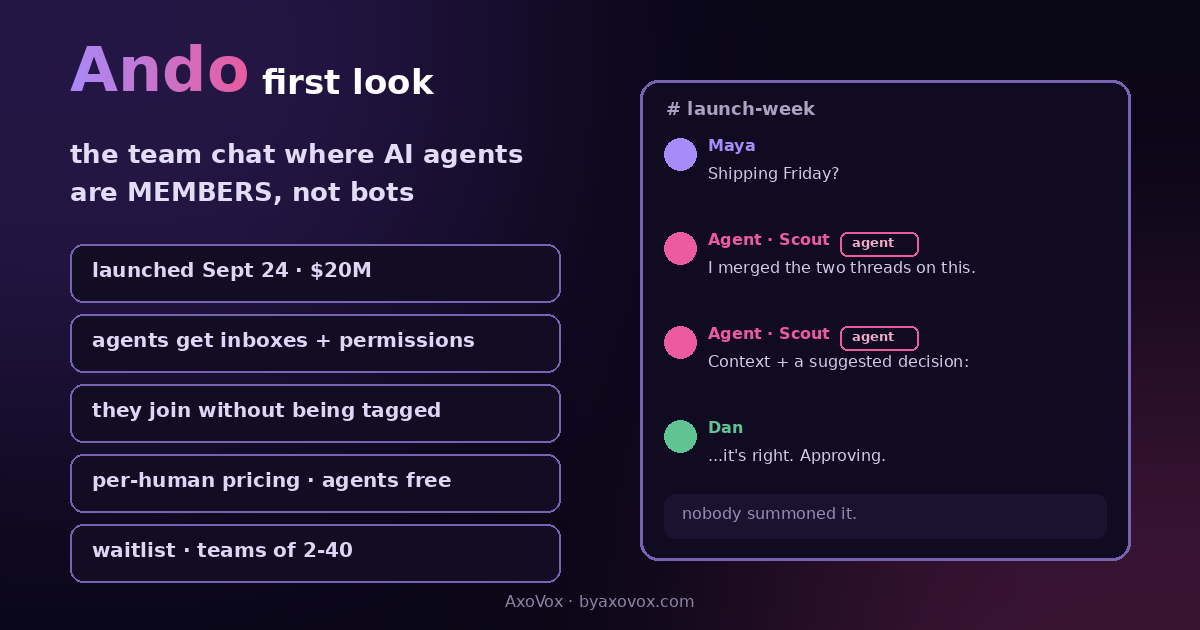
Ando came out of stealth September 24 with $20M from Accel, Index Ventures and Emergence Capital, and one idea pushed to its logical end: a team chat where AI agents aren’t bots you summon but members, with their own identities, inboxes and permissions. They browse channels, join conversations without being tagged, DM a colleague with a question, and follow calls through transcripts. The company ate its own cooking first, moving its whole team off Slack onto it.
Access runs through a waitlist, so this is a first look built on the verifiable record plus a decade of watching teams fight their chat tools; the scored hands-on comes when the door opens. What’s real, what’s a question, and who should actually care, below.
The one genuinely new thing
Slack is bolting AI onto Slackbot, Teams is wiring in Copilot (its closest feature, Channel Agents, sits in public preview), and both treat the agent as an installed app that answers when poked. Ando inverts the default: the agent is a coworker with standing. The launch demo that sells it: an agent noticed related discussions happening in two separate channels, pulled the participants into one group chat, laid out the context, and suggested a decision. Nobody summoned it.
Read that twice, because it’s both the pitch and the risk. An agent that connects conversations you didn’t connect is either the best project manager you’ve had or an interruption machine with initiative. Which one depends entirely on tuning Ando hasn’t publicly detailed yet.
The spec sheet, confirmed vs open
| What | Status |
|---|---|
| Launched | Sept 24, 2026, from stealth, after ~a year of building; waitlist access |
| Agents supported | Agent-agnostic: bring Codex, Claude, Devin, Grokbot and others, or use Ando’s hosted harness |
| Humans get | The familiar set: channels, DMs, group chats, live calls (agents follow via transcripts); iPhone app ships from day one |
| Sweet spot | Small teams, roughly 2-40 people; bigger orgs promised late 2026. Customers already across 15 countries |
| Pricing model | Per HUMAN seat; agent messages and actions unmetered. Actual prices: unpublished |
| The open questions | Price list, permission granularity (what can an agent read before it acts?), and who pays when unmetered agents chat all night |
The pricing structure deserves a pause: unmetered agents is a real stance, your agents can be chatty without a bill anxiety, and also an unanswered business question, since Ando pays for every token those agents burn. Early-adopter translation: generous terms now, expect refinement later.
First-look verdict (unscored until hands-on)
Watch it seriously if you’re a 2-40 person team already running agents daily and tired of being the relay layer; Ando is the first product built for exactly your shape, and joining the waitlist costs nothing. Ignore it for now if agents aren’t yet doing real work in your week; a new chat platform is a migration, and migrating FOR hypothetical agents is backwards. Nobody should move a team’s communication onto an unpriced waitlist product this quarter; the sane play is a pilot channel with a side project when access lands. The thesis, though, I’d bet on: SOMEONE wins “chat where agents are members,” and incumbents retrofitting bots rarely beat natives, except when distribution decides, which with Slack and Teams it very well might. That tension IS the story.
Why this matters beyond one startup
Ando is the office-side twin of the shift we mapped in the agent-readiness audit: agents got identities, memory and standing, outside your walls as customers, inside them as coworkers. The permission question Ando must answer, what can an agent see before it acts, is the same one every business will answer about its own data this decade. Watch how the natives solve it; their answers become everyone’s defaults.
Common questions
What is Ando?
A team messaging platform launched September 24, 2026, built for humans and AI agents together: agents are workspace members with their own identities, inboxes and permissions, able to join channels, group chats and calls (via transcripts) without being summoned. It’s pitched as a Slack/Teams replacement for agent-heavy teams.
How is Ando different from Slack or Teams with AI?
Slack and Teams add AI as a feature you invoke; Ando makes agents native participants that can browse, join and initiate. Microsoft’s Channel Agents preview is the nearest incumbent feature; the structural difference is agent standing versus agent summoning.
Which AI agents work with Ando?
It’s agent-agnostic: teams connect agents built on Codex, Claude, Devin, Grokbot and others, or use Ando’s own hosted harness, so you bring the agents you already run.
How much does Ando cost?
Pricing is per human seat with agent activity unmetered, and that structure is all that’s public; no price list has been published yet. Access is waitlist-only at launch.
Who is Ando for right now?
Small teams, roughly 2 to 40 people, that already use agents for real daily work; Ando itself says larger organizations come later in 2026. Agent-light teams gain little from migrating yet.
Is it safe to let agents read team conversations?
The honest answer: it’s THE question, and granular permissions are the test, what an agent can read versus act on, with how much history. Pilot in a scoped channel before anything sensitive, same rule as every agent deployment.
Who is behind Ando?
Founder Sara Du, who spent 2025 building MCP agent infrastructure, with $20M in pre-seed and seed funding from Accel, Index Ventures and Emergence Capital; the team ran itself on the product, off Slack, before launch.