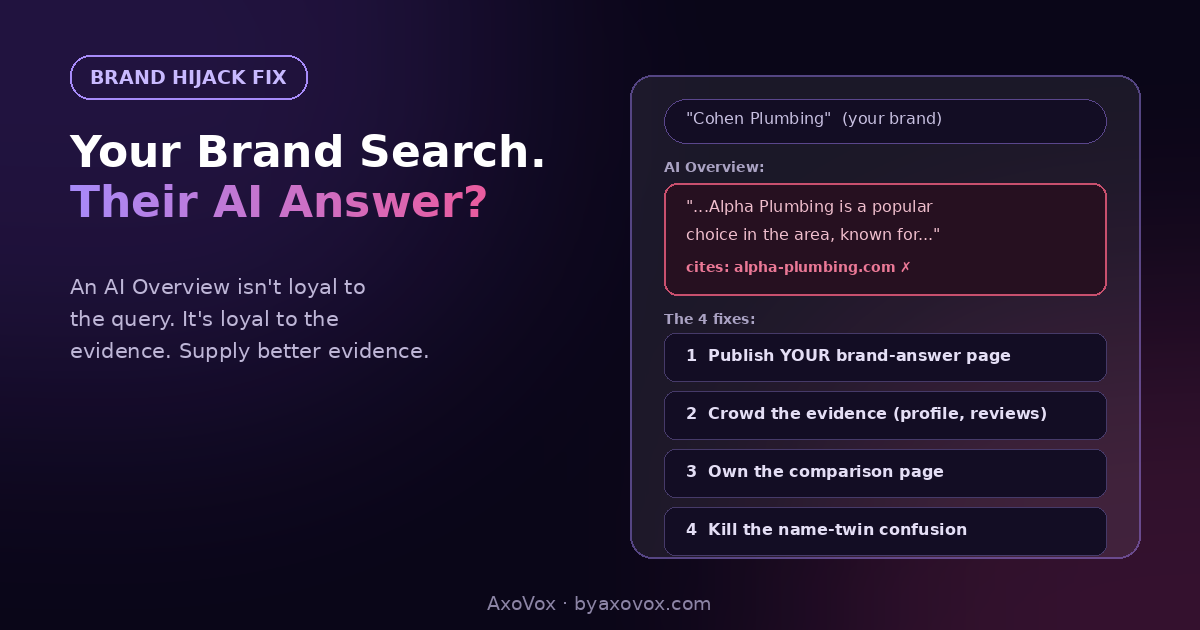
A customer googles your business name, the one on your sign, the one they were told, and Google’s AI answer opens with your competitor. Cited, summarized, sitting on top of the very search that was supposed to be yours. It feels like theft, and in attention terms, it is.
Here’s why it happens: an AI Overview isn’t loyal to the query, it’s loyal to the evidence. When someone searches a brand name, Google’s AI fans out into sub-questions (what is this business, is it good, what are the alternatives), and if a competitor’s comparison page, a directory list, or a “best X in [city]” article answers those sub-questions better than anything YOU published, their content gets quoted on your name. You’re not being punished; you’re being out-testified on your own trial.
Four fixes, in the order that actually moves it.
First: diagnose which hijack you have (5 minutes)
Search your exact brand name in an incognito window and read the AI Overview carefully. Which is it?
A. The AI describes YOUR business but cites competitor/third-party pages
B. The AI treats your name as a generic term and answers about the category
C. A competitor is presented as an alternative or comparison (“similar to…”)
D. The AI confuses you with a similarly named business
Each has its own fix below. Screenshot it; you’ll want the before/after.
Fix 1: publish the page that answers your own brand query (case A and B)
Your name is a query. Treat it like one.
- Most business sites have no page that directly answers “what is [brand], is it good, what does it cost, who is it for.” The homepage sells; nothing testifies. Build an About page (or upgrade it) that answers those sub-questions in liftable form: who you are, since when, what exactly you do, prices, service area, each under its own heading with the answer in sentence one
- Add Organization or LocalBusiness schema naming the brand, so the entity is machine-clear
- This is the same fan-out structure that wins any query, aimed at the one query you should never lose
Fix 2: crowd the evidence (case A and C)
- The AI cites third parties because third parties are all it found. Give it better witnesses: a complete Business Profile, fresh reviews mentioning you by name, and your profiles on the two or three directories that rank for your market
- If a “best [service] in [city]” listicle keeps being quoted on your brand search and you’re not in it, that’s an outreach email, not a mystery. Get listed where the AI already looks
Fix 3: the comparison play (case C)
- When the AI volunteers alternatives, someone’s comparison content is feeding it. You can contest the frame: a plain “[You] vs [Competitor]” or “alternatives to X” page, honest and specific, routinely becomes the cited source for that sub-question, because first-party comparisons with real details beat thin third-party ones
- Honesty is the weapon here: state what you’re better at AND what you’re not for. The AI rewards content that reads like testimony, not brochure
Fix 4: the name-twin cleanup (case D)
- Pair your name with city and service everywhere it appears: site title, profile, directories, socials. “Cohen Plumbing, Netanya” disambiguates; “Cohen Plumbing” invites the merge
- If a stale source is blending the two of you, hunt and fix it at the origin, the exact method from the wrong-AI-info guide
The uncomfortable question worth asking
Sometimes the AI surfaces a competitor on your brand search because the searcher’s real intent includes comparison, people genuinely ask “is there anyone better than X.” You can’t delete that intent, and trying reads as thin skin. What you can do is make sure the comparison happens on your evidence: your reviews, your prices stated plainly, your own comparison page. A business that answers the skeptic’s sub-questions itself rarely loses its own name; the ones that lose it left the witness stand empty.
If it won’t budge
You published the brand page weeks ago, AI still cites others. Check it’s indexed, request indexing, and confirm the page actually answers the sub-questions the current Overview contains (read the Overview like a spec). Citation follows extractability.
The Overview is fine but AI Mode’s answer isn’t (or vice versa). Different surfaces rebuild from the same evidence on different schedules; a fix that landed on one usually reaches the other within weeks.
A big-brand competitor dominates through sheer authority. On your exact brand name, specificity beats authority more often than anywhere else in search; keep the first-party evidence sharp and current, and track the citations monthly in Search Console’s AI report.
The cited “competitor” is a fake or scraper site using your name. Different problem: report it to Google (legal removal request for impersonation) while also outweighing it with legitimate evidence.
Common questions
Why does Google’s AI show a competitor when someone searches my business name?
Because the AI answers brand searches from the best available evidence, and if a competitor’s page, a directory or a comparison article answers the implied sub-questions (what is this business, is it good, what are alternatives) better than your own content, it gets cited on your name.
How do I control what the AI Overview says about my brand?
You can’t dictate it, but you can supply it: an About page answering your own brand query in liftable form, entity schema, a complete profile, fresh named reviews, and presence in the sources the AI already cites. First-party evidence usually wins brand queries once it exists.
Should I make a comparison page against my competitor?
If the AI is already volunteering alternatives on your brand search, yes: an honest, specific first-party comparison routinely becomes the cited source for that sub-question. State real trade-offs; brochure-speak doesn’t get quoted.
Can I report an AI Overview that misrepresents my business?
Each AI answer has feedback controls, and impersonation or fake sites can be reported through Google’s removal processes. For ordinary misrepresentation, fixing the underlying sources works faster and more permanently than feedback.
How long does it take to win back my brand’s AI answer?
After publishing the brand page and strengthening evidence: typically weeks, as the surfaces recrawl and rebuild. Track it with a monthly incognito search plus the Generative AI report in Search Console.
Does this affect ChatGPT answers about my brand too?
The same evidence feeds every assistant, so the fixes transfer: ChatGPT’s version of the problem and its cure are covered in our wrong-information guide, and improvements typically appear across assistants on their own schedules.
Is a competitor doing this to me on purpose?
Rarely. Comparison pages and listicles are ordinary marketing; the AI quoting them on your name is a side effect of your own evidence gap. The fix is supply, not accusation.