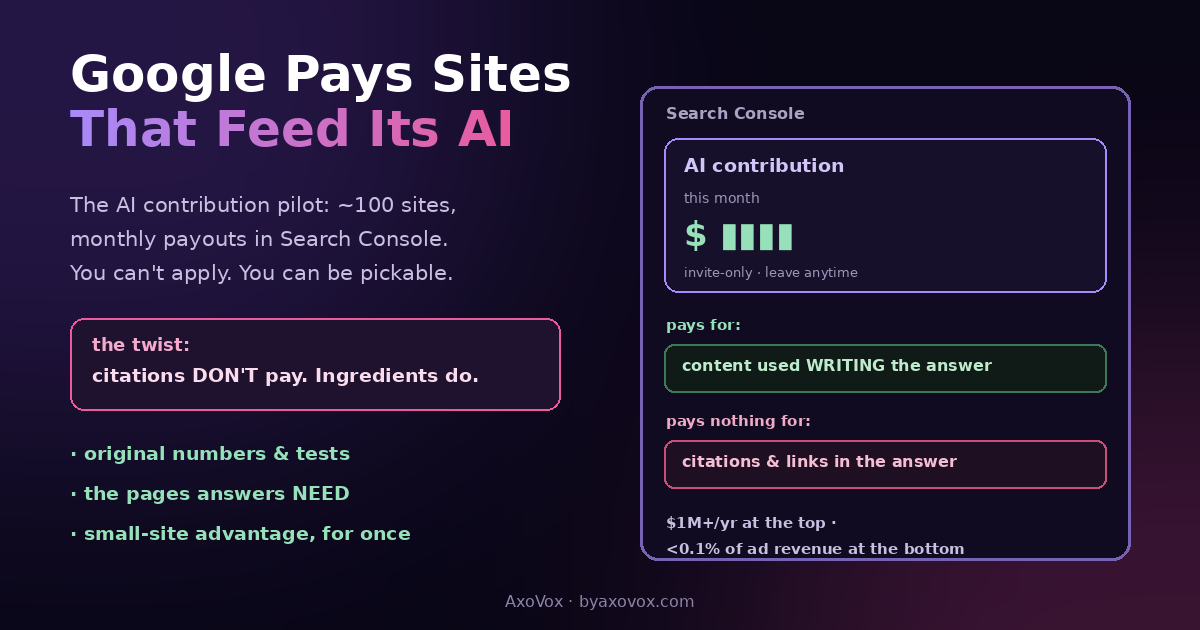
The morning I read that Google was paying websites for AI answers, I did the only sensible thing: opened Search Console for every property we manage at the agency and went hunting for the panel. No invitation on any of ours, which, as you’ll see, the numbers made predictable. But the hunt taught me exactly where it lives and what the fine print pays for, and the fine print is the story.
Google has started paying sites whose content feeds its AI answers. Jessica Davies and Sara Guaglione broke it at Digiday on September 14, 2026; Google confirmed to them it’s an “early-stage” pilot. 9to5Google’s Ben Schoon added the mechanics on the 17th, and Alix Coutures and Catherine Perloff at The Information put numbers on it September 29: roughly 100 publishers, one clearing $1M a year, several seeing less than 0.1% of their ad revenue.
You can’t apply, so every “how to join” headline you’ll see this month is selling a door that doesn’t exist. What the reporting DOES let you reverse-engineer is the shape of site that gets picked, and after fifteen years of building sites Google either rewards or ignores, that shape looked familiar to me immediately. Let’s read it together.
What’s confirmed, source by source
| Fact | Detail | Who reported it |
|---|---|---|
| What pays | Content that “significantly contributes” DURING generation of an answer in AI Overviews, AI Mode, or the Gemini app | Google’s help text, via Digiday, Sept 14 |
| What explicitly doesn’t | Citations and links. Appearing in the answer isn’t the paid event; being its raw material is | The help documentation’s own terms |
| Where it lives | An “AI contribution” panel in Search Console: monthly earnings, payment history, leave anytime from Settings | Digiday screenshots; 9to5Google, Sept 17 |
| Who’s in | ~100 publishers, skewing small and mid-sized, wider than news; large publishers mostly holding out | The Information, Sept 29 |
| The money | $1M+/year at the top; ~$50-60K mid; under 0.1% of ad revenue for several smaller sites | The Information, Sept 29 |
| How you join | You don’t. Google invites; the panel appears; you accept terms or you don’t | All three, consistently |
One more date worth knowing: Barry Schwartz of Search Engine Roundtable actually spotted the panel back in April 2026, months before anyone knew money was attached. Which means the pilot has been quietly selecting sites for at least half a year while the rest of us weren’t looking. I find that detail more instructive than the headlines: Google ran the selection first and let the story leak later.
The line that rearranged my thinking
Sit with the second row of that table, because it broke a mental model I’d been using with clients all year. A link in an AI Overview registers as an impression in your Generative AI report AND can pay nothing. Meanwhile a site the model leaned on while WRITING the answer earns, cited or not.
Google just told us, with money, which layer it values. Not the bibliography. The ingredients. I went back through our own Generative AI reports after reading that, and it reframed what I was proud of: the impressions we’d been celebrating are the visible layer, and the paid layer sits underneath it, mostly invisible from outside.
So what shape gets picked?
Honesty first: nobody outside Google knows the invitation algorithm. Digiday’s publisher sources, people INSIDE the pilot, called the system a black box, and I’m not going to pretend to see through a box its own participants can’t. But three selection pressures are visible in the design, and all three are buildable.
Grounding-grade content. “Contributes during generation” describes material a model reaches for when composing: original numbers, firsthand tests, definitions, specifications, local facts nobody else has. In our client work, the pages that keep earning AI citations are exactly these, a renovation firm’s real price ranges, a clinic’s plainly-written treatment explanations, and never the commentary pages. The pilot appears to pay for the same substrate. A summary of other summaries contributes nothing to generation; it IS generation.
Small and mid-sized, on purpose. The Information’s reporting says the big publishers are mostly staying out, holding for licensing deals, while the pilot fills with smaller sites. Whatever Google’s reasoning, the practical read for anyone running a focused niche site: for once, your size is the qualifying trait, not the handicap. I’ve spent years telling small-site owners they can’t out-publish the giants; this is the first Google program I can point to where that’s an advantage.
Already in the machine. You can’t contribute to answers that never use you. The closest public proxy for “the systems lean on this site” is your footprint in Search Console’s Generative AI report, which is also the one metric on this list you can actually move this quarter. It’s the first thing I now check in any new client’s Search Console, before rankings.
The become-payable playbook (the honest version)
- Check whether you’re already invited. Search Console → Settings, per property. The panel has existed since at least April, and given how quietly it shipped, I’d bet real money some invited owners haven’t noticed it. Two minutes; I checked all of ours the same morning
- Build grounding assets, not more commentary. One page of original material per month: your pricing survey, your measured test results, the category definitions you’re qualified to write. This is the exact substrate the pilot pays for AND the material that wins citations everywhere else; one effort, two payoffs. It’s what we moved our own content calendar toward this year, before the pilot existed, because the citation data already pointed there
- Grow your Generative AI report footprint. The evidence rules apply unchanged: answer-shaped pages, consistent facts, crawlers in. Every AI impression is a rehearsal for being judged a contributor
- Keep the boring eligibility clean. Verified property, current business details, and no AI-features exclusion flipped in Settings; you can’t be paid for feeding answers you’ve opted out of
- Decide your answer before the invite. Terms are accept-and-leave-anytime per the documentation, the precedent matters, and the crumbs-level payouts argue for treating it as a signal rather than a revenue line. Write your yes/no now, calmly, so the panel doesn’t decide for you in a busy week
How we verified this (and what we couldn’t)
Everything above traces to the primary reporting: Digiday (Sept 14), 9to5Google (Sept 17), The Information via multiple outlets (Sept 29-30), and Schwartz’s April sighting, with Google’s help-document language quoted through Digiday’s screenshots. What I verified myself: the panel’s absence on our own managed properties, the Settings path, and the Generative AI report behavior described here. What nobody outside Google can verify, including pilot participants: the selection criteria and the payment formula. Where this article says “appears to” or “suggests,” that’s deliberate. If the pilot’s terms change, this page gets updated and dated; that’s house policy on anything involving other people’s money.
Should you chase this? My actual advice
No, and I say that as someone whose job would get easier if I told you yes. The pilot is early-stage by Google’s own label, opaque to its own members, and could be reshaped next quarter. Every step in the playbook above is work I’d assign regardless, because it pays in citations, recommendations and rankings today, with pilot money as a possible bonus check. Chasing an invitation would be silly. Being the obvious invitee is just strategy, and it’s the same strategy either way.
The strategic read
Put September’s pieces side by side: ads selling entry into the answer on one end, this pilot paying the answer’s suppliers on the other, a UK regulator’s opt-out ruling pressing from outside, and Chartbeat measuring Google referrals down 40% year over year underneath it all. That’s a marketplace assembling its sides over a shrinking click economy. The precedent is the real prize: “sources of AI answers get paid” now exists as a fact in the world, and whichever direction it grows, the positioned sites are the ones whose content answers can’t be written without. Same sites that win the citations. Same work. Start there.
Common questions
What is Google’s AI contribution pilot?
An invitation-only program, first reported by Digiday on September 14, 2026, that pays publishers monthly when their content significantly contributes to AI-generated answers in AI Overviews, AI Mode and the Gemini app. Earnings show in an AI contribution panel inside Search Console, and participants can leave anytime from Settings.
How do I apply for the AI contribution pilot?
You can’t; no application exists. Google invites sites and the panel appears in Search Console, which is why the practical play is building the source-shape the pilot selects and checking your Settings periodically. Treat any “application form” you find elsewhere as a scam signal.
How much does Google pay in the pilot?
Per The Information’s September 29 reporting: roughly 100 publishers, one earning over $1M a year, another around $50-60K, while several small and mid-sized sites see under 0.1% of their ad revenue. Pay scales with judged contribution, a formula participants themselves call a black box.
Do citations in AI Overviews earn money?
Explicitly no, per the program’s own documentation: links and citations don’t qualify. Payment attaches to content used during the answer’s generation, which can include uncited grounding, a deeper layer than the bibliography.
What kind of sites is Google inviting?
Small and mid-sized publishers, deliberately beyond news, while most large publishers hold out for licensing deals. Focused niche sites with original, answer-feeding content fit the observed profile.
Where do I see the AI contribution panel?
In Google Search Console, per verified property, once invited: an earnings widget with monthly figures and payment history, terms and cancellation in Settings. It was spotted in the wild by Barry Schwartz as early as April 2026, before the payments were public.
Is this related to the Search Console AI opt-out?
Separate controls born of the same pressure: the opt-out (a UK regulator requirement) removes you from AI features; the pilot pays you for powering them. Opting out and getting paid are mutually exclusive by definition.
Should I change my content strategy because of the pilot?
Only in the direction the citation data already points: original numbers, firsthand testing and clear definitions. That material wins recommendations today and happens to be what the pilot pays for; build for the citation and treat pilot money as the tip jar.