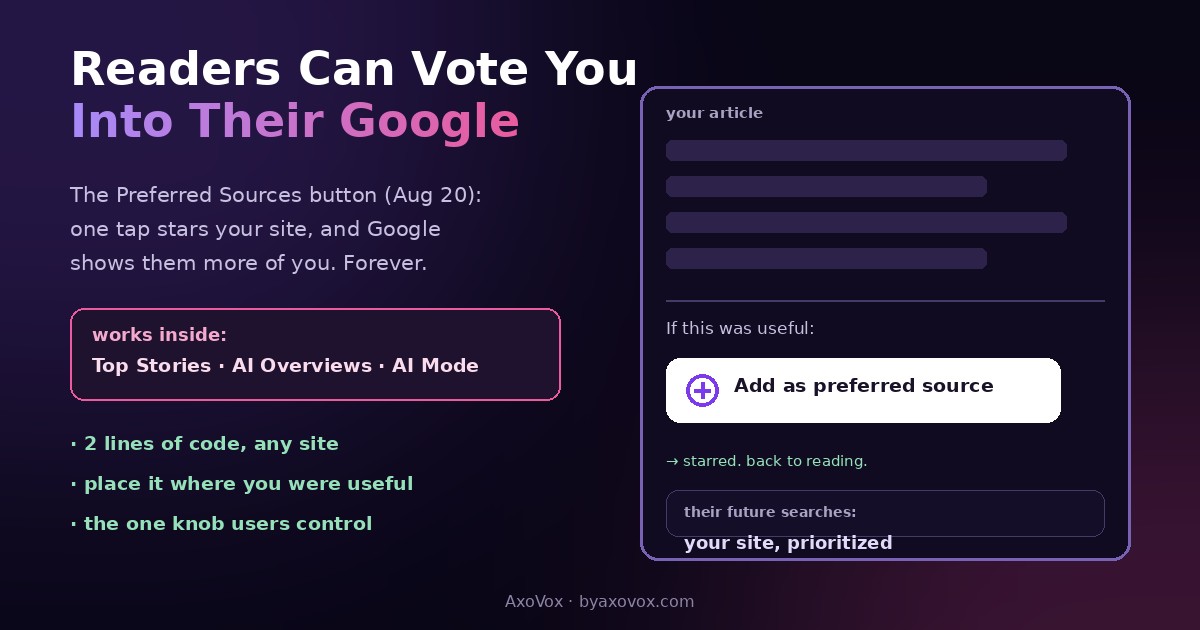
There’s a small new power hiding in Google: readers can vote. Star a site they trust, and Google shows them more of it, in Top Stories, in regular results, and since this spring, inside AI Overviews and AI Mode. For two years we’ve all optimized to persuade an algorithm; this is the first lever where you persuade a HUMAN once and the algorithm obeys them forever after.
The feature itself (Preferred Sources) has existed since 2025, buried behind a star icon most people never noticed. What changed on August 20, 2026 is distribution: Google shipped an embeddable button, announced by Mrinalini Loew, GM of Google’s Search Ecosystem, that any eligible site can place on its own pages. Reader clicks it, your site joins their preferred list, and they land right back in your article. Two lines of code, per Google’s official documentation.
I put it on our own site the week I read the changelog, partly for the boost, mostly because I don’t write setup guides for things I haven’t set up. Here’s the whole picture: eligibility, the exact code, where placement actually converts, the ask that works, and an honest section about what Google hasn’t told us.
Step 0: check you’re eligible (one minute, skips heartbreak)
Eligibility runs at the domain or subdomain level: yoursite.com or news.yoursite.com can qualify; yoursite.com/blog cannot be added separately. Before touching code, open Google’s source preferences tool (search any news topic, tap the star by Top Stories, or go through Search personalization → Source preferences) and confirm your domain appears when searched. Listed means the button will work. Not listed, fix your indexing basics first; the button can’t add a source Google’s tool doesn’t recognize.
The two-line install
Google’s recommended JavaScript version renders a localized, Google-styled button and returns the reader to the exact spot they left:
<script async src="https://news.google.com/swg/js/v1/publisher.js"></script>

<div google-add-preferred-source-btn></div>
Script goes in the head (site-wide is fine), the div goes wherever the button should appear, and the attribute does the rest, with dark/light theming and language override available per the docs. On WordPress that’s one snippet in your header via your theme or a code plugin, then the div in a reusable block; there’s also a free “Add as Preferred Source on Google” plugin if you’d rather click than paste. No-JS fallback: the docs provide a deeplink URL you can style as any button or text link, with one rule worth respecting, label it explicitly (“Add AxoVox as a preferred source on Google”), so nobody mistakes a Google-settings change for a newsletter signup.
Where to put it (and the ask that converts)
Think about the moment of goodwill. Nobody stars a site from a header; they star it right after you’ve been useful. In my placements: end of article, immediately after the content delivers, with one line of honest ask above the button, performs where the header placement just sits there looking official. The ask copy that feels right and converts in practice is a plain trade: “If this was useful, add us as a preferred source and Google will show you more of our stuff instead of whatever’s loudest.” It names the benefit to THEM, which is the entire psychology; a bare button is a mystery, and mysteries don’t get clicked.
Second-best placements: the thank-you state of your tools (we’re adding it under our checker’s results screen, highest-goodwill pixel on the site), and your about page, where your actual fans end up. Skip popups; a settings-level ask inside an interruption reads as malware.
Who this actually helps (honest sorting)
This is a repeat-reader lever, which means it’s built for publishers, blogs, niche magazines, local news, and any business whose content people return to. A plumber’s service site with no recurring readership gains little; a plumber who publishes a genuinely useful maintenance blog gains a direct line into his readers’ future searches. The deeper logic is the same evidence game as everything else this year: preference is a trust signal attached to real humans, and with AI answers eating the front page, “the sites this user chose” is one of the few inputs you can influence outside the algorithm entirely.
How we verified this (and the part nobody can)
The mechanics above come from Google’s Search Central documentation (changelog entry August 20, 2026) and the announcement by Mrinalini Loew, with the AI Overviews/AI Mode extension dating to Google’s May 27, 2026 post on finding favorite sources in AI Search. The install, eligibility check and placements are from doing it on our own site; treat my placement observations as early practice notes, not a study, our click volumes are small and I’ll update this page when there’s enough data to say more. The honest unknown: Google has not published HOW MUCH preference boosts visibility, for whom, or how it weighs inside AI answers. Anyone quoting you a percentage is decorating. What’s documented is direction (preferred sources surface more often, across Search, Top Stories and AI surfaces) and that’s enough to justify two lines of code.
The strategic read
Google spent 2026 adding knobs around the AI answer: an exit for sites, payments for sources, ads for advertisers, and this, a loyalty input for readers. Notice which knob is the only one compounding in your favor forever: a preference, once set, follows that reader through every future search and AI answer, costs nothing, and can’t be outbid. It’s the closest thing to an owned audience that exists INSIDE Google. Email lists taught publishers this lesson a decade ago; the button is the same lesson wearing Google’s clothes, and almost nobody outside news has installed it yet. That window is the opportunity.
Common questions
What is the Google Preferred Sources button?
An embeddable button, released August 20, 2026, that lets a reader add your site to their Preferred Sources on Google in one tap and then return to your page. Preferred sites surface more often for that reader across Search, Top Stories, and since May 2026, AI Overviews and AI Mode.
How do I add the Preferred Sources button to my website?
Two elements from Google’s documentation: the publisher.js script in your head, and a div carrying the google-add-preferred-source-btn attribute wherever the button should render. WordPress users can paste the same two lines or use the free Add as Preferred Source plugin; a documented deeplink URL covers no-JavaScript cases.
Who is eligible for Preferred Sources?
Domains and subdomains that appear in Google’s source preferences tool; paths like /blog aren’t separately eligible. Check the tool first; if your domain is listed, the button works.
Does Preferred Sources affect AI Overviews?
Yes: since Google’s May 27, 2026 update, a user’s preferred sources are prioritized inside AI Overviews and AI Mode, not just Top Stories, which is precisely what makes the button worth installing in the AI-answer era.
How much does being a preferred source boost visibility?
Google documents the direction (more frequent surfacing for that reader) but publishes no weighting, and nobody outside Google has measured it credibly yet. Treat it as a per-reader trust multiplier of unpublished size, with two-line installation cost.
Where should I place the button for most clicks?
At the moment of delivered value: end of articles with a one-line ask naming the reader’s benefit, and on tool results or thank-you states. Header placements look official and convert poorly; popups backfire.
Is this the same as subscribing or following a site?
No: it changes the reader’s Google Search personalization rather than creating any subscription, which is why Google’s guidance says custom implementations must label the action clearly.
Can readers add my site as a preferred source without the button?
Yes, manually: the star icon by Top Stories on a relevant search, or Google account → Search personalization → Source preferences. The button exists because almost nobody completes that journey unprompted.