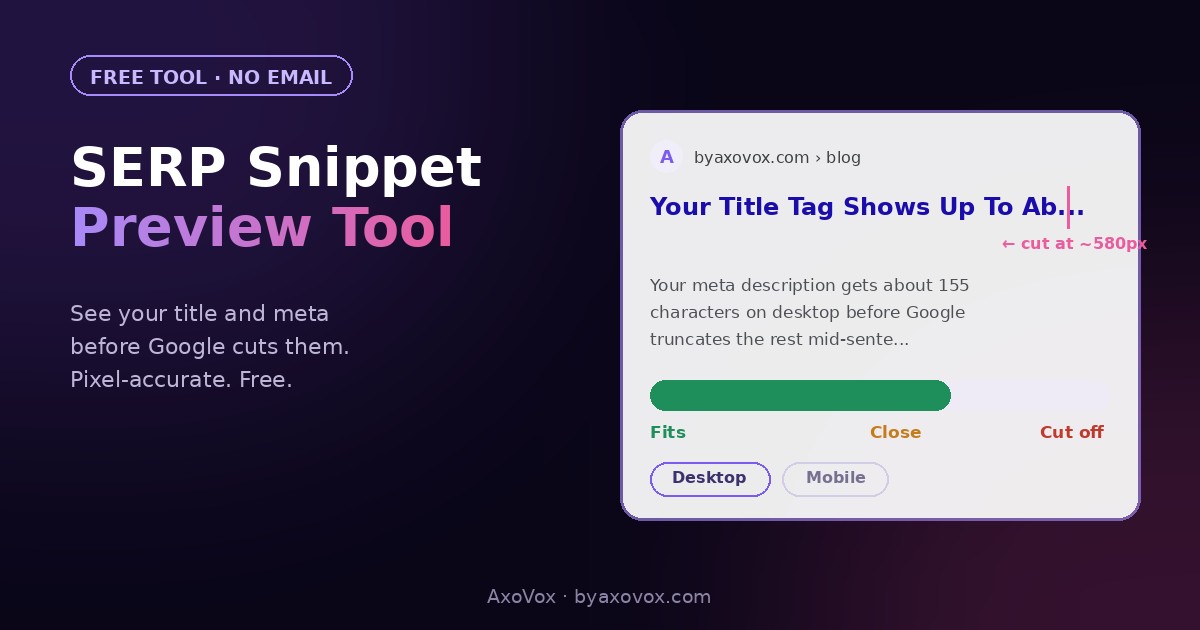
Google doesn’t show your title tag and meta description; it shows as much of them as fits, then cuts the rest mid-sentence. The limits are pixels, not characters, which is why “keep it under 60 characters” advice keeps failing people: a title full of wide letters truncates at 52 while a narrow one survives at 64. This tool renders your snippet the way Google actually measures it, desktop and mobile, and warns you before the ellipsis does.
Measured with Google’s result font (Arial 20px title / 14px description). Nothing you type leaves this page.
The limits that actually apply
Titles get roughly 580 pixels on desktop before truncation, which lands most titles between 50 and 60 characters. Mobile allows two lines, so slightly longer titles survive there. Descriptions get about 155-160 characters on desktop and a bit more on mobile before the cut. Google also rewrites descriptions it doesn’t like around 60% of the time, usually when the written one doesn’t match the query; a description that directly addresses the page’s core question gets kept far more often.
Two placements matter more than raw length. Front-load the keyword: truncation eats the end, so anything essential in the last third is at risk. And put the brand at the end, not the start, unless you’re a household name; the opening pixels are the ones every searcher reads. We covered why on our own homepage rewrite in the ranking guide.
Why snippet length now matters beyond the click
Your title and description do double duty in 2026. They’re still your ad in the classic results, but they’re also one of the clearest signals machines read when deciding what your page answers. A title that states the question and a description that compresses the answer feed the same systems that pick featured snippets and AI citations. Writing them as an afterthought wastes the two lines every system reads first.
Frequently asked questions
What’s the ideal title tag length?
Aim for 50-60 characters, verified against the pixel width above. Under 50 usually means you’re leaving keyword or persuasion space unused; over 60 risks the ellipsis on desktop.
What’s the ideal meta description length?
120-155 characters. Long enough to make a case, short enough to survive desktop truncation. Mobile shows a little more, so the 150s are safe if the final sentence isn’t essential.
Why does Google show a different description than the one I wrote?
Google rewrites descriptions when it thinks page text answers the specific query better, which happens on the majority of results. You reduce rewrites by making the description a direct, factual summary of the page rather than ad copy.
Do keywords in the meta description help rankings?
Not directly; the description isn’t a ranking factor. It’s a clickthrough factor. Matching words get bolded in results, which draws the eye, so include the target phrase naturally once.
Should every page have a unique title and description?
Yes, without exception. Duplicate titles make Google pick which page to show, and it picks wrong often enough that you don’t want to delegate the choice.
Writing titles for a whole site and want a second pair of eyes? Talk to AxoVox, or run your drafts through this tool and the AI visibility checker first, both free, both gate-free.