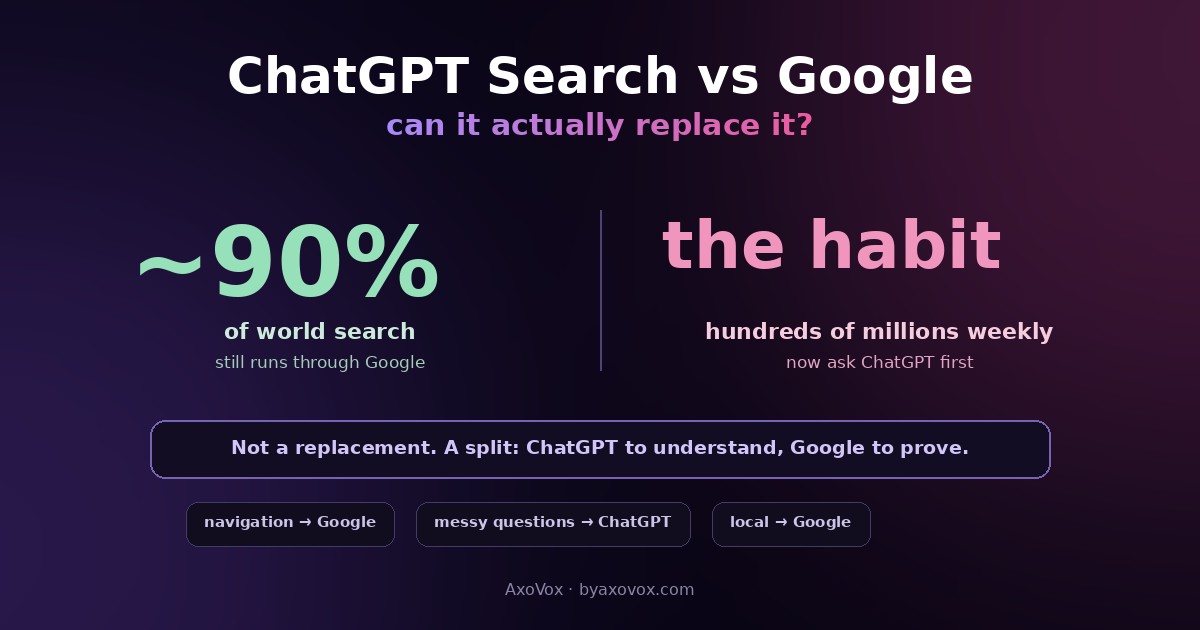
“I don’t Google things anymore, I just ask ChatGPT.” You’ve heard it, maybe said it. Meanwhile Google still handles around 90% of the world’s searches. Both facts are true at once, which tells you the replacement question is the wrong question.
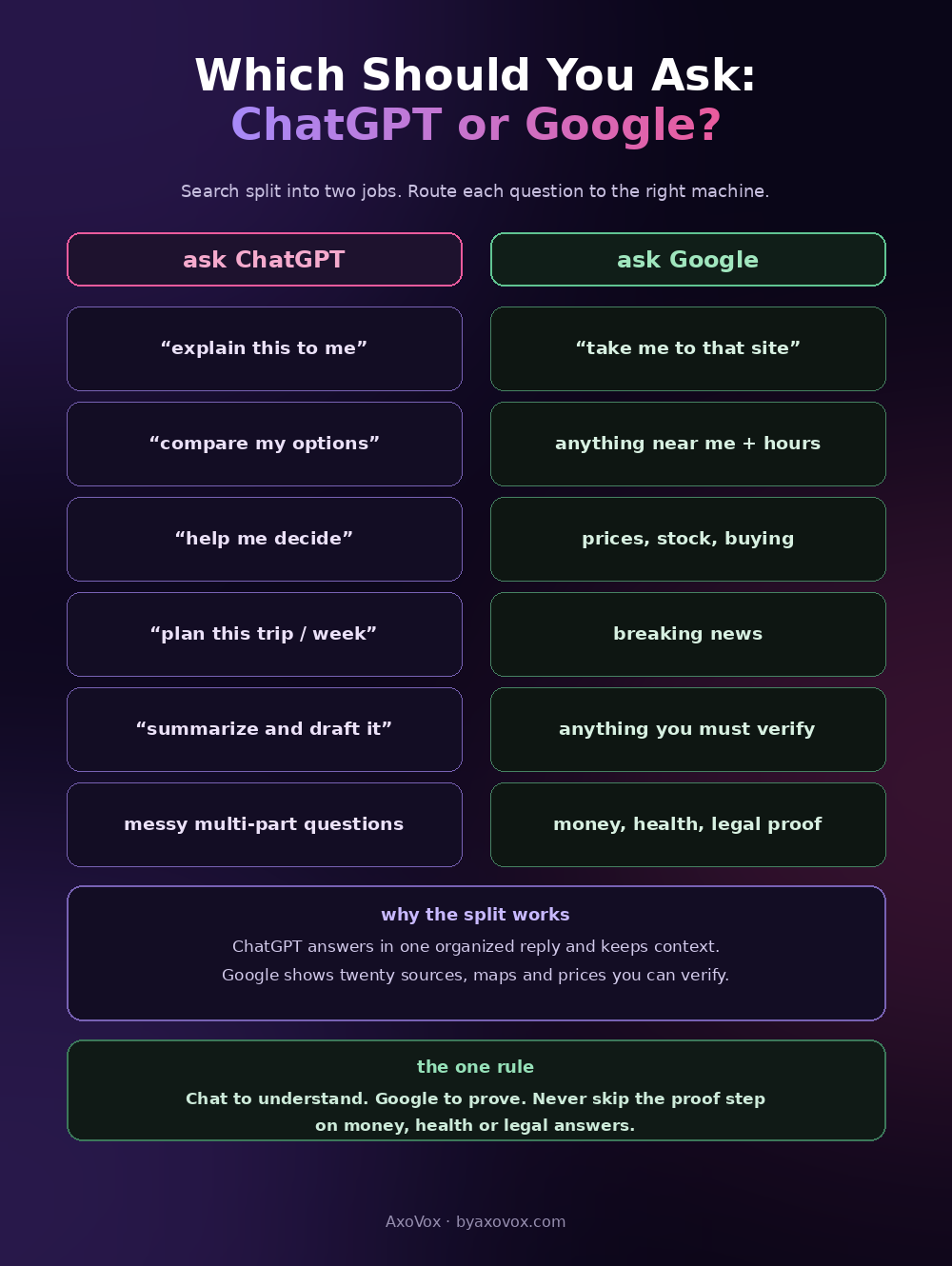
What’s actually happening: search split into two jobs, and each tool took one. ChatGPT took “figure this out for me”: the messy, multi-part, explain-and-compare questions. Google kept “take me there and prove it”: navigation, local, prices, and anything you need to verify with your own eyes. Here’s what ChatGPT Search really is, the honest scoreboard, and where your own searches should split.
What ChatGPT Search actually is
Inside any ChatGPT conversation, free accounts included, the model can search the live web: it fires searches automatically when a question needs fresh information (or when you tap the search icon), reads the results, and answers in sentences with inline source links. OpenAI has kept building around it, including the Atlas browser and daily-briefing experiments, because the ambition is obvious: make the chat window the front door to the web.
The structural difference from Google: you get an answer with a handful of citations, not a ranked page of twenty choices. Faster when the answer is right. Blinder when it isn’t, because you see what it chose for you, and little else.
| The job | Winner | Why |
|---|---|---|
| Messy multi-part questions | ChatGPT | One organized answer instead of six tabs; follow-ups keep context |
| Navigation (“site login”, “that store”) | A link beats a paragraph when you just want to GO somewhere | |
| Local: restaurants, services, hours | Maps, profiles and reviews are Google’s home turf | |
| Verifying something that matters | Twenty sources to cross-check beat three pre-chosen ones | |
| Research into a draft or plan | ChatGPT | It searches, then writes with what it found; Google stops at finding |
| Breaking news, fast-moving topics | Freshness and breadth still favor the big index | |
| Shopping comparisons | Split | ChatGPT for narrowing, Google for prices, stock and buying |
The numbers, without the hype
Google: roughly 90% of global search share, with AI Overviews now opening nearly half those searches, Google becoming an answer engine in self-defense. ChatGPT: the overwhelming leader of the new habit, with hundreds of millions of weekly users and the lion’s share of AI-chatbot traffic. One owns the gateway, the other owns the momentum, and “momentum” has been eating gateways since the internet began, just slowly. Nobody serious expects Google displaced this decade; nobody serious denies the habit shift either.
The split that actually works
After months of watching my own muscle memory: the browser address bar stays Google, questions that start with “why,” “compare,” “help me decide” or “explain” go to ChatGPT, and anything local or money-critical gets Googled even after ChatGPT answered it, because verification is a feature chat hides. The telling habit change: ChatGPT first for understanding, Google second for proof. That’s also exactly the pattern where mistakes happen, repeating a chat answer without the proof step, so keep the second step.
If you own a business, this fight is about you
Every question that moved from Google to ChatGPT is a customer Google’s rankings can’t deliver to you anymore. ChatGPT answers those questions from the open web it can read: your pages, crawlable reviews, directories, which means two checks decide your fate there. One: OAI-SearchBot isn’t blocked at your door (two minutes in the crawler guide). Two: your pages answer real questions in liftable sentences, since chat cites few sources and the cut is brutal. The same evidence still feeds Google’s own AI answers, so this isn’t double work; it’s one job, the machinery we unpack in the AI Overviews explainer and ChatGPT vs AI Mode.
Common questions
Can ChatGPT Search replace Google?
For understanding-type questions, it already has for millions of people; for navigation, local, verification and breaking news, no. Google holds around 90% of search while ChatGPT owns the fastest-growing habit, and the practical answer is a split by job, not a replacement.
Is ChatGPT Search free?
Yes: web search works on free ChatGPT accounts, firing automatically when a question needs fresh information, with inline source links. Paid tiers raise limits and add heavier research modes.
Is ChatGPT Search accurate?
Usually, and always confident, which is the trap: you see its few chosen sources and nothing else. Click a citation before acting on anything involving money, health or law; Google’s twenty-results page is still the better cross-checking tool.
What’s the difference between ChatGPT Search and Google’s AI Mode?
Mirror images: ChatGPT is a chatbot that learned to search; AI Mode is a search engine that learned to chat. AI Mode holds Google’s Maps, reviews and shopping data; ChatGPT holds the stronger writing and the conversation people already live in.
Why do people say they stopped using Google?
Because the question types they feel most, the confusing, multi-part, explain-it ones, genuinely moved to chat. The invisible searches (navigation, local, quick facts) still run through Google, which is how both “Google is dying” and “90% share” stay true.
Where does ChatGPT Search get its results?
From the live web via search partners and OpenAI’s own crawling (OAI-SearchBot), read and compressed into a cited answer. If a site blocks that crawler, it can’t be read or cited.
Is Google losing to ChatGPT?
Losing the monopoly on questions, not the search market. Google’s counter is making search itself an answer engine, AI Overviews on nearly half of searches plus AI Mode, so the real fight is answer engine vs answer engine.
How do I get my business mentioned in ChatGPT’s answers?
Be readable and citable: allow the AI crawlers, publish pages that answer real customer questions in direct sentences, keep facts consistent everywhere, and get review evidence onto the open web where ChatGPT can see it.