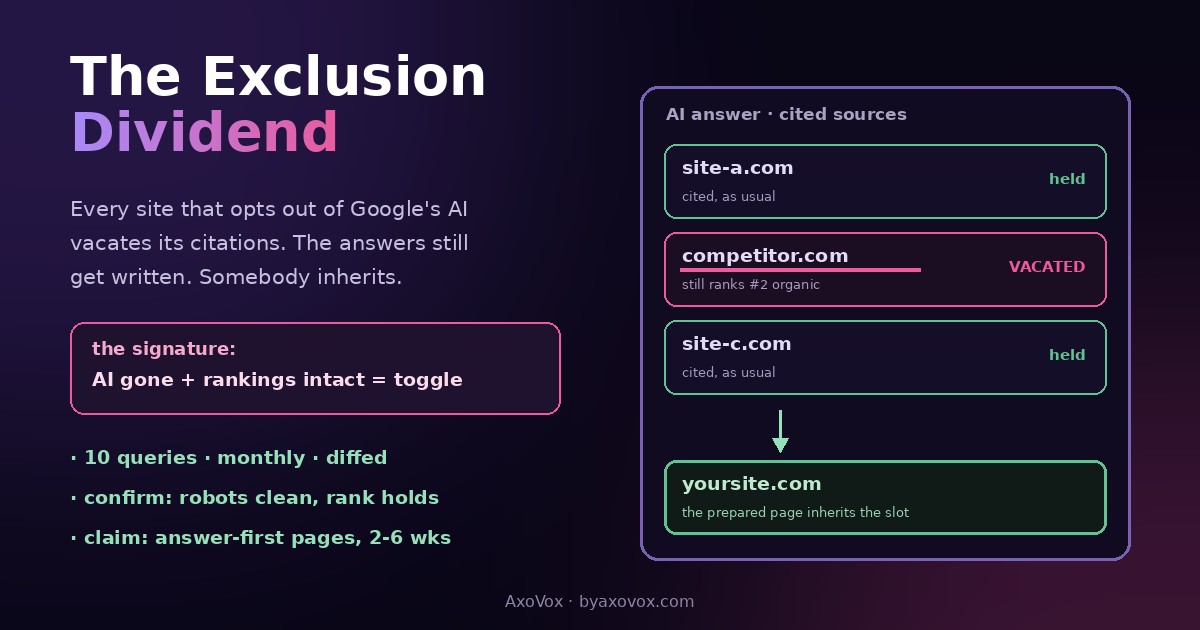
In one niche we monitor, a mid-sized publisher who used to appear in the AI answers for a dozen money questions went dark over a single week in August. Not demoted, dark: still ranking #2 and #3 organically, completely absent from every AI Overview and AI Mode answer that used to quote them. Rankings don’t die like that while AI presence alone evaporates. That pattern has exactly one common cause now, and it’s a settings page.
Google’s “Search generative AI” exclusion toggle, born of a UK regulator’s June 2026 order and rolled out worldwide by late September, lets any site pull itself out of AI Overviews, AI Mode and Discover AI within a day or two, rankings untouched. I wrote the should-YOU-flip-it guide already (short version: almost never). This is the other half of the trade, the half nobody writes because it sounds impolite:
Every site that opts out vacates citations, and those citations don’t disappear. They get reassigned. The answers still get written; Google’s systems simply reach for the next adequate source. If you’re in the niche, “next adequate source” is a job opening with your name on it. Here’s the audit we now run for clients to find the openings, and the claim process that fills them.
First, how exclusions actually look from outside
You can’t see a competitor’s Search Console, so this is detective work on observable behavior, and I want to be straight about what the evidence can and can’t prove. The exclusion signature has three parts, and you need all three:
- AI presence gone across the board: they’ve vanished from AI Overviews AND AI Mode answers on multiple queries where they were previously cited, not just slipped on one
- Organic intact: their blue-link rankings hold. This is the discriminator; a penalty, a deindexing or a quality fall takes both layers down, while the toggle surgically removes one
- It happened fast: the toggle acts within 1-2 days, so the disappearance is a cliff, not a slope. Content decay looks like erosion; exclusion looks like a light switch
Two innocent look-alikes to rule out before concluding anything: a site that newly blocked crawlers or added nosnippet (check their robots.txt and page source, both public), and ordinary citation churn, which is why single-query evidence means nothing and the audit below uses ten.
The 20-minute niche audit
This is the protocol as we actually run it, monthly, per niche. Tools required: an incognito window and a spreadsheet.
- Fix your query set. Ten money questions in your niche, written as customers ask them. Same ten every month; the value is in the diffs, not the snapshot
- Log the cited sources. For each query, record every domain cited in the AI Overview and, where it appears, the AI Mode answer. First run takes the full twenty minutes; repeats take ten
- Diff against last month. A domain that dropped from 1-2 queries is churn, ignore it. A domain that dropped from most or all of its slots while (check now) still ranking organically wears the signature
- Confirm the innocents. Thirty seconds on their robots.txt and a view-source for nosnippet. Clean robots plus held rankings plus cliff-shaped AI disappearance: you’ve found an exclusion, or something that behaves identically to one, which for your purposes is the same thing
- List the orphaned questions. Every query where the vanished domain was cited is now a vacancy. That list is the deliverable; everything else is execution
Claiming the vacancy
Here’s the part that surprised me when we started doing this: the inheritance isn’t automatic and isn’t instant, but it IS biased toward whoever shows up prepared. The answer still needs writing; the model regrounds on the remaining adequate sources, and “adequate” is a bar you can jump deliberately.
For each orphaned question: build or sharpen the page that answers it in the first two sentences, with a real number or specific in sentence one or two, the standard citation craft, aimed at the exact phrasing. Then request indexing, and extend to the obvious follow-ups, because expanded Overviews hand every reader an “Ask anything” box and the second-round questions are part of the same vacancy. In our runs, orphaned slots refill over roughly two to six weeks, and the refill went to a prepared page more often than to the incumbent #1, which matches how grounding works: the systems want the most liftable adequate source, not the most famous one.
Measure the claim in Search Console’s Generative AI report: impressions on the target queries are your scoreboard, and they move before clicks do.
What’s verified here vs what’s inference (the honesty ledger)
Verified, from Google and primary reporting: the toggle’s existence, scope, 1-2 day effect, rankings-untouched promise, UK origin and global rollout dates. Observed directly by us: the signature pattern (cliff-shaped AI disappearance with intact rankings) on a handful of domains since August, and vacancy refills within 2-6 weeks on queries we targeted. Inference, labeled as such: that any specific outside domain flipped the toggle; we can’t see their Search Console, only behavior consistent with it, and the audit is built so your decisions don’t depend on being right about WHY a slot opened, only THAT it did. The refill timelines are our sample, not a study; your niche may differ, which is exactly what the monthly diff exists to tell you.
Is this ethical? (the question a client actually asked)
Yes, and it’s worth saying why plainly. Opting out is a legitimate choice, usually a licensing or paywall stance, made knowing the citations go elsewhere; the regulator forced the toggle precisely so that trade could be made consciously. Nobody is being tricked, scraped or displaced: a question needed answering, a source withdrew, another source showed up prepared. That’s not a loophole; that’s how an open web is supposed to reallocate attention. The move I WOULD call out: misrepresenting a competitor’s exclusion to their customers. Inherit the slot; skip the eulogy.
The strategic read
Exclusions will keep coming in waves, every time AI answers anger publishers, after every licensing standoff, each one a small land release in somebody’s niche. The compounding move is making the audit a habit rather than a reaction: ten queries, monthly, diffed, with a ready pipeline of answer-shaped pages for whatever opens. It’s the rare SEO process where being small and fast beats being big and famous, because the vacancy goes to the prepared, and the giants aren’t watching this layer yet. They will be. The months before they are, are the dividend.
Common questions
How can I tell if a competitor opted out of AI Overviews?
You can’t see their settings, but the signature is readable: cliff-shaped disappearance from AI Overviews and AI Mode across multiple queries within days, while organic rankings hold and their robots.txt and meta tags stay clean. Penalties and decay take rankings down too; the toggle removes only the AI layer.
What happens to citations when a site excludes itself?
The answers keep being generated and the systems reground on remaining adequate sources, typically refilling slots over weeks. The citations are reassigned, not retired, which is the entire opportunity.
How do I find vacated AI citation slots in my niche?
The monthly audit: a fixed set of ten money queries, logging every cited domain in the AI answers, diffing month over month, and confirming disappearances against intact rankings and clean robots.txt. Domains that vanish from most slots at once mark vacancies.
How do I win a vacated citation?
Per orphaned question: a page answering that exact phrasing in its first two sentences with a specific fact, indexed promptly, extended to the obvious follow-ups. In our runs, prepared pages inherited slots within 2-6 weeks, often ahead of higher-ranking incumbents.
Is claiming a competitor’s vacated citations ethical?
Yes: exclusion is a conscious, regulator-enabled trade whose known cost is citation loss. A question needed a source, one withdrew, another showed up prepared. The line not to cross is spinning their exclusion to customers.
Could the disappearance mean something other than opting out?
Always possible, which is why the audit checks the innocents: new crawler blocks, nosnippet tags, or plain citation churn on isolated queries. Practically it doesn’t matter; the audit targets open slots, and a slot is claimable whatever opened it.
How fast do vacated slots refill?
The toggle empties them within 1-2 days; refills in our monitoring ran two to six weeks, moving first in Search Console’s Generative AI impressions. Treat those numbers as our sample, not a law.
Should I opt out myself to deny competitors my content?
That logic runs backwards: excluding yourself hands YOUR citations to them while keeping their content in the answers you’ve left. The deny-the-enemy move and the self-delete button are the same button.